The best aquarium water test kits for freshwater are liquid reagent kits like the API Freshwater Master Test Kit for accuracy and long-term value, while strip kits like Tetra EasyStrips 6-in-1 are best for fast daily checks — choose liquid if you keep sensitive species or are cycling a tank, and strips if you need 60-second monitoring of an established community tank.
As an Amazon Associate we earn from qualifying purchases at no extra cost to you.


Our Top Picks
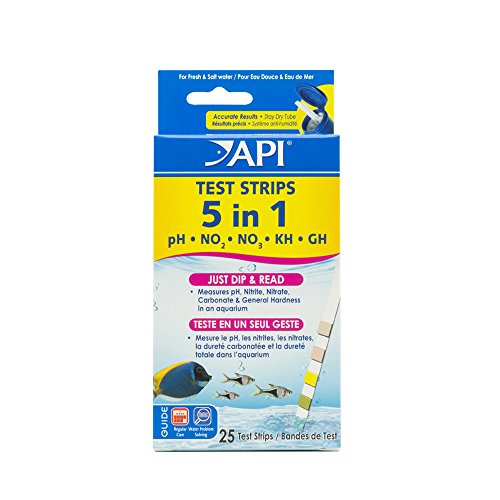 API 5-in-1 Test Strips Freshwater and Saltwater Aquarium25-Count3.5 x 1.75 x 6.5 inches0.1 poundsCheck on Amazon


Top 3 picks at a glance
Liquid vs. Strip Kits: The Core Difference for Freshwater
Both types test the same water, but they work differently and that affects every buying decision. Liquid kits use dropper bottles and glass test tubes where you add a set number of drops to a 5ml water sample and match the resulting color. Strip kits use paper pads impregnated with reagents that you dip directly into the aquarium for 1-2 seconds.
For freshwater, that method matters because ammonia is the critical toxin during cycling and most strip kits do not test it accurately, or at all. Liquid kits almost always include ammonia, which is why they remain the standard for new tanks, shrimp tanks, and cichlid setups.
Head-to-Head Comparison: Accuracy, Range, Speed and Cost
| Criteria | Liquid Reagent Kits (e.g., API Freshwater Master, JBL TestLab, Seachem MultiTest) | Strip Kits (e.g., Tetra EasyStrips 6-in-1, API 5-in-1 Test Strips, JBL ProScan) |
|---|---|---|
| Accuracy | High. Titration-based color matching, typically within +/- 0.25 ppm for ammonia/nitrite and +/- 5 ppm for nitrate. Less prone to humidity damage. | Moderate. Visual pad matching, typically within +/- 0.5 ppm for nitrite and +/- 10-20 ppm for nitrate. Pads degrade if vial is left open. |
| Ammonia Included? | Almost always yes. 0 to 8.0 ppm range. | Often no. Most 5-in-1 / 6-in-1 strips test pH, nitrite, nitrate, hardness and alkalinity only. Separate ammonia strips are needed. |
| Testing Range | Wider and more granular: pH 6.0-7.6 (and high-range 7.4-8.8), Ammonia 0-8 ppm, Nitrite 0-5 ppm, Nitrate 0-160 ppm | Narrower: pH 6.2-8.4, Nitrite 0-3 ppm, Nitrate 0-100 ppm. Steps are coarser (e.g., nitrate jumps from 20 to 40 ppm) |
| Parameters per Kit | 4-5 core: pH, high-range pH, ammonia, nitrite, nitrate (GH/KH sold separately) | 5-7 at once: nitrite, nitrate, pH, GH, KH, chlorine |
| Time per Test | 5-10 minutes (5 min wait for nitrate, shaking required) | 30-60 seconds |
| Shelf Life After Opening | 3-4 years if capped | 6-12 months, highly sensitive to moisture and air |
| Cost Per Test | Usually around $0 – around $0 | Usually around $0 – around $0 |
Cost Per Test: A Worked Calculation
Sticker price is misleading. Liquid looks more expensive upfront but is far cheaper over a year of weekly testing. Here is how to calculate it:
Formula: (Price Paid) / (Total Tests in Kit) = Cost Per Parameter Test | Multiply by parameters you test each time for cost per water check.
Example 1 – Liquid Kit: A freshwater master liquid kit usually $30-$45 and contains about 800 individual tests (approx. 130 pH, 130 high-range pH, 130 ammonia, 130 nitrite, 130 nitrate plus tubes). At $35 / 800 = $0.044 per test. A full 5-parameter freshwater check costs about $0.
Example 2 – Strip Kit: A vial of 100 x 6-in-1 strips usually $15-$25. Each strip tests 6 parameters at once. At $20 / 100 = around $0 per strip, but that is around $0 for the whole check. If you only need nitrite/nitrate/pH, the effective cost is still around $0. Add a separate 25-count ammonia strip pack (usually $10-$14) and a year of weekly full checks (52 weeks) costs around $20 in strips vs. around $11 in liquid for the same period, and the liquid kit still has ~70% of its reagents left for year two.
Conclusion: If you test weekly, liquid pays for itself in 4-6 months. Strips are cheaper only if you test rarely (less than once a month) or need a quick spot-check.
Which Parameters Do You Actually Need for Freshwater?
Not every freshwater tank needs the same panel. The “best” kit is the one that covers your livestock’s non-negotiables:
- The Cycling / New Tank Essentials (0-6 weeks): Ammonia, Nitrite, Nitrate, pH. You need to track the nitrogen cycle daily. A liquid kit is non-negotiable here. Strips without ammonia will not show a cycle stall.
- Community Tropical (Tetras, Mollies, Corydoras, Gouramis): pH 6.8-7.8, Ammonia/Nitrite 0 ppm, Nitrate <40 ppm, GH 4-12 dGH, KH 3-8 dKH. A 6-in-1 strip covers routine maintenance, but keep a liquid ammonia test on hand.
- Soft-Water / Sensitive (Discus, Cardinals, Crystal Shrimp, Bettas): pH 6.0-6.8, GH 3-6 dGH, KH 0-3 dKH, TDS critical. You need precise GH/KH and pH readings. Liquid GH/KH or a dedicated Seachem MultiTest is far more accurate than strip pads for low-range hardness.
- Hard-Water African Cichlids (Mbuna, Peacocks): pH 7.8-8.6, GH 7-12 dGH, KH 6-10 dKH. You need high-range pH (up to 8.8) and reliable KH. Most basic strip kits top out at pH 8.4. Choose a kit with high-range pH liquid test or JBL TestLab.
If your tap water contains chlorine/chloramine, any kit with a chlorine pad (common on strips) is useful for checking that your dechlorinator worked after a water change.
Decision Matrix: Map Your Situation to the Right Kit
Use this matrix to avoid over-buying or under-testing:
| Your Situation | Recommended Kit Type | Why |
|---|---|---|
| Cycling a new tank or fish-in cycle | Liquid Master Kit (API Freshwater Master or NT Labs Aquarium Lab) | You need daily, accurate ammonia and nitrite down to 0.25 ppm to know when to do water changes. |
| Established community tank, weekly maintenance | Strips for weekly + Liquid ammonia as backup | Speed matters more than lab accuracy. 60-second dip confirms nitrate <40 ppm and stable pH. |
| Shrimp (Neocaridina/Caridina) or breeding project | Liquid Kit + Separate Liquid GH/KH Test (API or Salifert) | Shrimp molt fails with unstable GH. Strip hardness pads are +/- 3 dGH – not precise enough. |
| Planted tank with CO2 injection | Liquid pH + KH + Nitrate + Phosphate kit (Seachem MultiTest or JBL) | You need to calculate CO2 from pH/KH chart and keep nitrate 10-25 ppm. Requires tighter range. |
| Kids, classrooms, or multiple small tanks | Strip Kit (Tetra EasyStrips) | No glass tubes, no shaking, no reagent spills. Fast enough to test several tanks in minutes. |
| Tap water is very hard or very soft | Liquid TestLab-style kit with full GH/KH range | Strips compress the hardness scale. Liquid drop-count tests give exact dGH/dKH (1 drop = 1 dGH). |
What to Look for Before You Buy in 2026
1. Check the Ammonia Test First
If the box says “5-in-1” and lists nitrite/nitrate/pH/GH/KH without ammonia, it is not a complete freshwater kit. For freshwater, total ammonia (NH3/NH4+) is the most toxic parameter above 0.25 ppm. A kit without it forces you to buy a second product.
2. Understand Nitrate Test Limitations
Nitrate liquid tests require vigorous shaking – API’s nitrate Bottle #2 must be shaken hard for 30 seconds and the tube for 60 seconds or it will read falsely low. This is chemistry, not a flaw. Strip nitrate pads are easier but they saturate above 100 ppm, so a heavily neglected tank can look like “40 ppm” when it is actually 160 ppm+. If your nitrate routinely reads at the top of the strip, confirm with liquid.
3. Freshwater vs. Saltwater Labeling
Some kits like API Saltwater Master or generic reef strips use different color cards. Freshwater cards are calibrated for lower pH and hardness. Using a saltwater kit on freshwater will give incorrect pH and nitrate readings. Look for “Freshwater” on the label.
4. Storage and Expiry
Liquid reagents last 3-4 years if stored at room temperature and not cross-contaminated (never swap caps). Strips expire quickly – keep the desiccant in the vial, close the lid immediately after taking a strip, and never pull a strip with wet fingers. An expired strip typically reads low pH and low hardness.
How to Get an Accurate Result Every Time
Accuracy issues are usually technique, not the kit:
- Rinse test tubes with tank water before filling, not tap water.
- Hold liquid bottles vertically and count drops precisely. A 45-degree angle creates smaller drops and under-doses reagent.
- Read colors in natural daylight against a white background, looking down through the tube, not from the side.
- Dip strips for the exact time on the instructions (usually 1 second dip, read at 60 seconds). Reading too early or late changes the colors. Do not shake off excess water.
- Test at the same time of day. pH in planted tanks can swing 0.4-0.6 between morning and evening due to CO2/O2 cycles.
FAQ
Are test strips inaccurate?
They are less precise than liquid, not useless. For an established freshwater tank where you just need to know “is nitrate under 40 ppm and pH stable?” strips are accurate enough. For cycling, diagnosing sick fish, or keeping shrimp, the +/- 0.5 ppm error on ammonia/nitrite can hide a problem – use liquid.
Can I use freshwater test kits for a planted tank?
Yes, but add phosphate (PO4) and ideally iron (Fe) if you dose fertilizers. Standard master kits do not include phosphate. Kits like JBL TestLab or Seachem MultiTest offer those as add-ons. Aim for phosphate 0.5-2.0 ppm and nitrate 10-25 ppm in a high-tech planted tank.
How often should I test freshwater?
Daily during cycling until ammonia and nitrite stay at 0 ppm for 3 days. Weekly for the first 3 months after stocking. Monthly for a mature, stable tank, plus 24 hours after any large water change, filter cleaning, medication, or fish death.
Why does my liquid ammonia test show 0.25 ppm even after a water change?
Many dechlorinators that detoxify ammonia (like Seachem Prime) convert it to non-toxic ammonium (NH4+), but most liquid tests read total ammonia (NH3 + NH4+). You will still see 0.25-0.50 ppm on the card for 24-48 hours even though it is detoxified. Test before adding dechlorinator for a true toxic ammonia reading, or use a free-ammonia specific kit like Seachem MultiTest Ammonia.