The best guitar strings for most electric players are nickel-wound 10-46 gauge, for most acoustic players phosphor bronze 12-54, and for classical nylon normal tension, but the ideal choice depends on your guitar type, tuning, and whether you prioritize brightness, longevity, or bending comfort.
As an Amazon Associate we earn from qualifying purchases at no extra cost to you.


Our Top Picks

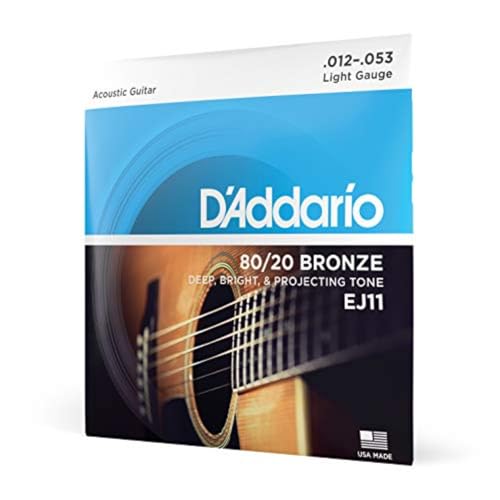


Top 3 picks at a glance
Decision Matrix: Match Your Playing Style to the Right String Type
Instead of searching for a single “best” set, use your primary guitar and playing goal to narrow the field immediately. This matrix maps the most common situations to the spec class that balances tone, tuning stability, and comfort without trial-and-error buying.
| Your Situation | Recommended Material & Coating | Recommended Gauge | Why It Works |
|---|---|---|---|
| Electric, standard tuning, rock / blues / pop with lots of bending and lead work | Nickel-wound, uncoated (e.g., Ernie Ball Regular Slinky, D’Addario NYXL) | 9-42 or 10-46 | Nickel is balanced and magnetic-friendly for pickups; lighter gauges lower tension for easier bends |
| Electric, drop tunings (Drop D, Drop C, C Standard) or baritone | Nickel-wound or stainless steel, uncoated | 10-52, 11-56, or 12-62 | Heavier bottom strings prevent floppiness and intonation drift when tension drops |
| Acoustic, strumming and singer-songwriter | Phosphor bronze, uncoated or coated | 12-54 (Light) | Warm, full midrange that supports vocals; light gauge is the acoustic standard for projection vs. playability |
| Acoustic, fingerstyle or recording | 80/20 bronze or phosphor bronze, coated (e.g., Elixir Nanoweb Phosphor Bronze) | 11-52 (Custom Light) or 12-53 | 80/20 is brighter and more articulate; coating reduces finger squeak and extends life under mics |
| Acoustic, heavy strummer or bluegrass | Phosphor bronze, uncoated | 13-56 (Medium) | Higher tension drives the top harder for more volume and headroom |
| Classical / nylon-string | Clear nylon trebles, silver-plated copper wound basses (e.g., D’Addario Pro-Arte, Savarez Alliance) | Normal or Hard Tension | Nylon requires lower tension design; hard tension gives more projection, normal is easier on fingers |
String Materials Explained: How They Actually Affect Tone
Material matters more than brand marketing. For electric guitars, the string must be magnetic to interact efficiently with pickups, which is why acoustic materials sound weak and dull on an electric.
Electric Guitar Strings
- Nickel-wound (nickel-plated steel): The industry standard. A steel core wrapped with nickel-plated steel. Balanced highs, smooth mids, moderate output. Usually $6–$14 per set.
- Pure nickel: Warmer, rounder, vintage-style tone with softer attack. Less string noise. Preferred for blues, jazz, and classic rock.
- Stainless steel: Brighter, more output, and more resistant to corrosion. Feels slightly stiffer and can wear frets faster.
- Cobalt (e.g., Ernie Ball Cobalt Slinky): Higher magnetic response for slightly hotter output and extended dynamic range. Brighter than nickel-wound without the harshness of stainless.
Acoustic Guitar Strings
- 80/20 Bronze (80% copper, 20% zinc): Very bright and crisp when new, with strong treble sparkle. Loses brightness faster than phosphor bronze. Great for dark-sounding dreadnoughts that need clarity.
- Phosphor Bronze (92% copper, 8% tin with phosphorus): Warmer, more complex, and longer-lasting brightness than 80/20. The default choice for most acoustics, including sets like D’Addario EJ16 and Martin Authentic Acoustic Lifespan 2.0.
- Silk and steel / Silk and bronze: Lower tension with a silk filament inside the winding. Mellow, soft, and easy on fingers. Ideal for vintage parlors or folk fingerstyle, not for heavy strumming.
Classical Guitar Strings
- Clear nylon: Traditional warm, mellow trebles. Standard on sets like D’Addario Pro-Arte EJ45.
- Rectified nylon / Titanium / Composite (e.g., Savarez Alliance): More precise intonation and brighter projection than clear nylon. Titanium trebles sit tonally between nylon and steel.
- Silver-plated copper wound basses: Universal for classical bass strings. The silver plating prevents tarnish while keeping the basses warm and deep.
Gauge and Tension: The Real Trade-Off Between Feel and Tone
Gauge is the diameter of each string in inches. A set labeled 10-46 means the high E is 0.010″ and the low E is 0.046″. Heavier gauges increase tension, volume, and tuning stability but require more finger pressure and make bending harder.
Coating and material do not change this physics. The tension difference is substantial and can be calculated.
Worked Calculation: How Much Harder Is a Heavier String?
String tension (T) can be estimated with:
T (lbs) = (UW x (2 x L x F)^2) / 386.4
where UW is unit weight in lb/in, L is scale length in inches, and F is frequency in Hz. For a quick comparison, you can use published unit weights. On a standard 25.5″ scale electric in E standard (E2 = 82.41 Hz):
- A 0.046″ nickel-wound low E has a unit weight of ~0.00079 lb/in, which calculates to ~17.5 lbs of tension.
- A 0.042″ nickel-wound low E has a unit weight of ~0.00066 lb/in, which calculates to ~14.6 lbs of tension.
- A 0.056″ nickel-wound low E (from a heavy bottom set) has a unit weight of ~0.00117 lb/in, which calculates to ~25.9 lbs of tension.
That means moving from a 42 to a 46 on the low E adds about 20% more tension, while moving to a 56 for drop tuning adds over 75% more tension than the 42. This is why a standard 9-42 set feels floppy and buzzes in Drop C — you have lost roughly 15-20% tension across all strings by lowering pitch, and you need that extra mass to restore it.
| Set (Low E String) | Tension in E Standard (25.5″ scale) | Tension in Drop D (D2 = 73.42 Hz) | Tension in Drop C (C2 = 65.41 Hz) | Feel |
|---|---|---|---|---|
| 0.042 | 14.6 lbs | 11.6 lbs | 9.2 lbs | Very loose, likely buzz in low tunings |
| 0.046 | 17.5 lbs | 13.9 lbs | 11.0 lbs | Balanced in E standard, loose in Drop C |
| 0.052 | 22.2 lbs | 17.6 lbs | 14.0 lbs | Tight in E standard, balanced in Drop D |
| 0.056 | 25.9 lbs | 20.6 lbs | 16.3 lbs | Balanced in Drop C |
For acoustic guitars with a typical 25.4″ scale, tensions run higher. A phosphor bronze 12-54 light set totals about 160-165 lbs of pull across all six strings, while a 13-56 medium set totals about 185-190 lbs. That extra 25 lbs is why many older or lightly braced acoustics specify not to use mediums — it can belly the top over time.
Coated vs. Uncoated: Longevity, Feel, and Tuning Stability
Coating is a micro-thin polymer layer (e.g., Elixir Nanoweb and Polyweb, D’Addario XS and XT, Ernie Ball Paradigm) applied over the winding to seal out sweat and debris.
- Uncoated: Most natural, grippy feel and the brightest initial attack. Tone fades within 1-3 weeks of regular playing as corrosion builds in the windings. Cheapest, usually $6–$10 for electrics and $7–$12 for acoustics.
- Coated: Slicker feel, reduced finger squeak, and noticeably longer tone life — typically 3 to 5 times longer before the tone dulls. Initial brightness is slightly rounded off (Nanoweave/XS is thinner and brighter, Polyweb is warmer and more damped). Usually $13–$20 per set. Tuning stability is slightly better over time because the winding stays clean and consistent.
Choose uncoated if you prefer maximum bite and change strings often, or if you record and want the freshest possible transient. Choose coated if your hands sweat, you gig, you hate changing strings, or your acoustic lives in a humid environment.
Top Picks by Category in 2026
These are established spec classes with proven manufacturing consistency, not hype launches. All are widely available as of 2026.
Best for Electric – All-Around
Ernie Ball Regular Slinky (10-46) and D’Addario NYXL (10-46): Both are nickel-wound standards. Regular Slinky is the benchmark for balanced tension and classic rock tone. NYXL uses a reformulated high-carbon steel core that holds tuning better after bends and claims higher break resistance. If you bend aggressively and want stronger tuning return, NYXL is worth the premium (usually $11–$16 vs. $6–$8).
Best for Electric – Drop Tunings and Heavy Riffs
Ernie Ball Beefy Slinky (11-54) or Not Even Slinky (12-56), D’Addario EXL148 (12-60): These heavy bottom sets keep the low strings above 16 lbs of tension even in Drop C. Pure nickel or cobalt versions of these gauges are not recommended for low tunings because they feel too loose — stick to nickel-plated steel for magnetic strength.
Best for Acoustic – Most Players
D’Addario EJ16 Phosphor Bronze Light (12-54) and Elixir Nanoweb Phosphor Bronze Light (12-53): EJ16 is the reference uncoated phosphor bronze sound — warm, balanced, and affordable. Elixir Nanoweb is the same tonal family with a coating that preserves the shimmer for months. Martins Retro Monel (MM12) is the alternative if you want a drier, vintage midrange with less zing.
Best for Acoustic – Long Life and Low Noise
D’Addario XS Phosphor Bronze and Elixir Polyweb 80/20: XS is thinner-coated than Elixir and feels closer to uncoated while lasting longer. Polyweb is the slickest and quietest for fingerstyle recording but sounds warmer from day one.
Best for Classical
D’Addario Pro-Arte EJ45 Normal Tension and Savarez 500CJ Corum Cristal: EJ45 is the student-to-pro standard for balanced tension and intonation. Savarez Alliance/Corum mixes offer higher tension and brighter carbon trebles for concert projection. Never put steel or acoustic bronze strings on a classical — the 80+ lbs of extra tension can damage the bridge and neck, which are not reinforced for it.
How to Set Up for New Gauges Without Ruining Playability
Changing gauge by more than one step (e.g., 9-42 to 11-48) is not just a string swap — it changes setup geometry.
- Check intonation: Heavier strings sharpen less when fretted. After changing, tune open, then check the 12th fret harmonic vs. fretted note. If the fretted note is sharp, move the saddle back slightly.
- Adjust truss rod in small increments: More tension pulls the neck forward (more relief). If action feels higher after going heavier, a quarter-turn clockwise (tighten) is often enough. Let the neck settle for an hour before rechecking.
- Nut slots: A 56 or 60 low string will not sit properly in a nut cut for a 42. If the string pings when tuning or sits too high in the first fret, the nut needs filing by a tech.
- Stretch correctly: After installing, tune to pitch, then gently stretch each string at the 12th fret by pulling it 1/2 inch away from the fretboard, retune, and repeat 3 times. This seats the wrap at the tuning post and dramatically improves tuning stability, especially with uncoated strings that slip more when new.
FAQ
Do heavier strings sound better?
Heavier strings produce more output and stronger fundamental tone because higher tension moves the guitar top or magnetic field more efficiently, but they only sound better if your fingers can fret them cleanly and your guitar is braced for the tension. A well-played 10-46 set sounds better than a 12-56 set that causes fretting fatigue and intonation problems.
How often should I change guitar strings?
For uncoated strings with daily playing, change electric strings every 2-4 weeks and acoustic every 1-3 weeks before the wound strings lose overtones and tuning drifts. Coated strings can go 2-4 months. Change immediately if you see discoloration on the plain strings, feel grooves under the strings on the frets, or cannot intonate the G or low E.
Can I use electric strings on an acoustic?
You can physically, but the result will be thin and quiet. Electric strings are mostly steel and nickel, which do not drive an acoustic top efficiently, and their lower tension (a 10-46 electric set is ~95 lbs total vs. ~160 lbs for acoustic 12-54) will not produce acoustic volume. Use bronze-based strings for acoustics.