Best Oversized Terracotta Italian Garden Planters
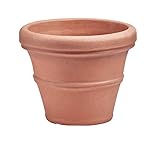
The best oversized terracotta Italian garden planters are frost-rated Impruneta-style pots with a diameter of 60–90 cm, walls at least 3–4 cm thick, and a generously sized drainage hole; choose the final size according to the plant, access route, and whether the planter will remain outside through winter.
Quick comparison: which planter size fits your space?
| Nominal diameter | Typical height | Approximate empty weight | Recommended plant size | Best placement |
|---|---|---|---|---|
| 50–55 cm | 40–48 cm | 25–45 kg | Small olive, citrus, rose, or 3–5 mixed perennials | Terraces and compact entrances |
| 60–70 cm | 48–60 cm | 40–75 kg | Young olive, bay, Japanese maple, or large ornamental grass | Most patios and medium entrances |
| 80–90 cm | 60–75 cm | 70–130 kg | Mature olive, large citrus, fig, palm, or substantial shrub | Open patios and driveway approaches |
| 100–120 cm | 75–95 cm | 130–250 kg | Large specimen tree or architectural evergreen | Permanent ground-level installation |
These figures are useful planning ranges rather than guaranteed specifications. Handmade terracotta varies in shape, clay density, and wall thickness. A broad, low bowl can weigh less than a tall, narrow cylinder of the same diameter, while frost-resistant fired clay may be noticeably heavier than porous decorative terracotta.
As an Amazon Associate we earn from qualifying purchases at no extra cost to you.

What separates a good oversized Italian planter from a decorative one?
Diameter and usable root space
Measure the internal diameter, not only the widest external measurement. A pot advertised as 70 cm wide may offer only 60–64 cm of planting space after accounting for a thick rim and tapered walls. For woody plants, the internal base width matters as much as the opening because a narrow bottom can restrict root development and make the planter top-heavy.
For a tree or shrub, select a container with an internal diameter at least 30–45 cm wider than the existing root ball. Do not jump from a small nursery pot directly to a huge container without improving drainage: excess unused compost stays wet for longer and can encourage root rot.
Wall thickness
Wall thickness is a practical indicator of durability, but it is not the only one. Thin terracotta can be attractive for sheltered seasonal planting, yet large outdoor containers benefit from walls roughly 3–5 cm thick around the body and a reinforced rim. Thicker walls moderate rapid temperature changes and provide more resistance to accidental knocks, but they increase weight and transport difficulty.
Inspect the rim for hairline cracks, uneven firing, or a hollow-sounding section. Small tonal variations and minor surface marks are normal in handmade Italian terracotta. A crack extending through the wall, especially near the drainage hole or base, is a structural concern.
Drainage design
One small hole is inadequate for a large planter exposed to heavy rain. For a 60–90 cm container, look for one central hole approximately 4–6 cm across or several holes with equivalent open area. A raised internal base, drainage feet, or a sloped bottom is useful because it prevents the pot from sitting in a saucer of permanent water.
Do not fill the bottom with a deep layer of gravel as a substitute for drainage holes. Gravel does not remove water from the soil above it; it reduces planting volume and can move the saturated zone upward. Instead, cover the hole with mesh or a curved piece of broken terracotta, then use a free-draining potting mix.
Frost resistance: the specification that matters most outdoors
Standard terracotta absorbs water through its pores. If that water freezes, it expands and can split the container. For year-round outdoor use, choose clay explicitly described as frost-resistant or frost-proof and ask whether the rating applies to the entire pot, including the base and rim.
Frost resistance is strongest when three conditions are met:
- The clay was fired at a suitable high temperature and has relatively low water absorption.
- The planter drains rapidly and never stands in water.
- The pot is raised slightly above the paving so the drainage hole cannot freeze against a flat surface.
Even a frost-rated pot deserves winter protection in climates with repeated freeze-thaw cycles. Remove the saucer, elevate the container on stable feet, avoid placing it where roof water falls directly into it, and use a breathable cover around the plant rather than sealing the entire pot in plastic.
Worked calculation: how heavy will a large planter become?
Oversized terracotta is difficult to reposition after planting. Consider a cylindrical planter with an internal diameter of 70 cm and an internal planting depth of 55 cm. Its approximate soil volume is:
3.14 × 0.35 × 0.35 × 0.55 = 0.212 cubic metres, or about 212 litres.
Moist container mix commonly weighs around 0.7–1.0 kg per litre, depending on its ingredients and water content. That means the wet growing medium may weigh approximately 150–210 kg. Add 50–70 kg for the terracotta and the complete planter can approach 200–280 kg before the plant matures.
This calculation changes the buying decision. A 70 cm planter may be appropriate for a patio, but it should be placed before filling and should not sit on a balcony unless a qualified professional confirms the load capacity. For an elevated terrace, a lighter composite planter or a smaller terracotta container may be safer.
Head-to-head choices by use case
| Your situation | Best choice | Why | What to avoid |
|---|---|---|---|
| Front entrance with symmetrical planting | Two 55–70 cm frost-rated urns or cylinders | Balanced scale without making the doorway difficult to pass | Two different finishes or pots that leave less than 90 cm of clear passage |
| Open patio with one focal plant | 70–90 cm wide, thick-walled planter | Provides visual weight and reduces the chance of a tall plant tipping | Lightweight, narrow pots with a high centre of gravity |
| Large olive, fig, or citrus | 80–100 cm diameter with a broad base | Supports a substantial root ball and gives room for structural pruning | Oversizing without a porous, well-drained mix |
| Cold, wet winter climate | High-fired frost-resistant terracotta with raised feet | Reduces freeze damage and keeps the drainage hole open | Unrated decorative clay on a permanently wet saucer |
| Frequent layout changes | 50–60 cm pot or a planter with an integrated concealed mover | More manageable before and after planting | 90 cm handmade pot filled in its final position |
Choosing the finish and colour
Classic orange-red terracotta suits Mediterranean planting and becomes more weathered over time. A pale, chalky surface can make a large pot look lighter against dark paving, while charcoal, brown, and grey finishes provide stronger contrast with silvery foliage. Some Italian makers offer aged, lime-washed, or hand-finished surfaces; these variations may be attractive but can weather unevenly.
For a formal entrance, match the finish of both pots rather than expecting handmade pieces to be perfectly identical. For a relaxed patio, slight differences in colour and texture can look intentional. Avoid placing a dark-finished container in a full-sun heat trap if the plant has shallow roots: dark surfaces can raise the temperature of the root zone substantially.
Placement rules for patios, entrances, and large plants
Patios
Check the paving for a level, load-bearing area and leave enough room to walk around the pot. Keep drainage water away from porous stone, painted surfaces, and exterior walls. Felt or rubber pads can protect paving, but they must not block the drainage hole.
Entrances
Measure the clear route before buying. Leave at least 90 cm of unobstructed walking space where possible, and keep the pot away from door swings, delivery paths, and handrails. Matching containers should be equal in height and similar in volume, not merely equal in external width.
Large plants
Use a broad-based planter for olives, bay trees, citrus, palms, and tall shrubs. Install a stake or temporary support while the plant establishes, but avoid packing soil tightly around the trunk. Prune the canopy when necessary: reducing wind resistance can prevent a tall plant from rocking the root ball and stressing the terracotta.
Buying checklist
- Confirm the internal diameter, internal depth, and base width.
- Look for walls around 3–5 cm thick on large outdoor models.
- Confirm frost resistance rather than assuming all Italian terracotta is winter-safe.
- Check the number, diameter, and position of drainage holes.
- Calculate the filled weight before using a balcony or roof terrace.
- Choose a shape that matches the plant’s eventual height and wind exposure.
- Plan delivery, placement, and filling before the planter arrives.
For most ground-level patios, the best oversized terracotta Italian garden planters are 60–90 cm frost-rated vessels with thick walls, a broad base, and serious drainage. Move to 100 cm or more only when the location is permanent, the surface can support the load, and the plant truly needs the additional root volume.
Frequently asked questions
Can a large terracotta planter be moved after it has been filled?
A large terracotta planter should be positioned before it is filled because wet growing medium and the pot can become extremely heavy. A planter with an internal diameter of 70 cm and planting depth of 55 cm may contain about 212 litres of mix, with the completed container approaching 200–280 kg. For easier future changes, choose a smaller pot or one with an integrated concealed mover.
How should I prepare a large planter before adding the plant?
Prepare the planter by confirming its drainage, placing it in its final position, and using a free-draining potting mix. Cover the drainage hole with mesh or a curved piece of broken terracotta, but do not add a deep gravel layer. Position the container on stable feet or another support that keeps the drainage opening clear and prevents permanent contact with standing water.
Can I use a saucer beneath an oversized terracotta planter?
A saucer can be used only if it does not leave the planter sitting in permanent water. For outdoor containers, raised feet, a drainage base, or a sloped bottom are preferable because they help water escape. Remove the saucer during winter, keep the container slightly elevated, and direct drainage away from porous stone, painted surfaces, and exterior walls.
What should I do if the terracotta planter arrives with a small crack?
A small surface mark or tonal variation can be normal in handmade Italian terracotta, but a crack through the wall is a structural concern. Pay particular attention to damage near the drainage hole or base, where weakness can affect the container under the weight of wet growing medium. Inspect the rim and body for hairline cracks before planting.
How much space should I leave around a planter at an entrance?
Leave at least 90 cm of unobstructed walking space where possible, and keep the planter clear of door swings, delivery paths, and handrails. Measure the entire access route before buying, including the route needed for delivery and placement. With matching containers, compare their height and volume rather than relying only on equal external width.