The best motorized toilet seat lifts for seniors are powered units that lift 3.5 to 10 inches with a weight capacity of 300 to 400 lbs, and the right choice depends on your toilet type, required lift height, and whether you need battery backup or bidet integration.
As an Amazon Associate we earn from qualifying purchases at no extra cost to you.



Our Top Picks
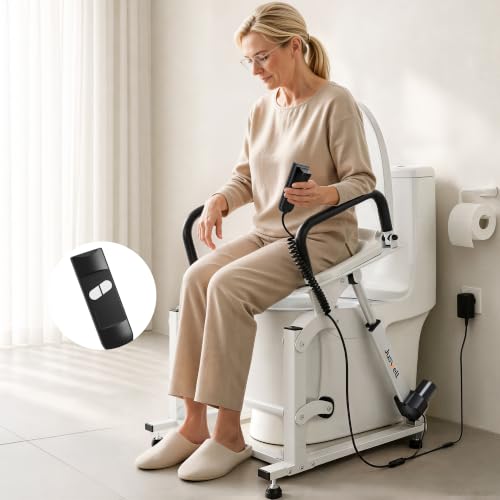 Juswell Upgraded Electric Toilet Seat Lift for Seniors25.9 x 22.8 x 0.99 inches41.8 PoundsCheck on Amazon


Top 3 picks at a glance
How to Choose a Motorized Toilet Seat Lift
Unlike manual risers or spring-assist seats, motorized lifts use an electric actuator to raise and lower the user at a controlled speed, typically 1 to 1.5 inches per second. This reduces knee and hip strain for seniors with arthritis, post-surgery restrictions, or limited lower-body strength. Evaluate these seven factors before buying:
- Lift height: Determines how much assistance you get standing up. Low lifts (3.5-4.5 inches) help with mild weakness; high lifts (8-10 inches) are for severe mobility limits or very low toilets.
- Weight limit: Most motorized models are rated for 300 lbs standard, with bariatric-class units rated to 400-450 lbs. Exceeding the rating slows the motor and voids safety certification.
- Toilet compatibility: Fit depends on bowl shape (elongated vs. round), height (standard 15-inch vs. comfort height 17-19 inch), and mounting style.
- Control accessibility: Handheld wired remotes, integrated armrest buttons, or wireless remotes matter for users with arthritis or cognitive impairment.
- Installation needs: Freestanding frame vs. bolt-down vs. toilet-mounted. Check floor space, electrical outlet proximity, and whether you rent.
- Emergency features: Battery backup, manual override, and emergency stop are critical if power fails mid-cycle.
- Cleaning requirements: Seams, electronics, and removable seats affect hygiene and long-term maintenance.
Types of Motorized Lifts Available in 2026
You will find three spec classes on the market, each suited to a different situation. Specific models within these classes include well-established units such as the Dignity Lifts DL1 and the EZ-ACCESS Tilt Toilet Incline Lift, but specifications are more important than brand names.
1. Toilet-Mounted Motorized Seats
These replace your existing toilet seat and use side arms with an integrated actuator. They lift 3.5 to 5 inches and are the most compact option. Usually $600–$1,000. Best for seniors who need moderate assistance and want to preserve bathroom space. They bolt directly to the toilet’s seat mounting holes, so they work with most standard and elongated bowls but may not fit one-piece designer toilets with concealed mounts.
2. Freestanding Frame Lifts
A steel frame surrounds the toilet and lifts the entire seat and armrest assembly 8 to 10 inches vertically. Usually $1,000–$1,800. Best for users with significant mobility loss, hip replacement precautions, or who cannot bear weight on their knees. These do not attach to the toilet itself, so bowl compatibility is almost universal, but they require 24-28 inches of width and a flat floor. No plumbing modification is needed, which makes them suitable for rentals.
3. Incline / Tilt Lifts
The platform and seat tilt forward 25 to 35 degrees to assist the sit-to-stand motion without a full vertical lift. Usually $900–$1,600. Best for seniors who can stand once tilted forward but lack the leg strength to push up from a flat seat. The EZ-ACCESS Tilt Toilet Incline Lift is representative of this class. Tilt lifts typically have a lower weight capacity than vertical lifts and require more depth in front of the toilet.
Comparison Table: Key Specifications
| Specification | Toilet-Mounted Seat (e.g., Dignity Lifts DL1 class) | Freestanding Frame Lift | Tilt / Incline Lift |
|---|---|---|---|
| Lift Height / Range | 4 – 5 inches vertical | 8 – 10 inches vertical | 0 – 6 inches + 30-degree tilt |
| Weight Capacity | 300 – 350 lbs | 300 – 450 lbs (bariatric versions available) | 300 lbs |
| Lift Speed | ~1.2 inches/sec | ~1.0 inches/sec | ~5 seconds full cycle |
| Power Source | 120V AC + 24V DC battery backup | 120V AC + battery backup (lead-acid or lithium) | 120V AC, battery backup optional |
| Toilet Compatibility | Standard 2-bolt mount, elongated/round | Universal (frame surrounds toilet) | Requires 21+ inches front clearance |
| Footprint (W x D) | 21 x 19 inches (adds 2 inches height to bowl) | 24-27 x 26-30 inches | 25 x 30-34 inches |
| Cleaning | Wipeable seat, electronics in armrests | Removable seat, open frame for access | Hinged platform, more crevices |
| Typical Market Range | usually $600–$1,000 | usually $1,000–$1,800 | usually $900–$1,600 |
Decision Matrix: Match Your Situation to the Right Lift
Use this matrix to narrow your choice without comparing every spec sheet:
| If Your Situation Is… | Choose… | Why |
|---|---|---|
| Mild knee pain, can still push up but need a boost, small bathroom | Toilet-mounted motorized seat | Minimal footprint, preserves existing toilet, sufficient 4-5 inch lift |
| Hip or knee replacement with 90-degree flexion precaution, cannot squat | Freestanding frame lift (8-10 inch) | Brings user to near-standing height, no hip flexion violation |
| 340+ lbs or need bariatric support | Freestanding frame with 400-450 lb rating | Only class consistently rated over 350 lbs with reinforced actuator |
| Good balance but weak quadriceps, can stand if leaned forward | Tilt / incline lift | Forward tilt uses body weight to assist, less vertical space needed |
| Rental apartment, cannot modify toilet or drill floor | Freestanding frame | No bolt-down, no seat-bolt removal required on some models |
| SENIOR with low vision or arthritis in hands | Any class with large armrest buttons + battery backup | Large paddle buttons are easier than small handheld pendants |
Worked Calculation: Power Needs and Battery Backup Runtime
A spec sheet lists motor wattage, but it does not tell you if a lift will work during an outage or whether your bathroom outlet is sufficient. Here is how to calculate it with real numbers.
Example setup: A freestanding lift with a 24V DC actuator rated at 120W peak, 60W average during a lift cycle. Lift cycle is 8 inches at 1 inch/sec = 8 seconds up + 8 seconds down = 16 seconds total per use. Assume 6 uses per day.
1. Daily energy use: 60W x (16 seconds / 3600) x 6 = 60 x 0.00444 x 6 = 1.6 watt-hours per day. This is negligible for your electric bill. Any standard 120V 15A bathroom GFCI outlet (1800W capacity) easily handles the 120W peak, even with a 2x safety margin.
2. Battery backup runtime: Many lifts include a 24V 1.2Ah sealed lead-acid battery pack (28.8Wh). Usable capacity is about 70% to avoid deep discharge, so 20Wh usable. Number of full cycles on battery alone = 20Wh / (60W x 0.00444h per cycle) = 20 / 0.266 = ~75 cycles. In practice, manufacturers derate to 15-25 cycles to account for battery age and cold temperatures. That equals 2-4 days of normal use during a power outage.
What this means for you: If you live in an area with frequent outages or the user cannot stand without power, prioritize a model that explicitly lists battery backup with at least 10 cycles. If no backup is included, you will need to keep a non-motorized commode chair as a fallback. Never rely on an extension cord; the actuator should plug directly into a GFCI-protected outlet within 4-6 feet.
Installation and Toilet Compatibility Checks
Check these three measurements before ordering:
- Seat bolt spread: Measure the distance between the two seat-mounting holes. Standard is 5.5 inches. Toilet-mounted lifts require this spacing. One-piece toilets with top-mount or hidden bolts may be incompatible.
- Bowl height from floor to rim: Standard is 15 inches, comfort height is 17-19 inches. If you already have a 19-inch comfort-height toilet, a 10-inch freestanding lift will raise the seat to 27-29 inches, which may be too high for shorter users to sit with feet flat. For comfort-height toilets, choose a 4-5 inch seat instead.
- Clearance around toilet: For freestanding and tilt lifts, measure wall-to-front of bowl and side-wall clearance. Tilt lifts need at least 34 inches of depth when tilted, and freestanding frames need 2-3 inches on each side for the legs. Check that the bathroom door can still swing open.
Installation for toilet-mounted seats takes 20-40 minutes with a wrench and requires removing the old seat. Freestanding frames are tool-free assembly but are heavy (50-70 lbs) and may require two people to position. All motorized lifts require a nearby outlet; do not use a power strip in a wet area.
Controls, Safety, and Emergency Features
For seniors with limited dexterity, control design is more important than lift speed. Look for:
- Armrest-integrated rocker or paddle switches rather than small handheld pendants that can be dropped or lost. The best designs require continuous press (dead-man switch) so the lift stops if the hand slips.
- Anti-entrapment sensors that stop the motor if an object is under the seat. Not all budget models include this.
- Emergency stop button within thumb reach and a manual crank or release lever that lowers the seat slowly without power. Test the manual lowering procedure with the user before it is needed.
- Weight distribution interlock: Lifts should not operate unless weight is centered. This prevents tipping if the user leans heavily on one armrest.
Cleaning and Maintenance Requirements
Motorized lifts introduce electronics into a wet environment, so cleaning is different from a standard toilet seat.
- Disconnect power before cleaning. Wipe armrests and control housings with a damp cloth and mild disinfectant; never spray directly onto buttons or actuator joints.
- Choose a model with a removable seat that can be lifted off for thorough cleaning. Sealed, one-piece polypropylene seats resist staining better than padded vinyl, which can crack and harbor bacteria.
- Inspect the actuator screw and pivot points every 3-6 months for hair or dust buildup. A dry silicone spray on moving joints (not WD-40) keeps operation quiet.
- Battery backup units need replacement every 18-36 months even if unused. Mark the installation date on the battery.
For incontinence care, a lift with an open front and minimal seams reduces cleaning time significantly. Closed shrouds look cleaner but trap moisture.
FAQ
Will a motorized lift work with a bidet seat?
Most toilet-mounted motorized lifts replace the seat entirely, so a separate add-on bidet seat will not fit. Some manufacturers offer a lift with integrated bidet functions (wash and dry) in the same unit, usually $1,200–$2,000. Freestanding frame lifts leave the existing toilet and bidet seat in place, so they are compatible with most bidet seats.
Does Medicare or insurance cover motorized toilet lifts?
In the U.S., motorized toilet seat lifts are generally considered convenience devices rather than durable medical equipment and are usually not covered by Original Medicare. Some Medicare Advantage or private long-term care plans may offer partial reimbursement with a physician’s letter of medical necessity. Check with your provider before purchasing.
Can one person install a motorized lift alone?
Toilet-mounted seats can be installed by one person with basic tools. Freestanding frames weigh 50-70 lbs and are bulky; assembly is easier with two people, though one strong adult can manage it in about 30 minutes.