Electric baseboard heaters look simple, but they are one of the easiest systems to buy the wrong thermostat for. Unlike a furnace, a baseboard heater runs on line voltage, usually 120 or 240 volts, straight through the thermostat. A standard low-voltage thermostat from a hardware store aisle will not work and can be dangerous. The decision this keyword implies is whether you need a basic mechanical dial, a built-in unit that mounts inside a specific heater, or a modern smart thermostat that adds Wi-Fi scheduling to old baseboards.
This guide is for owners of apartments, basement rooms, cabins, and older homes heated by electric baseboards who want better control or lower bills in 2026. It compares eight thermostats: two Wi-Fi smart models from Mysa, a Matter-compatible model from meross, a digital non-programmable Honeywell, and four line-voltage manual options from Cadet and YeloDeer. Specs come from listing titles, so confirm voltage, load, and wiring against your heater before you buy.
Our Top Picks
Top 3 picks at a glance
Quick Picks
As an Amazon Associate we earn from qualifying purchases at no extra cost to you.


| Product | Best for | Key spec from the title |
|---|---|---|
| Mysa Smart Thermostat LITE | Smart scheduling at a lower tier | WiFi, 7-day scheduling, HomeKit, Alexa, Google |
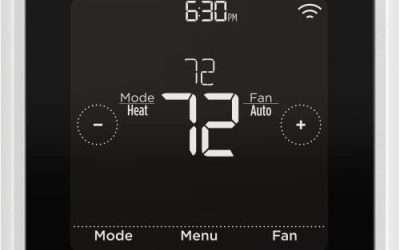
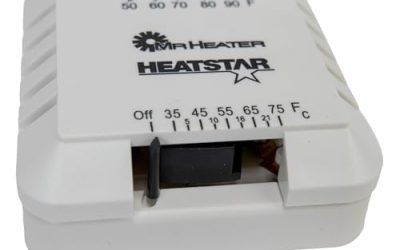
| Honeywell Home RLV3120A1005 | A simple digital display | Digital, non-programmable, electric heat only |
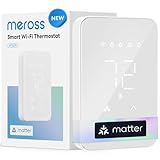
| meross Matter Smart Thermostat | Matter and multi-platform smart homes | WiFi, HomeKit, Alexa, Google Home, SmartThings |
| Cadet F Series BTF2W | Double-pole built-in replacement | Double pole, 22 amp, 120/208/240V |
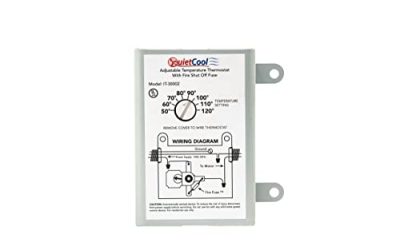
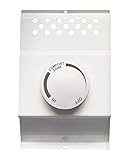
| Cadet Single Pole Line Voltage Thermostat | Wall-mounted manual control | Single pole, baseboard and wall heaters |
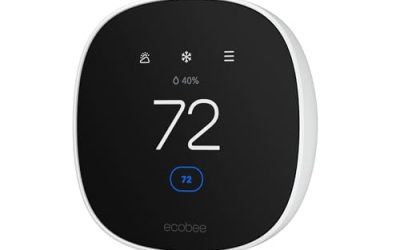
| Mysa Smart Thermostat V2 | Full-featured smart control | No subscription, humidity sensor, touchscreen, geofencing |
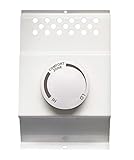
| YeloDeer 240V Manual Thermostat | Basic dial in a 240V circuit | 240V only, 4-wire, single pole dial |
| Cadet Built-In Kit BTF1W | Single-pole built-in replacement | Single pole, 22 amp, 240/208/120V |
How to Choose
Confirm voltage and the number of wires
Before comparing features, open the existing thermostat or check the heater label. Baseboard heaters run on 120V or 240V, and the thermostat must match. The YeloDeer unit is listed as 240V only with four wires, so it will not suit a 120V heater. The Cadet models list 120, 208, and 240 volts, which gives more flexibility. Wiring also matters: a four-wire thermostat connects to two line wires and two load wires, which is typical of 240V circuits. If the wiring in the wall does not match the listing, do not force it; call an electrician.
Single pole or double pole
A single-pole thermostat switches one leg of the circuit, so even when it is off, part of the circuit remains live. A double-pole thermostat switches both legs and provides a true off position. For 240V baseboards, many installers prefer double pole for safety, and the Cadet F Series BTF2W is listed as double pole. Single-pole units are common and acceptable for many installations, but check local code and the heater maker’s guidance. A true off position matters when you service the heater.
Load rating and heater size
Every thermostat has a maximum load. The Cadet models list 22 amps, which at 240 volts is roughly 5,280 watts, enough for several baseboards on one circuit. Smart thermostats have their own load limits, usually lower than the heavy-duty mechanical units, so add up the watts of every heater on the circuit and compare it to the thermostat’s rating before buying. Exceeding the limit overheats contacts and can cause failures. If your circuit is large, a mechanical thermostat or multiple smart units may be needed.
Smart features and what to ignore
Smart thermostats such as the Mysa V2 and LITE add Wi-Fi, scheduling, and app control. The V2 lists a humidity sensor, a touchscreen, and geofencing, while the LITE lists 7-day scheduling and support for HomeKit, Alexa, and Google. The meross adds Matter and SmartThings. Savings claims in titles, such as the percentage on the LITE, depend on how you heat today and should be treated as marketing. Mechanical dials are simple and reliable, but they cannot schedule. Ignore features you will not use, and note that subscription-free operation, listed on the V2, avoids ongoing fees.
Placement and room use also shape the decision. Baseboards heat by convection, so a thermostat mounted behind a curtain, above a heater, or beside a drafty window will read the wrong temperature and cycle badly. Wall-mounted units belong at about eye level on an interior wall, away from direct sun. Built-in thermostats read the air at the heater itself, which tends to run warmer than the room, so expect to set them lower. Smart units that rely on a separate sensor or on geofencing can reduce that mismatch, but only if they are installed where they sense the room rather than the heater.
Finally, think about how many rooms you heat. A single smart thermostat is easy to justify in a main bedroom or home office. Outfitting every room can add up quickly, so many owners start with the room they use most and leave rarely used rooms on a simple manual dial.
The 8 Best Options
Mysa Smart Thermostat LITE
The LITE is a WiFi programmable thermostat for electric baseboards with 7-day scheduling, HomeKit, Alexa, and Google support, and a claim of savings up to 26 percent on heating. It suits renters and homeowners wanting smart scheduling in a leaner package.
- Strength: smart assistants and 7-day scheduling are listed.
- Strength: aimed specifically at electric baseboards.
- Trade-off: the title does not list the V2’s humidity sensor or touchscreen.
Good for bedrooms and offices on predictable schedules, where lowering the temperature during the day makes sense. Skip it if you want a built-in display on the unit itself, or if you want the added sensor features found on the V2.
Honeywell Home RLV3120A1005
This is a digital non-programmable thermostat for electric heat only. It gives a clear temperature readout without any schedule, making it a straightforward replacement.
- Strength: simple digital display and operation.
- Strength: made for electric heat, so it fits baseboard use.
- Trade-off: no scheduling, so you control it by hand.
It suits anyone replacing a failed dial with something more precise, such as landlords and homeowners fixing a single room. Skip it if you want to schedule temperature setbacks or control it remotely, and confirm that the wiring matches before ordering.
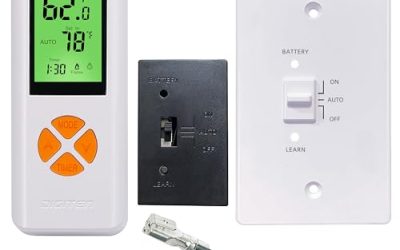
meross Matter Smart Thermostat
The meross is a WiFi programmable thermostat for electric baseboards that lists Matter along with HomeKit, Alexa, Google Home, and SmartThings. It suits mixed smart-home setups where several platforms are in use.
- Strength: Matter and wide platform support.
- Strength: programmable scheduling from an app.
- Trade-off: the visible title does not show the load rating, so check it.
Good for households already using several smart ecosystems, where one app should not lock you in. Skip it if you want a long-established brand in heating control, or if you need the load rating confirmed in the title.
Cadet F Series BTF2W
A double-pole built-in baseboard thermostat listed for 22 amps and 120, 208, or 240 volts, in white. Built-in thermostats install inside compatible Cadet heaters and replace the original control.
- Strength: double-pole switching offers a true off position.
- Strength: a 22-amp rating handles heavy loads.
- Trade-off: it is a manual unit with no scheduling.
It is the pick for a Cadet heater that needs a like-for-like replacement and a true off position. Skip it if your heater is another brand or you want smart features, because it will not fit other makers’ enclosures.
Cadet Single Pole Line Voltage Thermostat
This is a single-pole line-voltage thermostat for baseboard and wall heaters, mounted on the wall rather than inside the heater. It is a general-purpose manual choice.
- Strength: works for baseboard and wall heaters.
- Strength: simple wall-mounted operation.
- Trade-off: the title gives no load rating, so verify it.
Suitable for a simple room upgrade where the old wall dial has worn out or become inaccurate. Skip it if you want a double-pole off position or schedule control, and read the wiring instructions before you start.
Mysa Smart Thermostat V2
The V2 lists no subscription, a humidity sensor, a touchscreen, WiFi programmable scheduling, and geofencing. It is the feature-rich Mysa and works well for a house where heating habits change.
- Strength: geofencing and scheduling adapt to your routine.
- Strength: a touchscreen and humidity sensor are listed.
- Trade-off: it sits at a higher tier than manual dials.
Best for owners wanting full control and a screen on the wall, especially in a home where schedules change with work or travel. Skip it if you only need a basic dial, or if you would rather not manage another app.
YeloDeer 240V Manual Thermostat
A 240V-only, four-wire manual thermostat with a single-pole dial for wall mounting. It is a no-frills controller for a 240V circuit.
- Strength: simple dial control.
- Strength: wall mounting is straightforward.
- Trade-off: it is restricted to 240V, so it will not suit 120V heaters.
Good for basic rooms such as garages and workshops, where a dial is all anyone wants. Skip it if your heater is 120V or you want scheduling, and double-check the four-wire layout before buying.
Cadet Built-In Kit BTF1W
A single-pole built-in thermostat kit for Cadet electric baseboard heaters, listed for 22 amps and 240, 208, or 120 volts. It replaces the control inside a compatible heater.
- Strength: designed for Cadet heaters.
- Strength: a 22-amp rating and broad voltage range.
- Trade-off: single-pole switching leaves part of the circuit live.
A sensible replacement for a Cadet heater whose built-in control has failed. Skip it if your heater is not a Cadet or you want a double-pole off position, since single-pole switching leaves part of the circuit energized.
Which One Fits Your Situation
You want to cut heating costs with scheduling
The Mysa Smart Thermostat V2 gives scheduling, geofencing, and a screen, while the Mysa LITE is the lower-tier route.
You use several smart-home platforms
The meross Matter Smart Thermostat lists Matter, HomeKit, Alexa, Google Home, and SmartThings.
You need to replace a Cadet heater’s control
Choose the Cadet F Series BTF2W for double pole or the Cadet Built-In Kit BTF1W for single pole.
You want the simplest possible dial
The YeloDeer 240V Manual Thermostat or the Cadet Single Pole Line Voltage Thermostat will do, and the Honeywell RLV3120A1005 adds a digital display.
Common Mistakes
- Installing a low-voltage thermostat on a line-voltage baseboard heater.
- Ignoring the thermostat’s load rating and overloading it.
- Buying a 240V-only unit for a 120V circuit.
- Forgetting that built-in kits fit specific heater brands.
- Assuming a smart thermostat will save a promised percentage regardless of how you heat.
Related guides
- Windows Macos Linux Gaming Performance Comparison Strengths Weaknesses
- Desktop Operating Systems Gaming Performance Strengths Weaknesses
- 5G Home Internet Wifi Modem Settings Low Latency Gaming
Frequently Asked Questions
Can I use a regular thermostat on baseboard heaters?
No. Baseboards use line voltage, so you need a thermostat made for it. A low-voltage model is unsafe.
What is the difference between single and double pole?
A single-pole unit switches one wire, while a double-pole switches both, giving a true off. Check code and the heater instructions.
Do smart thermostats really save energy?
They can, mostly through scheduling and setbacks. Results depend on your habits and home.
Should I hire an electrician?
If you are unsure about line-voltage wiring, yes. Mistakes can cause fire or shock hazards.