
When shopping for a gaming keyboard, it is easy to get distracted by flashing RGB lighting, sleek aluminum frames, and aggressive marketing promises. But any experienced PC gamer will tell you that the true heart of your keyboard—the component that dictates whether you win a clutch firefight or suffer from hand fatigue after an hour—is the mechanical switch beneath the keycap. Choosing the wrong switch can ruin an otherwise premium setup, while the right switch can make a budget-friendly board feel like a custom-tuned instrument.
The most common mistake gamers make is buying a keyboard based solely on switch color without understanding how those colors translate to real-world performance. Many assume that the loudest, clickiest switches are the “most mechanical” and therefore the best for gaming, only to realize later that the high activation force and loud noise level drive their family or stream audience crazy. Others buy soldered boards, locking themselves into a single switch type forever. As we look ahead to the gaming landscape of 2026, hot-swappable sockets have transitioned from a premium enthusiast luxury to an absolute baseline standard, making it easier than ever to customize your setup—if you know what to look for.
As an Amazon Associate we earn from qualifying purchases at no extra cost to you.


Our Top Picks
 Redragon K556 PRO Wireless RGB Mechanical Gaming KeyboardRed Switch17.1 x 4.9 x 1.1 inches2.4 poundsCheck on Amazon
 Razer BlackWidow V4 X Mechanical Gaming Keyboard20.5 x 8 x 2 Inch18.36 x 6.01 x 1.71 Inches2.51 poundsCheck on Amazon

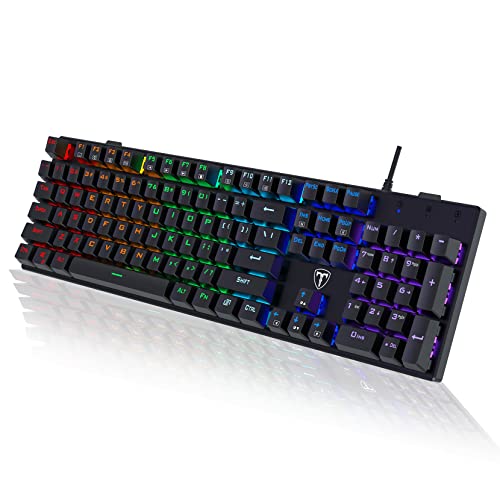
Top 3 picks at a glance
Decide These 3 Things First
Before diving into the granular specifications of travel distances and housing materials, you must narrow your focus by making three foundational decisions. These choices will instantly eliminate 70% of the options on the market, saving you hours of research.
- The Switch Behavior (Linear vs. Tactile vs. Clicky): Linear switches (typically Red or Yellow) offer a smooth, uninterrupted keystroke from top to bottom, making them the gold standard for rapid double-taps in fast-paced games. Tactile switches (Brown) feature a physical bump at the actuation point, offering a balance between typing accuracy and gaming. Clicky switches (Blue) combine that tactile bump with an audible “click” sound, which is highly satisfying for typing but can be too loud and slow for competitive gaming.
- Hot-Swappable vs. Soldered PCB: A soldered keyboard permanently attaches the switches to the circuit board. If a single switch fails, or if you want to try a different style, you must replace the entire keyboard or use a soldering iron. A hot-swappable board allows you to pull switches out and snap new ones in within seconds. If you want longevity and customization, always choose hot-swappable.
- Your Acoustic Environment: Mechanical switches are inherently louder than membrane keyboards. If you share a bedroom, stream on Twitch, or work in an office, clicky blue switches are a recipe for conflict. Linear switches or specialized “silent” switches are essential for shared spaces.
Switch Size, Travel Distance, and Actuation Force
When comparing switches, the technical specifications tell the real story of how they will perform under pressure. You need to look closely at three primary numbers: total travel distance, actuation point, and actuation force.
Total travel distance is the depth the switch can be pressed down, usually ranging from 3.0mm to 4.0mm. The actuation point is the exact depth at which the keyboard registers your keypress. Standard switches actuate at around 2.0mm, but “speed” switches (like Razer Yellow or Cherry MX Speed Silver) actuate at a shallow 1.2mm. This shorter distance means your character jumps or dodges milliseconds faster.
Actuation force is measured in grams (g) or centinewtons (cN). This is the amount of physical pressure required to register a keypress. Lightweight switches require 35g to 45g of force, making them incredibly fast but prone to accidental presses if you rest your fingers heavily on the keys. Heavy switches require 55g to 65g or more, which prevents accidental inputs but can tire your fingers during marathon gaming sessions.
Keycap and Switch Materials
The materials used to build your switch and the keycaps resting on top of them dictate the sound profile, friction, and long-term durability of your keyboard. Standard switches use a combination of Polycarbonate (PC) for transparent top housings (to let RGB shine through) and Nylon for the bottom housing, which provides a deeper, lower-pitched sound profile. The internal stem is usually made of POM (Polyoxymethylene), a self-lubricating plastic that ensures smooth movement.
For keycaps, the two main materials are ABS and PBT:
- ABS (Acrylonitrile Butadiene Styrene): This is a cheaper, lighter plastic. ABS keycaps are prone to developing a greasy, reflective “shine” over time as the oils from your fingers wear down the texture. They also produce a higher-pitched, hollow typing sound.
- PBT (Polybutylene Terephthalate): PBT keycaps are thicker (typically 1.2mm to 1.5mm), highly durable, and feature a textured matte finish that resists finger oils. They produce a deeper, more satisfying “thock” sound and do not wear down or shine even after years of heavy use. Look for “double-shot PBT” keycaps, where the legends are molded from a separate piece of plastic so they can never wear off.
Keyboard Size and Desk Footprint
The physical size of your keyboard impacts your desk ergonomics and how much space you have to swing your mouse during intense gaming moments. Keyboard sizes are categorized by a percentage of a standard 104-key layout:
- Full-Size (100%): Includes the alphanumeric keys, function row, arrow keys, and a dedicated number pad. These keyboards are typically 17.5 inches wide and weigh 2.2 to 3.0 pounds. While great for productivity, they force your mouse hand further to the right, which can strain your shoulder during gaming.
- Tenkeyless (80% or TKL): Drops the number pad, reducing the width to roughly 14 inches. This is the sweet spot for most gamers, freeing up valuable desk space while keeping the dedicated arrow keys and function row.
- Compact (60% or 65%): Removes the function row and occasionally the arrow keys, measuring a compact 11.5 inches wide. This layout maximizes mouse space, making it a favorite among low-sensitivity first-person shooter (FPS) players.
Comfort, Ergonomics, and Inclination Angles
Long gaming sessions put repetitive stress on your wrists and fingers. To prevent strain or long-term injury like carpal tunnel syndrome, pay attention to the ergonomics of the keyboard chassis. Most mechanical keyboards sit relatively high off the desk, with a front height of 0.75 inches to 1.0 inch. Typing at this height without support forces your wrists to bend upward, restricting blood flow.
Look for keyboards with dual-stage flip-out feet on the bottom, allowing you to adjust the inclination angle between 4 degrees, 6 degrees, and 9 degrees. Additionally, a quality wrist rest is crucial. A plush, ergonomic wrist rest that slopes down to meet the desk surface allows your hands to rest in a neutral, flat position, protecting your joints during multi-hour raids.
Price Tiers and What You Get
The mechanical keyboard market is highly segmented, and your budget will dictate the build quality, switch options, and customization features available to you.
- Budget Tier ($25 – $45): In this range, you will find wired, plastic-framed keyboards with generic switches (such as Outemu or content brands). While affordable, these boards often use thin ABS keycaps and may have soldered switches, though some budget options now offer hot-swappable sockets. Examples include entry-level wired models starting around $28 to around $29.
- Mid-Range Tier ($50 – $85): This tier offers a massive jump in quality. You can expect aluminum top plates, high-quality double-shot PBT keycaps, wireless connectivity (2.4GHz and Bluetooth), and hot-swappable switches from reputable brands like Gateron or Kailh. Keyboards in this range, typically priced around $64, offer the best balance of features and longevity.
- Premium Tier ($90 – $200+): At this level, you are paying for enthusiast-grade features, custom tuning, and premium brand ecosystems. Expect heavy, fully aluminum CNC-machined cases, specialized rapid-trigger magnetic or optical switches (such as Razer’s Yellow linear switches at around $99), sound-dampening foam layers, and highly polished software suites for custom macros and RGB sync.
Warranty and Lifespan Guarantees
Mechanical switches are famous for their longevity compared to cheap membrane keyboards. A standard membrane keyboard is rated for about 5 to 10 million keystrokes. In contrast, entry-level mechanical switches are rated for 50 million keystrokes, while premium switches (like Cherry MX or Razer mechanical switches) are rated for 80 million to 100 million keystrokes.
When buying a keyboard, check the manufacturer’s warranty. Budget brands typically offer a basic 1-year limited warranty, while premium brands extend this to 2 years. Ensure the warranty covers key chattering (when a single press registers twice) and dead LEDs, which are the most common points of failure in mechanical keyboards.
Spec Checklist
Use this quick-reference table to compare what features you should expect to find across the three main price tiers when shopping for a gaming keyboard.
| Feature / Spec | Budget ($25 – $45) | Mid-Range ($50 – $85) | Premium ($90 – $200+) |
|---|---|---|---|
| Switch Lifespan | 20 to 50 Million Keystrokes | 50 to 80 Million Keystrokes | 80 to 100+ Million Keystrokes |
| Keycap Material | Thin ABS Plastic | Double-Shot PBT or Thick ABS | Premium Double-Shot PBT |
| Chassis Construction | Full Plastic Frame | Plastic Base with Aluminum Top Plate | Full CNC Aluminum / Heavily Dampened Case |
| Socket Type | Soldered or Outemu-only Hot-Swap | Universal 3/5-Pin Hot-Swappable | Universal Hot-Swap, Optical, or Magnetic Sockets |
| Latency / Connectivity | Wired Only (High Latency) | Wired & Low-Latency 2.4GHz Wireless | Ultra-low Latency (Up to 8000Hz Polling Rate) |
| Warranty | 1-Year Limited | 1 to 2 Years | 2-Year Comprehensive |
Red Flags
When shopping, keep an eye out for these warning signs that indicate a keyboard might not deliver the performance or durability you need:
- Non-Standard Bottom Row Layouts: Some brands use non-standard sizes for the spacebar, Ctrl, and Alt keys. If you ever want to replace your keycaps with a custom PBT set, you will find it nearly impossible to find caps that fit a non-standard layout.
- “Mechanical-Feel” or “Semi-Mechanical”: This is a marketing trap. These are cheap membrane keyboards with a plastic slider added to make a clicking sound. They do not offer the performance, speed, or longevity of true mechanical switches.
- Proprietary Optical Sockets: Some brands offer hot-swappable optical keyboards, but their sockets only accept that specific brand’s proprietary optical switches. This severely limits your customization options compared to standard mechanical hot-swappable boards.
- High Latency/No Anti-Ghosting: A gaming keyboard must have N-Key Rollover (NKRO) or advanced anti-ghosting. If a keyboard only supports 6-key rollover, it may fail to register your movements when you press multiple keys simultaneously during complex gaming maneuvers.
FAQ
Are red or blue switches better for gaming?
Red switches (linear) are universally considered superior for fast-paced gaming. Because they do not have a physical tactile bump or click mechanism, they allow for faster, smoother double-taps and rapid key presses. Blue switches (clicky) have a heavy tactile bump that can slow down rapid inputs, and their loud noise can be distracting during gameplay or voice communication.
What does “actuation force” mean, and why does it matter?
Actuation force is the amount of physical pressure (measured in grams) required to register a keypress. A lower actuation force (around 35g to 45g) feels incredibly light and fast, making it ideal for competitive gaming. A higher actuation force (55g to 65g) requires more deliberate finger pressure, which is excellent for typing accuracy but can cause finger fatigue during long gaming sessions.
Can I swap switches on any mechanical keyboard?
No. You can only swap switches easily if the keyboard is explicitly labeled as “hot-swappable.” If the keyboard is not hot-swappable, the switches are permanently soldered to the internal printed circuit board (PCB). To change them, you would have to manually desolder every individual joint, which requires specialized tools and technical expertise.
Do I need to lubricate my mechanical keyboard switches?
While not strictly necessary, lubricating (or “lubing”) your switches makes a massive difference in how they feel and sound. Lubrication reduces internal friction, eliminating scratchy sounds and making the keystroke feel incredibly smooth. Many mid-range and premium keyboards now come with switches that are pre-lubricated from the factory, saving you hours of tedious manual work.









