As an Amazon Associate we earn from qualifying purchases at no extra cost to you.




# Best Thermal Paste for Overclocking: Compared and Ranked
Every serious overclocker knows the painful truth: your cooling loop is only as good as the interface between your CPU’s integrated heat spreader and your cooler’s cold plate. That microscopic layer of thermal paste — often less than 0.1 mm thick once mounted — is the last line of defense between your silicon and thermal throttling. Push a 250 W+ overclocked chip through a mediocre compound and you’ll watch temperatures climb 5–10 °C higher than necessary, costing you stability headroom exactly when you need it most. The right paste can’t turn a 360 mm AIO into a custom loop, but it can claw back degrees that translate directly into higher sustained boost clocks or a quieter fan curve.
The problem for buyers is that the thermal paste market is flooded with options ranging from $4 tubes to $15 syringes of liquid metal, all claiming “extreme performance.” Compounds differ wildly in conductivity, longevity, ease of application, and electrical safety — and a paste that’s brilliant on a delidded chip can destroy a motherboard if it spills. We sorted through the field and ranked eight compounds that consistently earn their place in an overclocker’s toolkit, from forgiving all-rounders to extreme-conductivity liquid metal for those who know what they’re doing.
Our Top Picks



Top 3 picks at a glance
Quick Picks
| Product | Best for | Price |
|---|---|---|
| Thermal Grizzly Kryonaut 1 g | Best overall for overclocking | Check on Amazon |
| Thermal Grizzly Kryonaut 1 g + 12 Wipes | Best value kit | Check on Amazon |
| ARCTIC MX-7 8 g | Best bulk buy for multiple builds | Check on Amazon |
| ARCTIC MX-7 4 g | Best for a couple of systems | Check on Amazon |
| Thermal Grizzly Duronaut 2 g + Wipes | Best for long-term durability | Check on Amazon |
| ARCTIC MX-4 4 g | Best budget pick | Check on Amazon |
| Corsair TM30 3 g | Best easy application | Check on Amazon |
| Thermal Grizzly Conductonaut 1 g | Best extreme-performance liquid metal | Check on Amazon |
How We Compared
We focused this roundup specifically on compounds suited to overclocking, which changes the priorities compared with a general-use list. Thermal conductivity matters most — measured in W/mK, higher is better — but it isn’t the whole story. Pump-out effect (paste creeping out of the interface during thermal cycling) matters enormously for a rig that swings between idle and heavy stress loads, so durability ratings and long-term stability factored heavily. We also weighed viscosity and spreadability, because a paste that’s too thick can leave voids under a contact-frame cooler mount, and one that’s too runny can spill onto board components.
Electrical conductivity was a critical safety filter. Liquid metal compounds like Conductonaut are gallium-based and highly electrically conductive — spectacular performers with real risk if misapplied — so they need clear warnings rather than blanket recommendations. Finally, we looked at total value: syringe size, included applicators, and bundled cleaning supplies, since surface prep matters as much as the compound itself. Every product here is widely available at the prices listed, which range from around $4 to around $14, and none require exotic storage or handling beyond what a hobbyist can manage.
The 8 Best Picks
1. Thermal Grizzly Kryonaut (1 g) — Best Overall for Overclocking
Kryonaut is the paste most overclockers reach for by default, and at around $8 for a 1 g syringe, it’s easy to see why. It’s a ceramic-based, non-electrically-conductive compound engineered specifically for extreme cooling applications, and it maintains consistent performance across a huge temperature range — important when your chip idles at 30 °C and spikes past 90 °C during stress testing. One gram is enough for roughly three to five CPU applications depending on spread method, which is plenty for most builders.
- Non-conductive formula is safe around motherboard components
- Excellent conductivity with proven results on high-wattage overclocked chips
The one complaint: Kryonaut can dry out if a tube sits uncapped or unused for a long stretch, so cap it tightly after each use. Skip it only if you need multi-year, set-and-forget durability — that’s where Duronaut below makes more sense.
2. Thermal Grizzly Kryonaut (1 g) + 12 Cleaning Wipes — Best Value Kit
This is the same excellent Kryonaut formula — a 1 g syringe of extremely high-performance paste — bundled with 12 cleaning wipes (6 wet, 6 dry) for around $11, a $3 premium over the standalone tube. For anyone replacing an old compound on a CPU, GPU, or even a console chip in a PS4, PS5, or Xbox repasting job, that premium is worth every cent. Proper surface prep — fully removing the old compound with a wet wipe, then drying with the second — is the step most beginners rush, and this kit makes it impossible to skip.
- Bundled wet and dry wipes eliminate the need for separate isopropyl alcohol and lint-free cloths
- Same top-tier overclocking performance as the standalone Kryonaut
The obvious con: if you already own cleaning supplies, you’re paying $3 for duplicates. Skip this and buy the plain 1 g tube if your bench is already stocked.
3. ARCTIC MX-7 (8 g) — Best Bulk Buy
At around $8 for a massive 8 g tube, MX-7 delivers ultimate-performance class thermal paste at a per-gram cost the premium brands can’t touch — roughly a dollar per gram versus $9 per gram for Kryonaut. ARCTIC markets it for long durability, and the thick, stable consistency resists the pump-out effect that degrades thinner pastes under thermal cycling. This is the tube for someone building or maintaining multiple systems: one 8 g supply comfortably covers a dozen CPU applications plus a GPU or two, with enough left over for annual maintenance through 2026 and beyond.
- Exceptional value at 8 g for under $9
- Long-durability formulation holds up across years of thermal cycling
The trade-off is that its peak conductivity likely sits a hair below Kryonaut’s in the most extreme scenarios. Skip it if you’re chasing the last degree on a record attempt; buy it for everything else.
4. ARCTIC MX-7 (4 g) — Best for a Couple of Systems
The 4 g version of ARCTIC’s MX-7 costs just around $7 and hits the sweet spot for most home builders. Four grams is enough for roughly five to eight CPU applications — a new build, a repaste, and spares for a couple of years — without committing to the 8 g tube’s bulk. It shares the same ultimate-performance, long-durability formula: non-electrically conductive, easy to spread, and stable over long service intervals, which matters if you don’t want to open your case annually.
- Right-sized tube for a typical builder’s needs at a bargain price
- Long durability means fewer repastes over the life of your system
Like its 8 g sibling, it’s not the absolute peak-conductivity option for extreme LN2-style sub-ambient work. If you only ever plan one build and want maximum headroom, the 1 g premium pastes are the better spend.
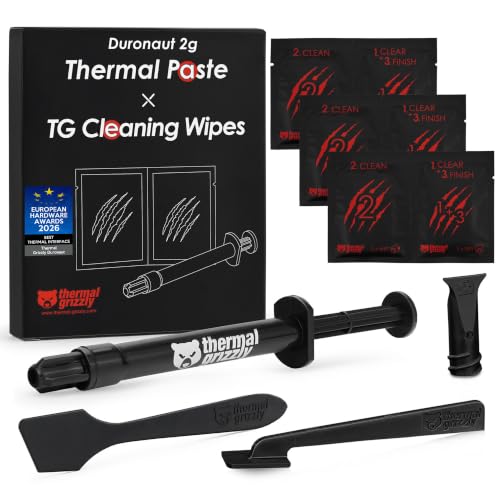
5. Thermal Grizzly Duronaut (2 g) + Wipes — Best for Long-Term Durability
Duronaut is Thermal Grizzly’s answer to the durability question, offering enhanced longevity alongside high performance and maximum conductivity while overclocking CPUs, GPUs, and console chips. The around $13 kit includes a 2 g syringe plus the same 12 cleaning wipes (6 wet, 6 dry) as the Kryonaut bundle, and the extra gram doubles your application count versus the 1 g Kryonaut tubes. For a system you plan to push hard for years without opening the case — a home server, a living-room rig, a workstation running sustained loads — Duronaut’s resistance to drying and degradation is the deciding factor.
- Enhanced durability formula designed to resist drying over long service life
- 2 g supply plus full cleaning kit in one purchase
At around $13 it’s the priciest paste-plus-wipes kit here, and its peak thermal performance is roughly on par with Kryonaut rather than dramatically better. Skip it if you repaste frequently and prioritize absolute lowest temperatures.
6. ARCTIC MX-4 (4 g) — Best Budget Pick
ARCTIC’s MX-4 has been the default answer to “what paste should I buy?” for over a decade, and at around $4 for 4 g, it remains unbeatable value for premium-performance-class paste. It’s non-conductive, non-capacitive, famously easy to spread, and doesn’t dry out quickly — ARCTIC rates it for years of reliable service. For a stock or lightly overclocked build, or as a backup tube in the drawer for every emergency repaste, MX-4 does 95% of what the premium compounds do at half the price.
- Outstanding price-to-gram ratio at around $4 for 4 g
- Forgiving consistency and proven long-term stability for beginners
The con is honest: its peak conductivity trails the MX-7 and Kryonaut tier, so heavily overclocked, high-wattage chips give up a few degrees. Skip it only for aggressive overclocking targets — buy it for everything else.
7. Corsair TM30 (3 g) — Best Easy Application
Corsair’s TM30 delivers ultra-low thermal impedance in a 3 g tube for around $7, and it comes with a small applicator spatula that makes spreading even and foolproof — a genuine plus for first-time builders nervous about the process. The paste is non-electrically conductive, so a stray smudge on the board isn’t a disaster, and its viscosity sits in the easy-to-work middle ground: thick enough not to run, soft enough to spread thin. Three grams covers several CPU applications plus a GPU repaste.
- Included applicator and beginner-friendly viscosity make for clean, even spreads
- Reliable performance backed by a major brand with broad availability
Its peak performance doesn’t quite match Kryonaut or MX-7 in demanding overclocking scenarios, and 3 g is a mid-sized supply. Skip it if you’re chasing maximum thermal headroom; it’s an easy recommendation for everyone else.
8. Thermal Grizzly Conductonaut (1 g) — Best Extreme-Performance Liquid Metal
Conductonaut is a gallium-based liquid metal, not a paste, and at around $14 for 1 g it’s the most expensive entry here — justified by thermal conductivity far beyond any conventional compound. On delidded CPUs (replacing the Intel stock solder or glue interface) or between a bare-die GPU and a water block, it delivers temperature drops no paste can match. It’s the choice for extreme overclockers and custom-loop enthusiasts extracting every last megahertz.
- Highest thermal conductivity category available for maximum cooling headroom
- Ideal for delidding and direct-die applications where pastes fall short
The critical con: Conductonaut is electrically conductive and reacts with aluminum, so it must never contact aluminum coolers or spill on board circuitry — application demands careful masking and experience. Skip it entirely unless you understand liquid metal handling; Kryonaut is the safer extreme-performance choice.
Buying Guide
Thermal Conductivity vs. Real-World Gains
Paste is one link in a cooling chain that includes your cooler’s mass, heatpipe count, and fan performance. Upgrading from a basic compound to a top-tier paste typically yields a few degrees of improvement — meaningful for overclocking stability, but not transformative. Match your paste investment to your cooling tier: a around $14 liquid metal makes sense on a delidded direct-die custom loop; it’s wasted under a basic tower cooler. Spend on the cooler first, then the paste.
Electrical Conductivity and Safety
Conventional pastes like Kryonaut, MX-7, MX-4, and TM30 are non-electrically conductive, meaning a small spill won’t short your motherboard. Liquid metal is different: gallium alloys conduct electricity and aggressively alloy with aluminum, so they require non-aluminum coolers (copper or nickel-plated surfaces), careful application, and often acrylic masking around the die. If you’re not comfortable with that workflow, stick with ceramic-based pastes — the performance gap on a standard IHS-mounted chip is modest.
Longevity, Pump-Out, and Syringe Size
Overclocked systems cycle between hot and cool repeatedly, and thinner pastes can gradually migrate out of the interface — the “pump-out effect” — degrading performance over months. Durability-focused formulas like Duronaut and MX-7 resist this, making them better for systems you won’t service annually. Also consider volume math: 1 g covers roughly 3–5 CPU applications, 2 g doubles that, and 4–8 g tubes like ARCTIC’s serve multiple builds and years of repastes. Frequent builders should always buy the larger tube; the per-gram savings are enormous.
Our Verdict
For most overclockers, the Thermal Grizzly Kryonaut 1 g tube at around $8 remains the benchmark — extreme-performance, non-conductive, and proven on high-wattage chips. Buy the around $11 wipes bundle for your first repaste. If you maintain several systems, ARCTIC MX-7 at around $8 for 8 g is unbeatable value, and MX-4 at around $4 is the budget default. For multi-year set-and-forget durability, choose Duronaut at around $13. And for delidders and direct-die enthusiasts only, Conductonaut at around $14 is the extreme-performance ceiling — handle with care.
FAQ
Does thermal paste really matter for overclocking?
Yes, though modestly. The difference between a basic paste and a top-tier compound is usually a few degrees Celsius on a standard chip — enough to matter when you’re pushing stability limits or tuning fan curves for a quieter build. On delidded or direct-die setups, the gap widens considerably, which is why extreme overclockers use liquid metal.
How much thermal paste do I need for one CPU?
A pea-sized dot (roughly 0.1–0.2 g) at the center of the IHS is enough for most direct-contact coolers; spreading methods may use slightly more. A 1 g syringe covers roughly three to five applications, which is why the 4 g and 8 g ARCTIC tubes represent far better per-gram value for multi-build builders.
Is liquid metal thermal paste safe to use?
Only with precautions. Gallium-based compounds like Conductonaut are electrically conductive and will damage aluminum surfaces, so they require copper or nickel-plated coolers, careful masking of nearby components, and controlled application. Experienced builders achieve excellent results on delidded chips, but beginners should stay with non-conductive pastes like Kryonaut or MX-7.
How often should I replace thermal paste?
For durability-focused formulas like MX-7, MX-4, or Duronaut, every three to five years is a reasonable interval, or whenever you remove the cooler. Softer, performance-first compounds may need attention sooner on systems with heavy thermal cycling. If you see rising temperatures at the same fan speeds and workload, a repaste is the first thing to try.
Related guides
- Best Gaming PC for Overwatch 2: Ten Prebuilts Matched to Your Monitor (2026)
- Best Gaming PC for Baldur’s Gate 3: Matching CPU, VRAM and Storage to the Game (2026)
- Best Gaming PC for Apex Legends: Which Listings Fit a High-Refresh Setup (2026)
- Best RTX 3060 Gaming PCs: Eight Prebuilt Listings Compared by CPU, RAM and Cooling (2026)