
Our Top Picks


The Short Answer
No, most people don’t need a capture card to stream. If you’re streaming gameplay from the same PC you’re playing on, or broadcasting from a webcam, phone, or console with a built-in streaming app, free software like OBS Studio handles everything. The one condition: you need a capture card if you want to stream (or record) gameplay from a console or a second device onto a PC — especially if you want that footage in 4K or at a clean 60 frames per second while your gaming PC stays free to handle the stream itself.
What You Actually Get
A capture card is a small device — typically a pocket-sized aluminum or plastic box weighing between 2 and 4 ounces, or an internal PCIe card — that takes the video signal from an HDMI source and converts it into data your computer can record or broadcast. Plug your console’s HDMI output into the card, plug the card into your PC via USB 3.0 (or into a PCIe slot), and your console’s footage appears in OBS or Streamlabs as just another video source.
As an Amazon Associate we earn from qualifying purchases at no extra cost to you.
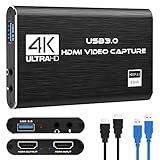

The two most common tiers look like this. Budget external cards in the $20–$40 range, like the generic 4K HDMI units sold widely online (a typical unit runs about $25), pass 4K video through to your TV or monitor while capturing at 1080p and 60fps. They draw power from the USB port, measure roughly 4 by 2 inches, and need no drivers on most systems. Mid-range dedicated cards like the Elgato 4K S, around $150, capture full 4K at 60fps (or 1080p at 120fps in some modes), are built specifically for PS5, Xbox Series X/S, and Switch 2, and include low-latency passthrough rated around 60ms or better so you can play on your TV with no perceptible delay.
What you don’t get is magic. The card doesn’t improve your internet upload speed, your microphone, or your scene layouts. It solves exactly one problem: getting clean video from a second device into your streaming PC.
Pros
- Offloads the encoding work — your gaming PC or console renders the game while a separate PC handles the stream, so neither machine drops frames.
- Unlocks 4K capture; built-in console streaming apps top out at 1080p, and software capture on a single PC often sags below 60fps in demanding games.
- Budget options start around $25, so the entry cost is genuinely low if you just want to try dual-PC streaming.
- Dedicated cards like the Elgato come with companion software, reliable drivers, and support teams — generic cards leave you troubleshooting OBS settings on your own.
- Works beyond streaming: useful for recording gameplay, video conferencing with a mirrorless camera, or digitizing older HDMI sources.
- External USB 3.0 models are plug-and-play on Windows and macOS, no power adapter needed since they run off the USB bus.
Cons
- It’s a second-device tax: to use one properly, you need another PC (or at minimum a laptop) to run the streaming software, which doubles your hardware footprint.
- Sub-$40 generic cards often add noticeable latency (some push past 100ms), lack reliable driver support, and can drop frames after long sessions as they heat up.
- A genuine 4K60 card costs $150 or more — real money for a feature many streamers never use.
- HDMI with HDCP protection (on some consoles and streaming apps) can produce a black screen until you disable the protection in your console’s settings, which frustrates beginners.
- If you stream PC games from the same PC you play on — the majority of streamers — it adds nothing at all.
Who Should Buy It
Buy a capture card if you stream console games and want better quality than the Twitch or YouTube apps built into your PS5 or Xbox. Buy one if you’re running a dual-PC setup and want your gaming machine completely free of encoding load. Buy one if you want to use a DSLR or mirrorless camera as a high-quality webcam — many modern cameras output clean HDMI, and a $25 card turns them into professional-grade video sources. And buy one if you’re producing edited YouTube content from a Switch 2 or console where built-in recording is limited or nonexistent.
Who Should Skip It
Skip it if you stream PC games from one computer — OBS captures your gameplay directly, no hardware needed. Skip it if you’re a brand-new streamer with a small audience; your microphone and lighting will matter infinitely more than a capture pipeline. Skip it if your console’s built-in 1080p stream already looks fine to you and you don’t plan to edit recordings later. And skip the cheap generic cards specifically if you need low latency for competitive play — passthrough lag under $40 is a real compromise, and you’d be better served saving for a dedicated card or skipping the category entirely.
Cheaper Alternatives
| Option | Cost | Trade-off |
|---|---|---|
| Console’s built-in streaming app (Twitch/YouTube on PS5, Xbox) | Free | Capped at 1080p, no overlays or scene control, no local recording |
| OBS Studio capturing PC gameplay directly | Free | Only works on the PC you’re gaming on; encoding costs some FPS |
| Stream from a phone or tablet with the native app | Free | Limited to mobile games unless you mirror, and quality is modest |
| Remote play / hardware encoding on console (PS5 and Xbox Series X/S) | Free | Fine quality for casual streams, but little control over bitrate or layout |
| Used or previous-generation capture card (1080p60 models) | $40–$80 | No 4K capture, and warranty is usually gone |
FAQ
Can I stream my PS5 or Xbox without a capture card?
Yes. Both PS5 and Xbox Series X/S have Twitch and YouTube apps built in that stream directly from the console at up to 1080p. You lose overlays, alerts, and local recording, but for casual streaming it works with zero extra hardware.
Do capture cards work with OBS Studio?
Yes. Every mainstream capture card — generic USB 3.0 units and dedicated brands alike — shows up in OBS as a “Video Capture Device” source. You add the source, select the card, and set your resolution and frame rate. Generic cards generally need no drivers on Windows 10 or 11.
Is a $25 capture card good enough?
For streaming 1080p at 60fps from a console with a second PC, a budget card is often good enough to start. Expect weaker build quality, occasional driver quirks, and higher passthrough latency than dedicated cards — so it’s a fine testing ground, not a long-term competitive-gaming solution.
What specs matter most when choosing a capture card in 2026?
Four things: capture resolution and frame rate (1080p60 minimum, 4K60 if you record for YouTube), passthrough latency (under 70ms if you play on the same display), connection type (USB 3.0 for external cards or PCIe for internal), and HDCP support so protected console signals don’t show a black screen.
Related guides
- Best Gaming PC for Overwatch 2: Ten Prebuilts Matched to Your Monitor (2026)
- Best Gaming PC for Baldur’s Gate 3: Matching CPU, VRAM and Storage to the Game (2026)
- Best Gaming PC for Apex Legends: Which Listings Fit a High-Refresh Setup (2026)
- Best RTX 3060 Gaming PCs: Eight Prebuilt Listings Compared by CPU, RAM and Cooling (2026)









