Our Top Picks


Top 3 picks at a glance
The Short Answer
For most desktop builds, choose a CPU cooler with a stated TDP rating at least 30% higher than your processor’s typical sustained power draw. If you use an unlocked Intel Core or AMD Ryzen chip, run long gaming sessions, edit video, compile code, or enable automatic boosting, a 50% or larger cushion is smarter.
As a practical starting point:
As an Amazon Associate we earn from qualifying purchases at no extra cost to you.


- Up to 100W actual CPU power: a compact 120W to 150W tower cooler is usually enough.
- 100W to 170W: choose a 180W to 225W single-tower cooler with four or more heat pipes.
- 170W to 230W: look for a 225W to 265W dual-tower air cooler or a quality 240mm liquid cooler.
- Above 230W sustained: use a large dual-tower cooler, a 280mm liquid cooler, or a 360mm liquid cooler if your case supports it.
Do not treat a cooler’s advertised TDP number as an industry-standard measurement. One brand’s “225W TDP” claim may not perform identically to another brand’s 225W claim. Use the rating as a rough comparison within a product line, then prioritize physical fit, heat-pipe count, fan size, noise expectations, and CPU power limits.
For example, a compact 150W cooler such as the ID-COOLING SE-903-XT V2 can suit lower-power processors and budget builds at around $14. A 225W, 157mm-tall tower cooler like the JONSBO CA40 is a better match for mainstream gaming CPUs at roughly $25. For hotter chips, a six-heat-pipe dual-tower model rated around 265W, such as the SAMA A60L, offers more thermal headroom without necessarily costing more than $25 to $35.
Standard Sizes
CPU cooler size matters as much as TDP rating. The key dimension is height: it must fit between the motherboard and your closed side panel. Check your computer case specification for “maximum CPU cooler height,” then leave at least 0.08 to 0.20 inches (2 to 5 mm) of clearance rather than selecting a cooler that exactly matches the stated limit.
| Cooler Type | Typical Dimensions (W × D × H) | Typical Height | Typical TDP Range | Best For |
|---|---|---|---|---|
| Low-profile air cooler | 3.7–5.0 × 3.7–5.0 × 1.5–2.8 in 9.5–12.7 × 9.5–12.7 × 3.8–7.1 cm |
1.5–2.8 in 3.8–7.1 cm |
45–95W | Mini PCs and slim small-form-factor cases |
| Compact 92mm tower | 3.7–4.3 × 2.5–3.3 × 4.7–5.3 in 9.4–10.9 × 6.4–8.4 × 11.9–13.5 cm |
4.7–5.3 in 11.9–13.5 cm |
95–150W | Budget and compact mid-tower builds |
| 120mm single-tower | 4.7–5.1 × 2.8–3.2 × 5.7–6.2 in 11.9–13.0 × 7.1–8.1 × 14.5–15.7 cm |
5.7–6.2 in 14.5–15.7 cm |
150–225W | Mainstream gaming and work PCs |
| 120mm tall single-tower | 4.7–5.3 × 2.9–3.4 × 6.1–6.5 in 11.9–13.5 × 7.4–8.6 × 15.5–16.5 cm |
6.1–6.5 in 15.5–16.5 cm |
180–225W | Higher-performance mid-towers |
| Dual-tower air cooler | 4.9–5.5 × 4.7–5.5 × 6.1–6.5 in 12.5–14.0 × 11.9–14.0 × 15.5–16.5 cm |
6.1–6.5 in 15.5–16.5 cm |
225–265W+ | Hot gaming, rendering, and productivity CPUs |
| 240mm liquid cooler radiator | 10.8–11.2 × 4.7 × 1.1 in radiator 27.4–28.4 × 12.0 × 2.8 cm radiator |
About 2.1 in with fans About 5.3 cm with fans |
200–300W | Cases with top or front radiator support |
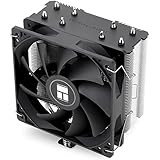
A common reference point is the Thermalright Assassin X120 Refined SE. It is a 120mm single-tower design, generally suited to cases allowing roughly 5.8 inches (148 mm) of cooler height. At about $18 to $22, this style is an economical choice when you need more capability than a stock cooler but do not have room for a large dual-tower unit.
How to Measure Your Space
- Find the case’s published CPU cooler clearance. Look in the case manual or specification sheet for maximum cooler height. Record the number in millimeters and inches. For example, a 160 mm limit equals 6.30 inches.
- Measure if the case is already assembled. With the side panel removed, measure from the CPU’s metal heat spreader to the inside edge of the closed side panel. This is more accurate than measuring to the glass or steel panel while it is off the case.
- Subtract a clearance margin. Take away at least 2 mm, or about 0.08 inches. Use a 5 mm (0.20-inch) margin for tempered-glass side panels, cable-heavy builds, or cases with a side-panel mounting bracket.
- Check RAM clearance. Tall RGB memory can be 1.7 to 2.2 inches (43 to 56 mm) high. A front-mounted fan on a large air cooler may need to sit higher to clear it, increasing total cooler height beyond the listed specification.
- Check motherboard socket clearance. Large heatsinks can overhang the first memory slot or interfere with bulky motherboard heatsinks. Review the cooler’s width and depth, not only its height.
- Verify the mounting socket. Confirm support for your exact CPU platform, such as AMD AM4 or AM5, or Intel LGA 1700 and LGA 1851. A cooler can physically fit the case but still require a different mounting kit.
- Consider airflow direction. In a conventional tower case, the cooler fan should normally pull air from the front and push it toward the rear exhaust fan. Reversed or blocked airflow can reduce the value of buying a higher-rated cooler.
By Room or Use Case
Home Office or Everyday Family Computer
For web browsing, video calls, documents, streaming, and light photo work, CPU power is often well below 100W. A 92mm tower cooler rated around 120W to 150W is usually adequate, especially in a compact desktop tucked into a cabinet or office nook. Choose a model under 5.3 inches (135 mm) tall if space is limited. Expect prices of roughly $14 to $25.
Living Room PC or Small-Form-Factor Build
Living room systems prioritize low noise and small dimensions. Start with the case, not the cooler rating. A slim case may only accept a 2.0-inch (51 mm) low-profile cooler, which limits practical cooling capacity. For a compact 6- to 8-inch-wide case, a 95W-rated low-profile model may be the realistic limit. Pair it with an efficient CPU or set sensible power limits rather than forcing a hot processor into a tight enclosure.
Gaming Bedroom or Den Setup
For a mainstream gaming PC, a 120mm single-tower cooler rated from 180W to 225W is the value sweet spot. It provides useful headroom for boost behavior while typically fitting cases with 6.1 to 6.3 inches (155 to 160 mm) of clearance. Four heat pipes and a PWM fan are good baseline features. Budget approximately $18 to $35 for a capable air cooler.
Creative Studio, Rendering, or Heavy Multitasking
Long rendering jobs, code compilation, 3D work, and video exports can hold the CPU near its maximum power draw for extended periods. Select a 225W to 265W dual-tower air cooler when your case supports a 6.5-inch (165 mm) height. These coolers commonly use six heat pipes and one or two 120mm fans. If the processor routinely exceeds about 230W, consider a 280mm or 360mm liquid cooler instead.
Common Sizing Mistakes
- Matching the cooler’s TDP exactly to the CPU’s advertised TDP. Processor labels do not always reflect short-term or sustained boost power. Build in 30% to 50% headroom.
- Ignoring fan-adjusted height. A dual-tower cooler listed at 6.3 inches may become 6.6 inches after raising its front fan over tall RAM.
- Buying by heat-pipe count alone. More heat pipes can help, but fin area, fan quality, mounting pressure, and case airflow also matter.
- Forgetting case airflow. A 265W-rated cooler cannot perform at its best in a sealed desk compartment with no fresh-air intake.
- Assuming a liquid cooler always fits. Radiator length, thickness, fan thickness, tube routing, and graphics-card clearance all need checking.
- Overbuying for a low-power CPU. A huge cooler may be unnecessary if the processor draws 65W to 90W, particularly when it blocks RAM access or complicates installation.
FAQ
Is a higher CPU cooler TDP rating always better?
Not automatically, but it generally provides more cooling headroom. The better choice is the highest-capacity cooler that fits your case, clears your RAM, supports your socket, and meets your noise and budget goals. Compare models within similar sizes rather than relying on TDP claims alone.
How much cooler TDP headroom should I have?
A 30% margin is a solid minimum for ordinary use. Choose 50% or more for unlocked processors, warm rooms, quiet fan curves, overclocking, or sustained workloads. If your CPU can draw 170W during demanding use, target roughly a 225W cooler rather than a 170W model.
Will a 157mm CPU cooler fit in a 160mm case?
Usually, but it is close. A 157 mm cooler leaves only 3 mm, or 0.12 inches, of nominal clearance. It can work if the cooler’s stated height includes the fan in its installed position and your RAM does not force that fan upward. Measure carefully before buying.
Do I need a liquid cooler for a 265W CPU?
Not necessarily. A well-designed dual-tower air cooler rated around 265W can be appropriate when the case has strong front-to-rear airflow and at least 165 mm (6.5 inches) of cooler clearance. A liquid cooler becomes more appealing when sustained power is very high, case airflow is constrained, or you want to move heat directly to a top or front radiator location.
Related guides
- Best Gaming PC for Overwatch 2: Ten Prebuilts Matched to Your Monitor (2026)
- Best Gaming PC for Baldur’s Gate 3: Matching CPU, VRAM and Storage to the Game (2026)
- Best Gaming PC for Apex Legends: Which Listings Fit a High-Refresh Setup (2026)
- Best RTX 3060 Gaming PCs: Eight Prebuilt Listings Compared by CPU, RAM and Cooling (2026)