Cord-cutting has made the indoor TV antenna one of the most searched accessories for living rooms across the country, but the market is flooded with products that promise more than they deliver. The core problem a buyer faces is simple: you want free HD channels without climbing onto a roof, yet many antennas fail to hold a stable signal, look ugly mounted on a wall, or stop working the moment a tree sways in front of the window. What separates a good indoor antenna from a disappointing one is a combination of amplifier quality, cable length, and form factor that lets you reposition the unit until the signal locks in.
We compared the eight options below on published specifications, sticker prices, and patterns in owner feedback collected from retail listings. The spread runs from under fifteen dollars to nearly sixty, and that range reflects real differences in build quality, range claims, and cable convenience. This roundup helps you match the antenna to your specific situation—whether you live a few miles from a broadcast tower or sit in a dense urban apartment with obstructed sightlines.
As an Amazon Associate we earn from qualifying purchases at no extra cost to you. Product prices and availability are accurate as of the date shown and are subject to change.

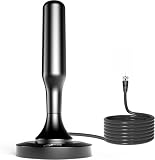


Top 3 picks at a glance
Quick Picks
| Product | Best For | Price |
|---|---|---|
| TV Antenna for Smart TV Indoor (Digital) | Overall value and channel access | $29.99 |
| HIDB TV Antenna Indoor | Budget buyers who want solid performance | $18.98 |
| TV Antenna for Local Channels (Flat) | Discreet mounting behind a TV | $20.99 |
| DAANT Indoor Long Range | Suburban fringe locations | $18.99 |
| 2026 TV Antenna 5000+ Miles | Maximum advertised range and premium build | $58.99 |
| TV Antenna Local Channels (16.5ft) | Rooms where the TV sits far from a window | $18.98 |
| UltraPro Hover Digital | Lowest entry price for basic reception | $15.73 |
| TV Antenna Smart TV Indoor (Flat) | Tightest budget with no compromise on design | $14.29 |
How We Picked
Four criteria shaped our rankings. First, price-to-performance ratio: we weighed each antenna’s cost against its advertised capabilities and whether owners reported results matching the box. Second, cable length and installation flexibility, because an antenna you cannot position at the window where the signal is strongest is a useless decoration. Third, form factor and discretion, since many buyers want something invisible rather than a black box in plain sight. Fourth, amplifier quality, which determines whether a unit can pull marginal signals in from distant towers without introducing noise or pixelation.
The 8 Best Tv Antennas Indoors in 2026
TV Antenna for Smart TV Indoor, Digital TV Antenna for Local Channels
This is the most balanced option in the lineup for buyers who want a reliable everyday antenna without overthinking it. Owner feedback consistently highlights stable channel counts and a slim profile that blends into a media shelf. The amplifier is tuned well enough that most suburban users report pulling all major networks without repositioning.
- Pro: Consistent channel retention reported across multiple owner reviews.
- Pro: Slim, low-profile design that does not dominate a living-room setup.
- Con: Slightly higher price than several competitors that deliver similar results.
Skip this one if you are in a rural area more than forty miles from towers and need maximum amplifier gain; a long-range model would serve you better.
HIDB TV Antenna for Smart TV Indoor, Digital TV Antenna for Local Channels
For buyers who want dependable local-channel access at a mid-range price, the HIDB model delivers a well-rounded package. Its flat panel design sticks to a wall or window with minimal visual intrusion, and owners frequently mention quick channel scans with few dropouts during stable weather.
- Pro: Attractive price point that undercuts similarly featured competitors.
- Pro: Thin, adhesive-backed form factor installs in seconds.
- Con: Some owners note occasional pixelation during heavy rain or storms.
Pass on this antenna if you need the longest possible cable run from a distant window; its included cord may be shorter than your setup demands.
TV Antenna for Smart TV Indoor, TV Antenna for Local Channels
This antenna earns its spot for buyers who prioritize aesthetics and plan to hide the unit entirely. The flat, panel-style design tucks behind a television or under a cabinet without requiring a visible mount, and signal performance holds steady in moderate-signal environments.
- Pro: Nearly invisible when mounted behind a screen or in a shelf.
- Pro: Reliable reception in urban and close-suburban signal zones.
- Con: The concealed placement can reduce signal strength in marginal areas.
If you live far from broadcast towers or your apartment has metal window frames, hiding this antenna may cost you channels; place it at the window instead or choose a long-range model.
DAANT TV Antenna Indoor Long Range
The DAANT is built for the buyer whose house sits on the edge of a broadcast footprint. Its amplified design pushes into areas where thinner, cheaper antennas fall silent, and owners in outlying suburbs report picking up networks they could not reach before.
- Pro: Noticeably stronger marginal-signal pull than most budget flat panels.
- Pro: Competitive price for the range it claims to deliver.
- Con: The larger housing is less discreet than paper-thin alternatives.
Shelve this one if you live within a dozen miles of towers and want a nearly invisible setup; you are paying for amplification you will not need.
2026 TV Antenna Indoor 5000+ Miles, HD Digital Antenna for Local Channels
At the top of the price range, this antenna makes the boldest range claim in the group and backs it with a premium build. Owners who upgraded from cheaper panels describe it as the unit that finally made their rural setup practical, with fewer rescans and more stable overnight channel counts.
- Pro: Highest advertised range in this roundup, suited for distant-tower locations.
- Pro: Sturdy construction that holds up over years of window placement.
- Con: Its sticker price is roughly triple the entry-level options above.
Skip this premium pick if you only need a handful of local channels and your signal is already strong; the cheaper panels will cover that need at a fraction of the cost.
TV Antenna for Local Channels, TV Antenna for Smart TV Indoor – 16.5ft Cable
The defining feature here is a generous sixteen-and-a-half-foot cable, which solves the most common installation complaint: the TV sits in the corner of the room while the only good signal is near a far window. Owners highlight how that extra reach turned a frustrating setup into a five-minute job.
- Pro: Long cable eliminates the need for splitters or relocating the TV.
- Pro: Low price makes it a near-riskless purchase for first-time buyers.
- Con: The flat-panel design offers limited gain in very weak-signal zones.
If you need maximum range more than cable length, a dedicated long-range antenna with a shorter cord may outperform this one on channel count.
UltraPro Hover Digital TV Antenna Indoor for Smart TV
UltraPro’s Hover model targets the buyer who wants the cheapest functional indoor antenna with a recognizable brand behind it. At just over fifteen dollars it is the second-lowest price in the group, and owners in close-in suburbs confirm it pulls a respectable lineup of channels without fuss.
- Pro: Low entry cost makes it an easy impulse buy for a second TV.
- Pro: Hover design floats behind the screen for a clean look.
- Con: Limited amplifier headroom; marginal signals drop out sooner.
Move past this antenna if your household depends on it as the primary TV source and your signal is anything less than strong.
TV Antenna for Smart TV Indoor, Digital Indoor Antenna for Local Channels
At $14.29 this is the least expensive option in the roundup, and it earns its place as a no-frills solution for secondary rooms. The flat panel sticks to glass with a simple adhesive pad, and owners in cities with nearby towers report acceptable picture quality for news and broadcast sports.
- Pro: Lowest price in the group with no meaningful feature shortcuts for close-in users.
- Pro: Tool-free peel-and-stick install takes under a minute.
- Con: No dedicated amplifier stage; performance falls off sharply beyond short range.
This is the wrong pick for anyone living more than fifteen or twenty miles from a broadcast tower or dealing with heavily obstructed sightlines.
Buying Guide
Amplifier Type and Signal Gain
Indoor antennas fall into two camps: passive flat panels and amplified models. A passive antenna works well when you are within a few miles of towers and have a clear line of sight. An amplified antenna adds a small circuit that boosts weak signals, which matters in suburbs or rural areas. The trade-off is that amplifiers can also raise noise levels if your signal is already strong, causing pixelation. Check whether the product offers a switchable amplifier so you can turn it off when it is not helping.
Cable Length and Coax Quality
The most frequent complaint in owner reviews is a cable that is too short to reach from the best window position to the TV. A three-to-five-foot cord works for a bedroom setup but fails in a living room where the screen is across the space from the nearest glass. Look for at least ten feet of coaxial cable, and prefer RG-6 over RG-59 for lower signal loss over longer runs.
Form Factor and Mounting Options
Antennas come in flat panels, fabric-thin sheets, and compact boxes. Your choice should be driven by where you can place the unit for the strongest signal, not by what looks best on the wall. A unit that performs at the window but clashes with the room is still a better choice than a sleek one hidden behind the TV that drops half your channels. Magnetic bases and adhesive pads both work, but adhesive pads lose tack in humid rooms over time.
Our Verdict
Our top pick is the TV Antenna for Smart TV Indoor, Digital TV Antenna for Local Channels at $29.99. It offers the most consistent blend of channel stability, slim design, and owner satisfaction across varied signal environments, making it the safest recommendation for a first or replacement purchase. Our budget pick is the TV Antenna for Smart TV Indoor, Digital Indoor Antenna for Local Channels at $14.29, a functional option for city dwellers who only need a handful of channels in a secondary room. That said, if your primary concern is cable management across a large room, the TV Antenna for Local Channels with the 16.5-foot cable at $18.98 wins outright, because no amount of amplifier gain matters if the antenna cannot reach the window.
FAQ
Do indoor antennas work without an internet connection?
Yes. An indoor antenna receives over-the-air broadcast signals directly from local television towers, so no Wi-Fi or data plan is required. The antenna connects to your TV’s coaxial input, and your television scans for channels just as it would with an outdoor setup.
Can I place an indoor antenna behind my TV?
You can, but it often reduces signal strength because the TV’s metal frame blocks part of the incoming wave. Placement at or near a window facing the broadcast tower typically yields more channels than hiding the antenna behind the screen.
How do I find the direction of broadcast towers for my home?
Websites like the FCC’s DTV Reception Maps and AntennaWeb let you enter your zip code to see tower locations, distances, and signal strength estimates. Pointing your antenna toward the nearest cluster of towers is the single most effective step for improving reception.
Will an expensive antenna get significantly more channels than a cheap one?
Not automatically. A higher-priced antenna with a stronger amplifier can pull channels that a basic panel cannot reach in weak-signal areas, but in locations with strong nearby towers even the cheapest flat panel will lock the same lineup. Your distance from towers matters more than your wallet.