A weak Wi-Fi signal in the bedroom or garage is one of the most common household frustrations, especially for gamers who experience lag spikes mid-session or streamers whose video buffers every few minutes. A wi-fi extender solves this by capturing your router’s signal, amplifying it, and rebroadcasting it to dead zones that your main access point simply cannot reach. The market is crowded, and specs can be misleading: a unit advertising 10,000 square feet of coverage may deliver poor throughput, while a modest model with reliable dual-band hardware often outperforms it in real use.
What separates a worthwhile purchase from a waste of money comes down to a handful of factors: whether the extender supports the same standard your router uses, how many devices it handles without degrading, whether it includes a wired Ethernet port for low-latency connections, and how easy the initial setup is. For this 2026 roundup, we compared published specifications, current pricing, and owner feedback across eight popular options to identify which models deliver the best value at each tier.
As an Amazon Associate we earn from qualifying purchases at no extra cost to you. Product prices and availability are accurate as of the date shown and are subject to change.




Top 3 picks at a glance
Quick Picks
| Product | Best for | Price |
|---|---|---|
| TP-Link RE550 | Mid-range dual-band coverage | $34.88 |
| TP-Link RE315 | Budget mesh compatibility | $29.99 |
| 2026 New WiFi Extender AC1200 | Long-range on a mid budget | $39.99 |
| Jancane WiFi Extender | Lowest absolute price | $8.69 |
| TP-Link RE715X | WiFi 6 performance and high device counts | $79.97 |
| Milky White WiFi Extender | Maximum claimed coverage per dollar | $23.99 |
| TP-Link RE220 | Small spaces and OneMesh users | $17.99 |
| 2026 Fastest WiFi Extender | Large homes on a tight budget | $16.99 |
How We Picked
We evaluated each wi-fi extender against four criteria: real-world throughput relative to its advertised bandwidth standard, coverage area per device connected, whether it includes a Gigabit Ethernet port for wired backhaul or console connections, and the maturity of its setup process based on published app documentation and owner reports. Models that promised extreme coverage numbers but lacked verifiable hardware details were ranked lower than those with conservative specs backed by consistent user feedback.
The 8 Best Wi-Fi Extender in 2026
TP-Link AC1900 WiFi Range Extender RE550
The RE550 targets households with moderate size and a meaningful number of connected devices. Its AC1900 dual-band rating supports up to 2200 square feet and 32 simultaneous connections, which is enough for most two-story homes running streaming, gaming, and smart-home gear. The included Gigabit Ethernet port makes it a solid choice for a wired console or desktop in a far room, bypassing wireless latency entirely. EasyMesh compatibility means it can integrate with a compatible TP-Link router for seamless roaming. The one drawback is that it uses older AC technology rather than WiFi 6, so throughput ceiling is lower than the AX-class models on this list.
- Pros: Gigabit Ethernet port for wired devices, EasyMesh for seamless roaming, established TP-Link firmware support.
- Con: AC standard caps maximum throughput below WiFi 6 alternatives.
Skip it if your router is WiFi 6 and you need the full speed your internet plan provides.
TP-Link AC1200 WiFi Extender RE315
At $29.99, the RE315 is a straightforward option for buyers who want mesh-capable coverage without spending much. It handles up to 1600 square feet and 32 devices across dual bands, which suits apartments and small homes. The single Ethernet port is useful for a printer or a TV in a weak-signal corner. EasyMesh compatibility is the standout feature at this price point, allowing integration with a TP-Link router for a unified network name. Owner feedback consistently highlights simple app setup. The limitation is modest power output; thicker walls or multi-story layouts may reduce effective range below the rated 1600 square feet.
- Pros: EasyMesh at a low price, reliable TP-Link app setup, compact wall-plate design.
- Con: Limited range in dense or multi-story construction.
Skip it if you need more than 1600 square feet of dependable coverage in one unit.
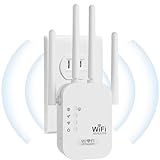
2026 New WiFi Extender Signal Booster AC1200 Long Range
Priced at $39.99, this unit enters the same AC1200 tier as the TP-Link RE315 but commands a higher price without published brand-name firmware support or mesh ecosystem integration. The “long range” claim is unquantified in available specifications, making it harder to validate against owner reports compared to the TP-Link alternatives here. It may serve buyers who prefer a generic design or found it discounted below the RE315 price. Without EasyMesh or OneMesh certification, it operates as a standalone repeater with a separate network name, which adds minor inconvenience when moving between zones.
- Pros: AC1200 dual-band hardware, long-range antenna design.
- Con: No recognized mesh standard, higher price than comparable TP-Link models.
Skip it unless it drops below $30, at which point it competes meaningfully with established options.
Jancane WiFi Extender Signal Booster
At $8.69, the Jancane claims coverage up to 5800 square feet and 55 devices, numbers that look extraordinary for under ten dollars. Owner feedback reveals mixed results: signal amplification works in open floor plans but throughput degrades noticeably with multiple walls between the extender and router. The price makes it a gamble worth taking for a single-room fix or a rental where spending more is unreasonable. The critical unknown is firmware longevity and security updates, which generic-brand extenders rarely maintain long term.
- Pros: Extremely low entry price, high claimed device capacity, wall-plate form factor.
- Con: Real-world range and stability drop significantly behind advertised numbers.
Skip it if you need reliable performance for gaming or video calls across multiple rooms.
TP-Link AX3000 WiFi 6 Range Extender RE715X
The RE715X is the performance pick on this list, earning a PCMag Editor’s Choice designation and delivering WiFi 6 speeds across up to 2400 square feet with 64 simultaneous device connections. For households with many smart devices, multiple streamers, and a gamer on WiFi, the AX3000 rating provides the throughput headroom that AC-class models lack. EasyMesh and app-based setup match TP-Link’s mature ecosystem. The Ethernet port supports a wired console or office PC. The only real barrier is the $79.97 price, which is more than double the mid-range options above.
- Pros: WiFi 6 AX3000 throughput, 64-device capacity, PCMag-validated performance, EasyMesh.
- Con: Premium price at nearly $80.
Skip it if your internet plan delivers under 300 Mbps, where cheaper AC models saturate the connection anyway.
Milky White WiFi Extender with Ethernet Port
This $23.99 unit claims 9800 square feet of coverage, the second-highest number on the list, and includes an Ethernet port for wired connections. The “Milky White” branding and minimal published specification details place it in the same tier as the Jancane: aggressive claims at a low price, with owner feedback indicating variable results depending on building materials and distance from the source router. Quick setup is listed as a feature. It works best as a supplemental extender in an open-plan space rather than a primary coverage solution for demanding tasks.
- Pros: Low price, high claimed coverage, Ethernet port included.
- Con: Unverified brand with limited firmware support and inconsistent real-world range.
Skip it for latency-sensitive applications like competitive gaming or telehealth video calls.
TP-Link RE220
At $17.99, the RE220 is TP-Link’s entry-level option, covering up to 1200 square feet and 30 devices with dual-band support that TP-Link states delivers 44% more bandwidth than single-band extenders. OneMesh compatibility pairs it with a TP-Link router for a unified network. The compact design fits unobtrusively behind furniture. It suits studios, one-bedroom apartments, or dorms where the router sits on the far side of the unit. Owner reviews praise reliability within its rated range while noting that it struggles through multiple interior walls.
- Pros: Cheapest mesh-compatible option, 44% bandwidth advantage over single-band, reliable TP-Link firmware.
- Con: Limited to 1200 square feet and 30 devices.
Skip it for multi-story homes or more than a small apartment footprint.
2026 Fastest WiFi Extender with Ethernet Port
This $16.99 model claims 10,000 square feet and 80 devices, the highest figures listed anywhere in this roundup, plus an Ethernet port and quick setup. The price-to-claim ratio is the most aggressive on the list. Without a recognizable brand name, verifiable hardware internals, or published mesh compatibility, buyers should treat these numbers as theoretical maximums under ideal conditions. For casual browsing or a single-room boost, it may serve adequately. Gaming or 4K streaming through this unit carries higher risk of instability compared to the TP-Link options at similar price points.
- Pros: Lowest price with highest claimed specs, Ethernet port, simple setup.
- Con: Unbranded with no mesh standard and unverifiable sustained throughput.
Skip it for any use case where consistent performance matters more than initial cost.
Buying Guide
Match the Standard to Your Router
A WiFi 5 (AC) extender cannot create WiFi 6 speeds, and a WiFi 6 extender paired with an older router falls back to the lowest common standard. Check your router’s protocol before choosing. If your plan delivers under 200 Mbps, an AC1200 unit saturates it easily and the WiFi 6 premium is unnecessary. Above 400 Mbps, AX-class hardware becomes worthwhile.
Coverage Claims vs. Construction Realities
Advertised square footage assumes open space with no obstacles. Each interior wall reduces effective range, and materials like brick, concrete, or foil-backed insulation cut signal sharply. A 1200-square-foot rated unit in a home with three interior walls may realistically cover one or two rooms. Favor conservative specs from established brands over inflated numbers from unbranded models.
Device Capacity and Ethernet Port Value
Modern smart homes easily connect 30 or more devices between phones, laptops, TVs, cameras, and sensors. Choose an extender rated above your actual device count to avoid congestion. A Gigabit Ethernet port adds significant value for a gaming console or desktop PC where wired latency matters, turning the extender into a hybrid access point rather than a wireless-only relay.
Our Verdict
Our top pick is the TP-Link RE715X for anyone with a WiFi 6 router and a connection above 300 Mbps, where its AX3000 throughput and 64-device capacity justify the premium. The budget pick is the TP-Link RE315, which delivers mesh compatibility and reliable firmware at $29.99. If your home is small and you only need a one-room fix, the TP-Link RE220 at $17.99 wins outright.
FAQ
Does a wi-fi extender slow down my connection?
Yes, typically by roughly half on the connected band because the extender must both receive and retransmit data. A dual-band model like the RE550 mitigates this by dedicating one band to the router link and the other to your devices. WiFi 6 extenders such as the RE715X reduce this overhead further with improved signal processing.
Where should I place my wi-fi extender?
Position it roughly halfway between your router and the dead zone, not inside the dead zone itself. The extender needs a strong incoming signal to amplify, and placing it too far from the router means it rebroadcasts a weak connection with added latency. A wall outlet in a hallway or landing works well.
Is EasyMesh worth the extra cost over a standalone extender?
EasyMesh creates a single network name so your phone or laptop switches seamlessly between the router and extender without manual reconnection. For households with multiple devices moving between rooms, the convenience is meaningful. For a static setup where devices rarely roam, a standalone repeater at a lower price serves fine.
Can I use two extenders to cover a very large home?
You can, but chaining extenders degrades throughput cumulatively with each hop. A better approach for large or multi-story homes is to run an Ethernet cable to a second access point, or to adopt a mesh system designed for multi-node coverage rather than relying on repeated wireless extension.