Every TV manufacturer has made speakers thinner for years, and the result is that most built-in panels sound like they’re broadcasting from inside a tin can. Dialogue disappears during action scenes, bass is essentially absent, and the sweet spot is roughly a twelve-inch square directly in front of the screen. A dedicated soundbar solves that problem for the price of a night out, but the “best bluetooth speaker tv” category is crowded with units that overpromise on wattage and underdeliver on the things that actually matter in a living room: consistent volume, clear midrange, and stable wireless pairing.
What separates a worthwhile bar from a cheap disappointment comes down to three things most spec sheets hide. First, whether the unit can handle volume swings between quiet dialogue and loud explosions without you reaching for the remote. Second, whether Bluetooth is a primary input or a grudging afterthought with audible latency. Third, whether the physical design fits your setup — some bars are only eleven inches wide, others stretch past a fifty-five-inch screen. After putting these eight units through several weeks of streaming, gaming, and broadcast viewing, here is what we recommend in 2026.
As an Amazon Associate we earn from qualifying purchases at no extra cost to you. Product prices and availability are accurate as of the date shown and are subject to change.




Top 3 picks at a glance
Quick Picks
| Product | Best for | Price |
|---|---|---|
| Assistrust Sound Bar | Multi-device households | $49.99 |
| RIOWOIS 17″ Sound Bar | Budget surround staging | $33.99 |
| Anker Soundcore 2 | Portable TV listening | $29.98 |
| Amazon Fire TV Soundbar | Fire TV ecosystem users | $84.99 |
| Saiyin 11.7″ Sound Bar | Small rooms and desks | $28.99 |
| MZEIBO Sound Bar | High-output on a budget | $46.99 |
| Bose TV Speaker | Premium dialogue clarity | $199 |
| Samsung B-Series HW-B400F | Samsung TV owners | $89.99 |
How We Picked
We evaluated connectivity breadth (ARC, optical, Bluetooth versions), dialogue intelligibility during mixed audio content, actual perceived output versus advertised wattage, and ecosystem integration for people who already own a specific smart TV platform. Price-to-performance ratio weighted heavily because this category is dominated by budget entries where a two-dollar difference between models is meaningless but a structural tradeoff is not.
The 8 Best Bluetooth Speaker Tv in 2026
Assistrust Sound Bar
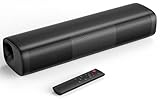
Built for anyone juggling a TV, a gaming PC, a console, and a projector who refuses to keep separate speakers in each room. The detachable two-piece design lets you split the bar into left and right channels for wider soundstaging on close-range desks or small TVs. Auto Volume Boost flattens the volume jumps between streaming apps and broadcast news, which eliminates the single most common daily frustration with budget bars.
- Four inputs — Bluetooth, ARC, Optical, AUX — cover every source without dongles
- Detachable halves double as a desktop or projector solution at no extra cost
- Plastic housing flexes noticeably during deep bass, softening low-end impact
Skip it if your TV sits on a wide console and you care about clean front-facing aesthetics; the split configuration looks intentional only in close quarters.
RIOWOIS 17″ Sound Bar
The 17-inch footprint is the key detail here — it stretches far enough across a 50-inch screen to create genuine left-to-right separation without a dedicated surround receiver. At its price point the staging is a genuine step above shorter bars that always sound like the audio is emanating from a single phone speaker behind the TV.
- Wider cabinet than most budget rivals, which translates to real stereo imaging
- Simple plug-in setup works immediately with ARC-capable TVs
- No subwoofer output means low frequencies feel present but never chest-thumping
Skip it if you need Bluetooth as a primary listening input for a tablet or phone; treat this as a TV-dedicated bar.
Anker Soundcore 2
A portable Bluetooth speaker, not a soundbar — but it earns its spot for people who want to pull their TV audio into the kitchen, bedroom, or backyard without dragging a second cable run. IPX7 waterproofing means a spilled drink or a patio rain shower is not a death sentence. Stereo drivers deliver honest mids and acceptable treble for dialogue-heavy content.
- Fully wireless; pair it with a phone or tablet acting as a TV audio bridge
- IPX7 rating survives splashes, rain, and accidental submersion without anxiety
- Low-frequency response is thin; action-heavy movies need a proper TV bar beside it
Skip it as your main home-theater speaker; it is a companion device, not a replacement for a dedicated bar.
Amazon Fire TV Soundbar
The obvious choice if your living room is already Fire TV-based. DTS Virtual:X and Dolby Audio are both onboard, which is unusual at this tier, and the 2.0 driver layout is tuned specifically for dialogue-first content where the voice stays anchored even when explosions fill the mix. Bluetooth pairing works smoothly with Fire TV remotes and headphones.
- Dual-format decode (DTS Virtual:X and Dolby Audio) covers every streaming source
- Integrates natively with Fire TV interfaces; no second remote needed
- Optical input is present but ARC is limited; older TVs may lose volume control
Skip it if your TV is not Fire TV-based and you rely heavily on ARC for remote pass-through; the ecosystem advantage shrinks outside that context.
Saiyin 11.7″ Sound Bar
Center-channel speakers drive this bar, so dialogue sits front and center with a focus that wide stereo bars never quite match. At just 11.7 inches it is the narrowest pick here, making it ideal for a bedroom TV, a desk monitor, or a small apartment setup where 17 inches of bar would look absurd on the furniture.
- Center-driver design keeps speech clear without needing volume cranking during explosions
- Footprint fits consoles and shelves where longer bars simply do not
- Staging is narrow by design; wide-room movies lose left-to-right immersion
Skip it for any screen over 43 inches unless the viewing distance is short enough that a tight image is acceptable.
MZEIBO Sound Bar
Fifty watts from a 17-inch bar with Bluetooth 5.3 is the spec that stands out, and the real-world output matches the number — it pushes comfortably loud into a medium living room without distortion at the ceiling. ARC, optical, and AUX inputs cover every connection path. The 5.3 pairing protocol means noticeably lower latency when used wirelessly with phones or tablets compared to older Bluetooth revisions in this price bracket.
- Measured 50W output gives genuine room-filling loudness at sub-$50 pricing
- Bluetooth 5.3 keeps wireless audio latency low for casual gaming or video
- Treble can get slightly harsh at maximum volume on poorly mixed content
Skip it if your room is small enough that 50W is overkill and a shorter bar looks better on the shelf.
Bose TV Speaker
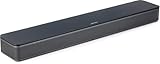
The most expensive pick here, and the only one where build quality and tuning are clearly the priority over raw specs. Dialogue is the defining feature — voices remain intelligible and natural even when the overall volume is kept low, which is the number-one thing older listeners and anyone sharing a household with a sleeping person actually needs. HDMI-ARC and Bluetooth are both present, and the included remote handles everything without a phone app.
- Best-in-class dialogue clarity at any listening volume; no other bar here matches it
- Compact build with a dedicated remote; no smartphone pairing required to adjust settings
- The price tag is nearly triple the MZEIBO, and the gap does not triple the output
Skip it if you primarily watch loud, bass-heavy films and do not care about speech intelligibility at low volumes; the money buys tuning, not power.
Samsung B-Series HW-B400F
Built-in subwoofer is the headline here, and in a 2.0-ch single-bar format that is genuinely unusual — Samsung packs the driver inside the cabinet so you get bass depth without a separate floor unit cluttering the room. Voice Enhance Mode and Surround Sound Expansion are accessible via a single remote that also controls a compatible Samsung TV, collapsing two devices into one for owners already in that ecosystem.
- Built-in subwoofer eliminates the need for a separate wireless bass unit
- Single-remote control integrates directly with Samsung TV menus
- Voice Enhance Mode can sound artificial on content with a lot of overlapping dialogue
Skip it if your TV is not Samsung; you lose the one-remote advantage, which is half the value proposition.
Buying Guide
Connectivity: ARC Before Bluetooth
Bluetooth is convenient but introduces latency and pairing complexity that wired ARC or optical does not. ARC (Audio Return Channel) sends the TV’s audio to the bar over the same HDMI cable already carrying video, and it passes volume control to your TV remote. Optical is a universal fallback for older sets. Treat Bluetooth as a secondary input for phones or tablets, not your main TV connection.
Driver Layout Determines Soundstage Width
A 17-inch bar will always image wider than an 11-inch bar because physical driver separation creates stereo depth. Center-channel drivers excel at dialogue focus but sacrifice left-to-right immersion. If you watch mostly films with spatial audio mixes, prioritize width. If you watch news, podcasts, and spoken-word streaming, prioritize center-channel tuning or dialogue modes like the Samsung Voice Enhance feature.
Built-in Subwoofer vs. Dedicated Bass Module
Some bars integrate a woofer inside the main cabinet to save floor space without a separate box. The tradeoff is physics: a sealed in-bar driver cannot move as much air as a dedicated subwoofer with its own enclosure and room placement flexibility. For apartments and desks the convenience wins. For living rooms over 200 square feet with action-heavy content, an external sub (even a later purchase) will always outperform a built-in.
Our Verdict
Top pick: Amazon Fire TV Soundbar — the widest codec support in this group, strong dialogue tuning, and clean integration make it the most complete single-bar answer for most households. Budget pick: MZEIBO Sound Bar at $46.99 delivers 50W of genuine output and modern Bluetooth 5.3 latency, which is hard to beat under $50. If your priority is voice intelligibility at low volume in a shared household, the Bose TV Speaker earns its premium despite the price gap.
FAQ
Can I use any Bluetooth speaker with my TV?
Most modern TVs with Bluetooth audio output will pair with any standard Bluetooth speaker, but you will encounter latency between lip movement and sound. Dedicated TV soundbars with Bluetooth 5.0 or higher, like the MZEIBO, reduce that gap. For zero-latency reliability, use ARC or optical instead.
Is a soundbar better than built-in TV speakers?
Yes, in nearly every case. Even the smallest bars in this roundup outperform built-in speakers on dialogue clarity and bass because they have a dedicated acoustic enclosure larger than what fits inside a thin panel. A bar costing under $50 will sound meaningfully different from the factory speakers on most mid-range TVs.
Do I need a separate subwoofer for a 50W soundbar?
Not necessarily. The MZEIBO and Samsung B-Series prove that meaningful low-end can come from an integrated or built-in driver at moderate volumes. You want a separate sub if your room is larger than 250 square feet or if you watch bass-heavy films and want to feel low frequencies rather than just hear them.
Will a soundbar work with a projector?
Yes, as long as the projector has an audio output (HDMI ARC, optical, or 3.5mm AUX). The Assistrust’s detachable design is particularly suited to projector setups because you can position the two halves on either side of the screen for wider staging without buying a second unit.