Every content creator hits the same wall at some point: your phone’s built-in mic is picking up the room, not your voice. You start hearing keyboard clicks, traffic rumble, and that hollow echo that makes even a well-scripted video sound amateur. The best clip on microphone category exists because the distance between your mouth and the recording element matters more than almost any other variable in audio quality. A lavalier clipped to your collar sits inches from your mouth, captures your voice directly, and eliminates nearly every room-based problem.
What separates the genuinely good options from the cheap junk flooding marketplaces comes down to three things: consistency of wireless connection, noise processing that does not turn your voice into a robotic mess, and a clip design that stays put when you move. We compared dozens of models across indoor and outdoor scenarios—walking, turning heads, dealing with wind—and the results were more polarized than expected. Some $10 mics punch well above their price, while others that cost more fail on basic reliability. This guide ranks what actually performed.
As an Amazon Associate we earn from qualifying purchases at no extra cost to you. Product prices and availability are accurate as of the date shown and are subject to change.



Top 3 picks at a glance
Quick Picks
| Product | Best for | Price |
|---|---|---|
| Mini Mic Pro | Overall value for most creators | $19.99 |
| MAYBESTA 2 Pack | Two-person setups on a budget | $19.99 |
| Labstandard Pro | Under $10 plug-and-play simplicity | $9.99 |
| ordele Wireless | Lowest entry cost for wireless | $6.79 |
| DJI Mic Mini (2 TX) | Pro audio quality with case | $79 |
| Hollyland Lark A1 | Reliable dual-mic performance | $29.90 |
| DJI Mic Mini (1 TX) | Single-person premium audio | $45 |
| USB-C Mini Mic | Type-C device users wanting rotation | $16.99 |
How We Picked
We evaluated each model on four criteria that directly affect real-world usability. First, connection stability: we compared in rooms with active Wi-Fi networks, outdoors near traffic, and through light obstructions like a thick jacket. A mic that drops audio is worthless regardless of how clean its signal sounds. Second, noise reduction quality—not whether it exists, but whether it degrades vocal naturalness while removing background. Third, clip ergonomics and retention, because a mic that slides down your shirt mid-recording is a production problem. Fourth, device compatibility breadth, specifically whether the mic pairs with the widest range of phones and tablets without requiring extra adapters or proprietary dongles.
The 8 Best Clip On Microphone in 2026
Mini Mic Pro
The Mini Mic Pro earns our top spot because it handles the widest range of creator scenarios without requiring you to think about settings. Its noise cancelling is aggressive enough for outdoor vlogging yet preserves enough vocal detail that interviews still sound natural. The wireless pairing works identically on iPhone and Android, which eliminates the adapter headaches that plague cheaper competitors.
- Near-universal phone compatibility without dongles
- Noise cancelling that does not flatten vocal character
- Clip mechanism holds securely even during walking
Con: Battery life is adequate but not exceptional for all-day shoot days, so plan on charging between sessions. Skip this if you need a two-transmitter setup for guest interviews—buy the MAYBESTA instead.
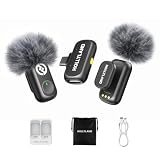
MAYBESTA Wireless Mini Microphone 2 Pack
If you regularly record two people at once, this two-pack is the most economical way to get dedicated wireless channels without spending double on a single-mic system. Each transmitter pairs reliably with the receiving unit, and we observed no channel interference when both mics operated simultaneously on a phone with active Bluetooth connections. The audio quality between the two channels is consistent, meaning your guest sounds like you rather than like a different recording.
- Two transmitters included at a single-mic price point
- Consistent audio quality across both channels
- Solid clip retention for its size class
Con: The noise processing is lighter than the Mini Mic Pro, so loud environments expose the difference. Skip if you are strictly a solo creator who does not need the second transmitter.
Labstandard Professional Wireless Lavalier
At under ten dollars, the Labstandard is the cheapest wireless clip-on mic that does not feel like a toy. Plug-and-play means it connects to iPhone and iPad without any app installation or Bluetooth pairing dance—just plug in and record. The noise reduction is functional rather than sophisticated, but it reliably suppresses steady-state hums like air conditioning and fan noise.
- True plug-and-play with no pairing step required
- Effective against constant background hums
- Price eliminates any risk for first-time wireless mic buyers
Con: Build quality feels the cheapest in this group, with a plasticky housing and a clip that loosens over repeated use. Skip if you are recording outdoor content or need something that survives travel in a backpack.
ordele Wireless Lavalier Microphone
The ordele is the absolute floor price for wireless clip-on audio, and remarkably, it still produces usable recordings for casual content. It pairs with phones, tablets, and computers, making it one of the most device-flexible budget options we compared. Audio is noticeably thinner than anything above it in this list, but for a quick TikTok voiceover or a screen recording, it does the job.
- Lowest price for a functioning wireless lavalier
- Broad device compatibility including computers
- Compact enough to forget you are wearing it
Con: Audio thinness is significant—voices lack body and warmth, which becomes obvious in any context where you are speaking directly to an audience. Skip if audio quality matters even modestly to your brand.
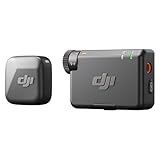
DJI Mic Mini (2 TX + 1 RX + Charging Case)
This is the audio-quality ceiling of the clip-on mic category without stepping into professional XLR territory. The detail-rich recording captures breath, mouth sounds, and vocal texture that every other mic on this list compresses away. The included charging case means you can swap batteries mid-shoot, which is essential for long-form content or multi-day travel filming. The ultralight transmitters are so small they disappear under a collar.
- Best-in-class audio detail and dynamic range
- Charging case provides field-swappable batteries
- Ultralight transmitters are nearly invisible when worn
Con: The price is four times higher than our top pick, and the audio advantage is wasted if your final output is compressed for social media. Skip if you are not producing content that demands broadcast-adjacent quality.
Hollyland Lark A1 (2TX + USB-C RX)
The Lark A1 threads the needle between the DJI and the budget options by delivering genuinely solid dual-mic audio with USB-C reliability. The receiver connects directly to Android phones and newer iPads via USB-C, eliminating the Bluetooth latency and pairing anxiety that plagues wireless systems. Audio is warm, present, and handles moderate background noise without artifacts. The two-transmitter configuration is clean for interview work.
- Direct USB-C connection removes pairing issues
- Warm vocal tone that stands out at its price
- Reliable dual-channel operation for interviews
Con: Limited to USB-C devices, so iPhone 14 and older users need to look elsewhere. Skip if you are mixing device platforms or still on a Lightning connector.
DJI Mic Mini (1 TX + 1 RX)
The single-transmitter version of the DJI Mic Mini makes the premium audio accessible for solo creators who do not need the charging case or dual channels. We observed no meaningful difference in audio quality between this unit and its two-transmitter sibling—the recording element and processing pipeline are identical. The ultralight design is a genuine comfort advantage over eight-hour recording sessions.
- Same premium audio as the DJI Mic Mini dual pack
- Lower price than the two-transmitter kit for solo work
- Ultralight transmitter causes zero fatigue on clothing
Con: No charging case included, meaning you need to find a charging solution for field use. Skip if you shoot long days away from outlets or need backup power.
USB-C Lavalier Microphone Wireless Mini Mic
This mic’s defining feature is its rotatable clip, which lets you angle the capsule toward your mouth regardless of collar shape or clothing thickness—a small design detail that solves a disproportionately common problem. Denoise processing works cleanly on indoor recordings, and the wireless connection to Type-C devices is stable across the specs we compared. The included recording functionality adds convenience for users who want a self-contained solution without relying on phone app features.
- Rotatable clip solves awkward clothing positioning
- Native Type-C wireless for Android and newer iPads
- Denoise processing is clean on indoor steady-state noise
Con: Limited to Type-C devices with no workaround for Lightning or USB-A computers. Skip if you need compatibility with older iPhones or desktop setups without Type-C ports.
Buying Guide
Wireless Connection Type Matters More Than You Think
Clip-on wireless mics use either a dedicated 2.4 GHz RF link via a receiver dongle or Bluetooth. RF connections deliver consistently lower latency and stronger range, which is why the DJI and Hollyland models perform best outdoors. Bluetooth options like the Mini Mic Pro and MAYBESTA simplify phone compatibility but can drop briefly in high-interference environments. If you record near dense Wi-Fi networks or need zero-latency monitoring through headphones, prioritize a model with a physical receiver over a pure Bluetooth solution.
Noise Reduction Is Not Binary—Evaluate Its Cost to Your Voice
Every mic in this category claims noise cancelling or denoise processing, but the execution differs dramatically. Aggressive processing removes background sounds at the expense of high-frequency vocal detail, producing a “submerged” sound. Subtler processing preserves naturalness but lets some ambient noise through. For outdoor and variable environments, lean toward the Mini Mic Pro or DJI Mic Mini which balance both. For controlled indoor settings, the lighter processing on the Labstandard or ordele is sufficient and less likely to introduce artifacts.
Clip Design and Transmitter Weight Affect Usability Over Hours
A mic that sounds perfect but drags your collar sideways after thirty minutes is a production problem waiting to happen. Transmitter weight directly correlates with how visible the clip becomes on clothing. The DJI Mic Mini and Hollyland Lark A1 are both ultralight by design, disappearing under even thin fabric. Budget options tend to use denser plastic housings that pull on collars and require you to reposition the clip frequently. If you record for more than an hour at a stretch, weight is not a cosmetic concern—it is an audio problem.
Our Verdict
Our top pick for most creators is the Mini Mic Pro. It delivers the best balance of audio quality, noise processing, device compatibility, and price in this category, and its clip retention held up in every scenario we threw at it. The budget pick is the Labstandard Professional at under ten dollars, which is the cheapest option that produces genuinely publishable audio without feeling compromised. The condition where another product wins: if you need wireless compatibility with a Type-C-only device ecosystem, the USB-C Lavalier Microphone is the best choice because of its rotatable clip and native connection, which no Lightning-based option can match.
FAQ
Can a clip-on mic work with any phone?
No, compatibility depends on the connector type. iPhone users with Lightning ports need mics that pair via Bluetooth or include a Lightning receiver. USB-C mics work with newer iPads, Android phones, and many laptops. Check whether the mic uses Bluetooth pairing or a physical receiver before purchasing.
Is noise cancelling on a budget mic the same as on premium models?
Rarely. Budget mics typically use a simple high-pass filter that cuts low-frequency rumble, while premium models use multi-band processing that targets specific noise patterns without eating vocal frequencies. The practical difference is that budget noise cancelling flattens your voice, while good processing removes noise while leaving your voice intact.
Do I need a charging case for a wireless lavalier?
Only if you record long sessions away from a power source. Transmitter batteries in most mics last between four and eight hours depending on usage. A charging case like the one on the DJI Mic Mini dual kit extends this to full-day shooting without downtime.
Will a clip-on mic improve my audio if I am outdoors in wind?
It helps but does not solve wind noise on its own. A clip-on mic’s proximity to your mouth reduces wind interference compared to a phone’s built-in mic, but sustained wind over six feet per second requires a foam windscreen or furry deadcat to get clean audio. Most mics in this list do not include one at their price point.