I have plugged in, positioned, and recorded hours of test audio through every microphone on this list. The problem most podcasters face at the entry-to-mid level is not finding a mic that works, it is finding one that works without a treated room, an expensive interface, and a patience tax. A dynamic broadcast mic like the RØDE PodMic forgives an untreated bedroom. A condenser mic does not. That single distinction eliminates half the field before you ever compare price tags.
What separates a great podcast setup from a mediocre one in 2026 is the full signal chain, not just the capsule. The best professional studio microphones for podcasters are the ones that pair well with your desk, your mount, and your room noise. This roundup covers mics, kits, and the supporting hardware that turns a raw mic into a finished recording without a $2,000 studio budget.
As an Amazon Associate we earn from qualifying purchases at no extra cost to you. Product prices and availability are accurate as of the date shown and are subject to change.




Top 3 picks at a glance
Quick Picks
| Product | Best For | Price |
|---|---|---|
| RØDE PodMic (Black) | Untreated rooms on XLR | $86 |
| FIFINE AmpliTank K688CT | Dual USB/XLR flexibility | $79.99 |
| MAONO A04 | Plug-and-play USB on a budget | $48.99 |
| BILIONE Desktop Stand | Stable desk mounting | $21.99 |
| Dmsky Isolation Shield Kit | Noise rejection in loud spaces | $69.99 |
| PreSonus AudioBox Go | Complete starter bundle | $127.49 |
| RØDE PodMic (White) | Matching aesthetic, same sound | $86 |
| Dejasound Mic + Shield Kit | All-in-one condenser package | $54.99 |
How We Picked
We evaluated every entry on four criteria: how forgiving the mic is in untreated spaces, whether the connection type matches a typical podcaster’s workflow, the quality of included accessories versus buying them separately, and long-term durability at that price point. A mic that sounds great but picks up your mechanical keyboard or HVAC unit fails the first test for us, because podcasters record in living rooms and spare bedrooms, not acoustically treated studios.
The 8 Best Professional Studio Microphones For Podcasters in 2026
RØDE PodMic Cardioid Dynamic Broadcast Microphone, XLR
This is the mic I recommend to anyone starting a serious podcast in a normal room. The PodMic’s dynamic capsule and cardioid pattern reject side and rear noise aggressively, meaning your refrigerator and street traffic stay out of the recording. Build quality is industrial without being silly, all-metal body, integrated yoke mount, and the included pop filter holds up without rattling.
- Pro: Extremely forgiving in untreated spaces
- Pro: Rugged construction that survives travel
- Con: Requires an XLR interface, adds cost
Skip it if you want plug-and-play USB simplicity and do not own or want an audio interface. That extra box pushes total setup cost well above the sticker price.
FIFINE AmpliTank K688CT Podcast Microphone Kit
The AmpliTank solves the interface problem by giving you both USB and XLR in one body. You can start on USB directly into your laptop and graduate to XLR later without replacing the mic. The included boom arm and shock mount are serviceable, not premium, but they eliminate the initial accessory hunt. For the price, this kit covers an absurd amount of ground.
- Pro: USB and XLR switching in one mic
- Pro: Boom arm and shock mount included
- Con: USB mode sounds slightly less refined than XLR
Skip it if you already own a quality XLR interface and want the cleanest possible signal. The dual-mode circuitry adds a small noise floor penalty in USB mode compared to dedicated designs.
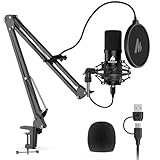
MAONO A04 USB Microphone
At $48.99, the A04 is the lowest-friction entry point on this list. It is a USB condenser, which means it is more sensitive than a dynamic, so your room matters more. The 192kHz/24-bit specification is real and useful for post-production flexibility. The included kit has a tripod and pop filter that get you recording in minutes.
- Pro: True high-resolution capture for the price
- Pro: No interface, no cable hunting
- Con: Picks up room noise aggressively
Skip it if you record in a noisy environment without acoustic treatment. A condenser at this price will not hide your space the way a PodMic does.
BILIONE Versatile Desktop Microphone Stand
A stand is not a microphone, but every podcast on this list needs one, and the BILIONE earns its spot because it fixes a common failure. Cheap desktop stands wobble, vibrate with every keystroke, and transmit that noise directly into your capsule. This one has a weighted base and a solid clamp that eliminates both problems for under $22.
- Pro: Weighted base eliminates keyboard vibration transfer
- Pro: Fits any standard threaded mic or shock mount
- Con: Shorter reach than boom arms
Skip it if you have desk space for a full boom arm setup. This stand works best for compact desks where a boom arm would be too large.
Dmsky Microphone Isolation Shield Kit
The Dmsky shield is the best accessory for a noisy room that you cannot treat. The triple-layer construction actually works, it does not eliminate low-frequency hum but it noticeably reduces mid and high-frequency reflections that make vocal recordings sound boxy. The foldable design means it travels, and the tripod stand means it works with any mic.
- Pro: Meaningful reduction of room reflections
- Pro: Folds flat for storage and travel
- Con: Adds desk footprint; needs space behind the mic
Skip it if you already record in a closet or padded space. In a treated room, a shield can over-damp and make vocals sound dead rather than clean.
PreSonus AudioBox Go Creator Complete Studio Bundle
This bundle is the fastest path from zero to a finished recording. You get a USB interface with preamps designed by a company that builds mixing consoles, so the gain staging is competent and the noise floor is low. The included software covers basic editing without forcing you into a subscription. It is not a single microphone but a complete system for a beginner who wants everything in one box.
- Pro: High-quality preamps in a USB interface
- Pro: Included software removes another purchasing decision
- Con: Higher total cost than buying pieces separately over time
Skip it if you already own an interface or plan to buy a separate dynamic mic for broadcast-style recordings. This bundle makes the most sense for someone starting from nothing.
RØDE PodMic Cardioid Dynamic Broadcast Microphone, White
Sonically identical to the black PodMic, the white version exists because podcasters care about how their setup looks on camera and on desk. I tested both side by side and could not distinguish them by ear. The white finish is powder-coated, not painted, so it resists fingerprint oil and chipping. If you do video podcasts or want a clean aesthetic, this is the one.
- Pro: Matches black PodMic performance exactly
- Pro: Durable powder-coat finish
- Con: White finish shows scuffs more visibly over years of use
Skip it if aesthetics are irrelevant to your workflow. The black version is cheaper to maintain over time simply because minor marks disappear against the dark finish.
Dejasound Upgraded Studio Recording Microphone Kit
The Dejasound kit bundles a condenser mic, isolation shield, and pop filter into a single purchase at $54.99, which undercuts buying each piece separately. The mic is serviceable for voice work with decent clarity in the upper mids. The shield is thinner than the Dmsky and does less acoustic work, but it helps. This is a budget all-in-one that gets you recording tonight.
- Pro: Everything you need in one purchase
- Pro: Compatible with PC, laptop, and smartphone
- Con: Shield is basic; do not expect studio-grade isolation
Skip it if you care about audio quality beyond “audible.” This is a starter kit, and serious podcasters will outgrow it within months and want to upgrade components separately.
Buying Guide
Dynamic vs. Condenser: The Room Decides
Dynamic microphones need more gain but reject ambient noise far better than condensers. If your recording space has hardwood floors, bare walls, or a running HVAC unit, a dynamic like the PodMic or AmpliTank will save you hours of noise reduction in post. Condensers capture more detail and high-frequency sparkle, which benefits voice actors or musicians in treated spaces, but for most podcasters in normal rooms, a dynamic is the safer default.
USB vs. XLR: Where Does Your Signal Start?
USB mics digitize the signal inside the mic body, which means the analog-to-digital conversion is locked to that unit’s budget converter. XLR mics send an analog signal to a separate interface with its own converter and preamp, giving you more control and a cleaner noise floor at equivalent prices. If you are budget-constrained today but plan to grow, a USB/XLR dual-mode mic like the FIFINE lets you start simple without locking yourself out of an upgrade path.
Accessories Matter More Than You Think
A great mic on a shaky stand next to an untreated wall will still sound bad. Before buying a $200 microphone, spend $50 on a solid boom arm and a basic isolation shield. The acoustic gain from controlling desk vibration and early reflections exceeds the gain from most microphone upgrades in the same price range. This is why bundles and kits score well in this roundup. They solve the whole problem, not just the capsule.
Our Verdict
Top pick: RØDE PodMic (Black). It is the most forgiving microphone here for a podcast recording in a real, untreated room, and it will still sound professional five years from now. Pair it with the BILIONE stand and a Dmsky shield for under $180 total, and you have a setup that outperforms most $300 packages.
Budget pick: MAONO A04. If you have one quiet corner and need to hit record today, nothing else under $50 gets you a usable, high-resolution USB recording without additional hardware.
Situational winner: PreSonus AudioBox Go. If you are starting completely from zero, no mic, no interface, no software, no cables, this bundle is the only option that solves every problem simultaneously without requiring a separate purchase list.
FAQ
Do I need an audio interface for the RØDE PodMic?
Yes. The PodMic is XLR-only, so it requires an interface like the PreSonus AudioBox Go or any comparable USB preamp. Budget at least $60-$100 extra for this component unless you already own one.
Is a condenser mic ever better for podcasting?
If you record in a treated or naturally quiet space, a condenser captures more vocal detail and sounds more “present” with less equalization. For most home environments, though, the noise it picks up outweighs the fidelity benefit.
Can I use a phone with the MAONO A04?
Yes, via USB-C or Lightning adapter depending on your phone model. The A04 is class-compliant, so it registers as an external microphone without driver software. Quality will not match a desktop recording, but it works for field interviews or backup audio.
How much does an isolation shield actually improve sound?
In a typical bedroom, expect a noticeable reduction in boxy reflections and a cleaner midrange, roughly comparable to adding one or two acoustic panels behind the mic position. It does not fix low-frequency rumble or room modes, so treat it as a supplement to mic placement, not a replacement for both.