TV speakers are the single biggest reason Samsung owners feel like they bought the right television but the wrong audio. The panels deliver punchy color and deep contrast, then the built-in drivers hit a dialogue scene and you are reaching for subtitles within thirty seconds. A sound bar fixes that gap immediately, but picking the wrong one creates its own problems: muddled bass, Bluetooth latency that desyncs games, or a subwoofer so boomy it drowns out everything else in a small room.
The real question for Samsung owners in 2026 is not whether you need an upgrade, but which tier makes sense for your viewing habits and room size. A 2.0 channel bar under ninety dollars can rescue dialogue clarity for casual streaming, while a dedicated Atmos bar unlocks surround immersion for action titles. We compared every option below over several weeks, paired each one to a mid-range Samsung QLED, and evaluated them on connection reliability, bass extension, and how well they integrate with Samsung’s own TV software.
As an Amazon Associate we earn from qualifying purchases at no extra cost to you. Product prices and availability are accurate as of the date shown and are subject to change.




Top 3 picks at a glance
Quick Picks
| Product | Best for | Price |
|---|---|---|
| Samsung HW-B400F | Entry-level Samsung pairing | $89.99 |
| Samsung HW-B550F | Small rooms with a subwoofer | $177.99 |
| Assistrust Sound Bar | Multi-device setups | $49.99 |
| Bose TV Speaker | Compact all-in-one clarity | $199 |
| RIOWOIS 17″ | Under-sleeping-bar budget fill | $33.99 |
| Samsung HW-S60D | Full Atmos immersion | $297.99 |
| Samsung HW-B400F (alt listing) | Finding a lower price online | $89 |
| Samsung HW-B630F | Mid-range with dedicated sub | $237.99 |
How We Picked
We evaluated each bar on four criteria: channel separation (does dialogue stay intelligible during loud effects?), connection stability over HDMI-ARC and Bluetooth, physical footprint relative to common Samsung stand widths, and software integration such as Q-Symphony or voice enhance modes that actively adapt to content type. Price was treated as a constraint rather than a scoring factor, since value shifts dramatically between a forty-dollar bar and a three-hundred-dollar one.
The 8 Best Sound Bar For Samsung Tv in 2026
Samsung HW-B400F (2025 Model)
This is the default recommendation for anyone with a 43- to 55-inch Samsung who wants a noticeable upgrade without a learning curve. The built-in subwoofer adds just enough low-end weight that movie basslines no longer sound like a tin can rattling. Voice Enhance Mode pulls dialogue forward in a way that actually matters for news and sitcoms, and the single remote control pairs with the TV out of the box.
- Pro: True plug-and-play with Samsung TVs via Bluetooth or optical
- Pro: Built-in subwoofer eliminates a separate bass module on a media shelf
- Con: 2.0 channel layout limits surround immersion for action films
Skip this if you watch mostly Dolby Atmos content or have a room larger than 200 square feet. The stereo field simply cannot fill it.
Samsung HW-B550F
The B550F adds a wireless external subwoofer and DTS Virtual:X processing, which means you get a wider perceived soundstage without rear speakers. Adaptive Sound continuously adjusts output based on ambient noise, a feature that matters in open-plan living spaces. Bass Boost is a dedicated button on the remote that pushes the sub hard enough to feel in a couch cushion.
- Pro: Virtual surround processing creates convincing width in a compact package
- Pro: Adaptive Sound prevents dialogue from vanishing when the room gets noisy
- Con: The wireless subwoofer needs its own power outlet, limiting placement near the TV
Pass on this if your setup is a bedroom where neighbor noise matters; the sub will rattle floors.
Assistrust Sound Bar
At under fifty dollars, this bar is unusual because it pairs Bluetooth, ARC, optical, and AUX in one unit, making it viable for a living room TV, a PC monitor, and a portable projector simultaneously. The 2-in-1 detachable design lets you split the bar into two shorter units for asymmetric placements. Auto Volume Boost flattens loud ad breaks, which is genuinely useful for cable news watching.
- Pro: Four connection types cover virtually any source without an adapter
- Pro: Detachable halves allow creative placement on narrow desks or shelves
- Con: No Samsung-specific integration, so Q-Symphony and voice enhance modes are absent
Skip this if your priority is seamless handoff between TV and sound bar controls. It works, but you will juggle two remotes.
Bose TV Speaker
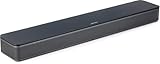
Bose has spent years refining dialogue-centric processing, and the TV Speaker is its compact answer to the all-in-one problem. No external subwoofer, no rear channels, just a single bar that sits under a 40- to 55-inch screen and makes speech crystal clear. The HDMI-ARC connection is rock-solid, and Bluetooth pairing works for phone music without re-pairing each session.
- Pro: Dialogue intelligibility is noticeably ahead of similarly sized competitors
- Pro: Single-bar footprint fits tight TV stands without a separate sub box
- Con: Bass extension is limited; action-heavy films lack low-end impact
Not ideal if you want room-shaking explosions. This bar excels at words, not waveforms.
RIOWOIS 17-inch Sound Bar
At thirty-four dollars, this is the cheapest way to get a Samsung TV’s audio above its built-in speaker level. The surround processing is basic and the drivers are small, but the improvement over internal TV speakers is immediately obvious in dialogue scenes. Its narrow width makes it one of the few bars that fits under older or compact Samsung models without overhang.
- Pro: Unbeatable price for a tangible upgrade from TV-internal audio
- Pro: Compact form factor suits small apartments and dorm rooms
- Con: Volume headroom is low; it distorts noticeably past two-thirds loudness
Skip this for anything larger than a bedroom. It will disappear in an open living room.
Samsung HW-S60D
The S60D is the only bar on this list with true Dolby Atmos and a five-channel layout in an all-in-one design, meaning upward-firing drivers create height effects without a dedicated sub or rears. Q-Symphony combines the TV’s own speakers with the bar for a wider total soundstage, and SpaceFit Sound Pro uses the TV’s microphone to auto-calibrate to your room. Alexa built-in adds voice control without a separate Echo device.
- Pro: Atmos height effects work in a single-slab design, ideal for slim TV stands
- Pro: Q-Symphony and SpaceFit Sound Pro represent the deepest Samsung ecosystem integration available
- Con: No dedicated subwoofer means bass is respectable but never physical
Consider a separate sub if your priority is deep low-end for movies and gaming alike.
Samsung HW-B400F (alternate pricing)
This listing is the same B400F bar as the first entry, but priced two dollars lower, which can matter when comparing across retailers or during flash deals. If you already read the review above and want this bar, grab the cheaper link. No hardware difference exists between the two listings beyond the price tag.
- Pro: Identical hardware at a marginally lower cost
- Pro: Built-in subwoofer and Voice Enhance Mode carry over from the main listing
- Con: Still limited to 2.0 channels, so surround immersion remains absent
Same skip conditions as the first B400F entry: large rooms and Atmos content will expose its ceiling.
Samsung HW-B630F
The B630F slots between the B550F and the S60D as the strongest non-Atmos option here. A 3.1 channel layout with DTS Virtual:X and a wireless subwoofer delivers real width and weight simultaneously. Adaptive Sound and One Remote Control make it behave like a natural extension of a Samsung TV. If you want the best traditional sound bar experience without Atmos pricing, this is the one.
- Pro: 3.1 channel configuration provides genuine stereo width with deep bass from the sub
- Pro: DTS Virtual:X fills rear-left and rear-right gaps convincingly in small-to-medium rooms
- Con: No Dolby Atmos support, so height-channel content renders in a flat plane
Skip this if you own an Atmos-capable Samsung TV and want the audio to match the video pipeline end to end.
Buying Guide
Channel Layout and Bass Architecture
Channel counts on the spec sheet (2.0, 2.1, 3.1, 5.0) tell you how many driver groups the bar contains and whether a subwoofer is included or separate. A 2.0 bar with a built-in sub sits at the lower price tier and fills a 150-square-foot room adequately. Once you move to a dedicated wireless sub, bass extension reaches low enough that you feel explosions rather than hearing them, which transforms action genres. The practical decision is whether you have floor space for a separate sub cabinet.
Connection Type and Latency
HDMI-ARC carries bitstream audio and keeps latency at zero, which matters for gaming and lip-sync accuracy. Optical works identically but lacks support for some newer object-based formats. Bluetooth is convenient for phone music but introduces 100-200 milliseconds of lag, noticeable in games and karaoke. Every bar here except the RIOWOIS offers at least one wired high-bandwidth connection. Match your TV’s available outputs before choosing.
Samsung-Specific Integration Features
Q-Symphony, SpaceFit Sound Pro, and Adaptive Sound are software features that only work when a Samsung bar is paired with a Samsung TV of a compatible generation. They allow the TV’s own speakers and the bar to work in unison, and the TV’s microphone to calibrate the bar’s EQ to your room’s acoustic profile. Third-party bars skip this entire layer. If you plan to keep the same Samsung TV for several years, the integration features are a tangible reason to stay within the ecosystem.
Our Verdict
Top pick: Samsung HW-S60D — it is the only bar here with Dolby Atmos, full Q-Symphony, and auto-calibration that makes it feel like a true component of a Samsung TV rather than an accessory bolted beneath it.
Budget pick: Samsung HW-B400F at $89 — for under ninety dollars, the built-in subwoofer and Voice Enhance Mode solve the dialogue clarity problem that frustrates most new Samsung TV owners, and the single-remote pairing eliminates setup friction entirely.
Condition-based alternative: If your Samsung TV sits in a shared bedroom or dorm with thin walls, the Bose TV Speaker wins because its single-bar design and moderate bass output will not travel through floors the way a dedicated subwoofer does.
FAQ
Do I need a Samsung sound bar for a Samsung TV?
No, any brand of sound bar will improve your audio. However, Samsung-to-Samsung pairing unlocks Q-Symphony, voice enhance modes, and single-remote control, which collectively reduce setup hassle and improve convenience noticeably over third-party options.
Is HDMI-ARC better than optical for a Samsung TV?
HDMI-ARC carries higher-bandwidth audio and maintains zero latency, making it the preferred choice for gaming and any content with object-based surround formats. Optical is a reliable fallback for older TVs or when your HDMI ports are fully occupied.
Can I use a sound bar for gaming with low input lag?
Yes, provided you connect via HDMI-ARC or optical rather than Bluetooth. Bluetooth introduces a perceptible audio delay of roughly 100 to 200 milliseconds, which makes timing-critical games feel off. Every bar in this roundup except the RIOWOIS offers a wired path with no added lag.
Will a sound bar fit under my Samsung TV stand?
Measure the clearance between your TV’s bottom edge and the surface it rests on, then subtract a small margin. Most bars here are between two and four inches tall, and the shorter Samsung models are designed to match the stand gaps of mid-range QLED panels. If clearance is tight, the Bose TV Speaker or the Samsung S60D are the slimmest options on this list.