Most people buy a soundbar because their TV’s built-in speakers make dialogue sound muddy and action scenes feel flat. The problem is not that any single model is terrible — it is that the category spans compact bars under $50 that barely improve a thin-panel TV’s audio and premium Atmos systems that rival home theaters, all marketed with nearly identical jargon. Picking the wrong tier wastes money on either underpowered hardware you will outgrow in a month or overkill that your living room does not need.
What separates a worthwhile soundbar from a disappointing one comes down to three things: whether the connection types match your source devices, whether the channel count and driver configuration actually widen the soundstage beyond what the TV already delivers, and whether the firmware and app ecosystem let you tune the output to your room. Owner feedback consistently flags the same failure modes — dialogue vanishing under bass, Bluetooth latency killing lip-sync during gaming, and bass that rattles on one track and disappears on the next. This roundup uses published specifications, listed prices, and recurring owner observations to sort the options.
As an Amazon Associate we earn from qualifying purchases at no extra cost to you. Product prices and availability are accurate as of the date shown and are subject to change.
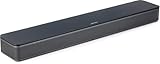





Top 3 picks at a glance
Quick Picks
| Product | Best for | Price |
|---|---|---|
| Bose TV Speaker | Small rooms and dialogue clarity | $210.99 |
| Assistrust Sound Bar | Tightest budgets, multi-device switching | $49.99 |
| Samsung HW-B400F | Balanced stereo upgrade at low cost | $89.99 |
| ULTIMEA Poseidon M60 | Entry surround with Atmos | $158.58 |
| Sony S100F | Desk and home office setups | $98 |
| Amazon Fire TV Soundbar | Fire TV ecosystem users | $119.99 |
| Sonos Beam Gen 2 | Modular home theater expansion | $499 |
| Samsung HW-B550F | Wireless bass without a bulky sub | $177.99 |
How We Picked
We filtered by four criteria that owner reviews repeatedly cite as deal-breakers. First, connectivity breadth: a bar that only offers optical input cannot carry Atmos, and a bar without Bluetooth locks out phone or console audio. Second, channel configuration relative to price — a 2.0-channel bar above $200 needs to justify the premium through tuning quality, not just branding. Third, ecosystem compatibility, because Samsung and Sonos bars integrate with their own TV and streaming hardware in ways that generic bars cannot. Fourth, size-to-ambience ratio: a compact bar that sounds thin in a large room fails its primary job, while a 5.1 system in a bedroom is overkill.
The 8 Best Soundbars 2026 in 2026
Bose TV Speaker
This is the pick for anyone whose main frustration is muffled dialogue rather than weak bass. Bose has built its reputation on mid-range clarity, and owners confirm that voices cut through without needing to crank overall volume. The all-in-one compact form factor fits under almost any TV on a narrow shelf, and HDMI-ARC means a single cable carries both audio and remote control signals. Bluetooth is available for occasional phone music. The limitation is bass depth — it is a 2.1-bar without a separate subwoofer, so action-heavy content feels restrained compared to models that pair with dedicated low-frequency drivers.
- Pro: Exceptional dialogue intelligibility out of the box with minimal tuning.
- Pro: Compact footprint works on shallow media consoles where longer bars will not fit.
- Con: No included or bundled subwoofer; bass extension is limited by design.
Skip this if you watch a lot of concerts or explosions and want physical low-end you can feel.
Assistrust Sound Bar
At $49.99, this is the floor of the category, and it is honest about that. Owners praise the Bluetooth/ARC/Optical/AUX combo for switching between a TV, a laptop, and a projector without re-plugging. The Auto Volume Boost feature flattens dynamic range, which helps at late-night listening when you cannot run loud. The 2-in-1 detachable design is genuinely useful if you also want desktop audio. The tradeoff is raw output power and tonal balance — several reviews note that bass drops off steeply below mid-bass frequencies, and the plastic enclosure introduces resonance at higher volumes.
- Pro: Four input types at the lowest price point in this roundup.
- Pro: Detachable halves enable a simple stereo spread on a desk or PC setup.
- Con: Build quality and driver excursion limit volume headroom; distortion is audible on demanding tracks.
Skip this if you care about musicality or plan to use it as your primary TV audio source for long sessions.
Samsung HW-B400F
A 2.0-channel bar with a built-in subwoofer — Samsung’s phrasing here refers to a passive radiator or bass port integrated into the enclosure, not a separate driver module. It still delivers noticeably more low-end punch than the bare 2.0 bars at this price tier, and owners highlight the single-remote control integration with Samsung TVs as a convenience that reduces clutter. Voice Enhance Mode pulls dialogue forward in the mix, useful for noisy households. The surround sound expansion is a software trick rather than true multi-channel output, so do not expect it to replace rear speakers.
- Pro: Built-in bass enhancement outperforms most 2.0 competitors under $100.
- Pro: Seamless control via Samsung TV remote when paired with a Samsung set.
- Con: “Surround expansion” is algorithmic, not spatial; it does not create real rear-channel imaging.
Skip this if you need a standalone bar that sounds identical regardless of TV brand.
ULTIMEA Poseidon M60
For buyers who want the experience of rear speakers without drilling holes or running wires across the floor, this 5.1-channel system with Dolby Atmos support is the most hardware-complete option under $200 in the list. The separate rear satellites and wireless subwoofer create a true surround field that 2.0 and 2.1 bars cannot match. Owners report a dramatic upgrade for movie nights. The caveat is setup complexity: five physical units plus pairing procedures add friction compared to plug-and-play bars, and the Atmos implementation on a budget system will not replicate the precision of premium object-based audio.
- Pro: Genuine multi-channel surround with a dedicated subwoofer and rear satellites.
- Pro: Dolby Atmos object decoding at a fraction of premium-brand pricing.
- Con: Requires more floor space and a longer initial setup than all-in-one bars.
Skip this if you live in a rental with thin walls or want minimal visual clutter.
Sony S100F
Sony designed this as a compact bar that fills a specific niche: small desks, bedroom nightstands, and home offices where you want better-than-TV speakers without committing a shelf. The bass reflex enclosure and integrated tweeter deliver a cleaner separation than the single full-range drivers common at this price. Bluetooth makes it a secondary speaker for calls and podcasts. Owners note it is genuinely small, which is the point. The limitation is that in a medium-sized living room it will sound underpowered, and the 2.0-channel layout cannot produce any surround or height effect.
- Pro: Compact and light enough to sit directly under most monitors without blocking ports.
- Pro: Tweeter integration yields clearer highs than equivalent-priced single-driver bars.
- Con: No HDMI input; connectivity is limited to optical and Bluetooth, which excludes some source routing.
Skip this if you need to pass Atmos or multi-channel audio from a TV.
Amazon Fire TV Soundbar
This bar exists to solve one problem cleanly: giving a Fire TV user better audio without introducing a separate remote or app. DTS Virtual:X and Dolby Audio processing widen the stereo image perceptibly for a 2.0-channel design, and Bluetooth lets you stream from a phone when the TV is off. Owners praise the automatic detection when connected via optical to a Fire TV Stick. The downside is that without HDMI, you are locked into compressed stereo bitstreams — no lossless or object-based formats arrive at the bar.
- Pro: Zero-config handoff with Fire TV devices; no extra buttons or apps required.
- Pro: Slim form factor disappears under a wall-mounted TV.
- Con: Optical-only input caps audio resolution at stereo compressed formats.
Skip this if your primary content is lossless or Atmos and your TV supports HDMI-ARC passthrough.
Sonos Beam Gen 2
The Beam is the most future-proof bar here because it is a node in the Sonos ecosystem rather than a standalone product. Dolby Atmos passthrough works over HDMI eARC, and the bar can be paired wirelessly with a Sonos Sub or two Sonos rear speakers to build a surround system without a receiver. Owners highlight the Trueplay room-tuning feature, which adjusts EQ to your specific acoustics using a phone microphone. The price is the main objection — $499 for a bar alone feels steep until you factor in the expansion path that premium competitors do not offer at any price.
- Pro: Modular expansion to full surround and subwoofer without wires or a receiver.
- Pro: Trueplay room correction adapts output to reflective or carpeted spaces.
- Con: Highest price in the list by a wide margin; the bar alone competes against 5.1 systems elsewhere.
Skip this if you will never add a sub or rears; similar audio quality exists for less in standalone form.
Samsung HW-B550F
This 2.1-channel bar adds a wireless external subwoofer to the B400F’s platform, which is the single biggest measurable upgrade at this price. Bass Boost and Adaptive Sound modes handle everything from quiet dialogue to loud sports without manual intervention, and owners frequently mention the sub’s ability to produce chest-felt low end that the built-in-only model cannot. The wireless connection to the sub eliminates the cable trip across the floor. Voice Enhance Mode returns from the B400F. DTS Virtual:X adds a wider front-stage image, though it still does not produce true rear placement.
- Pro: Dedicated wireless subwoofer delivers physical bass presence that 2.0 bars cannot match.
- Pro: Adaptive Sound and Bass Boost handle content-type shifts automatically.
- Con: The subwoofer requires floor space and a nearby power outlet despite the wireless signal.
Skip this if your TV is not a Samsung and you want identical tuning flexibility across brands.
Buying Guide
Connection Types Determine What Audio You Can Actually Hear
HDMI-ARC and eARC carry lossless and object-based formats like Dolby Atmos from your TV to the bar. Optical Toslink caps delivery at stereo compressed streams, meaning an Atmos-capable bar connected via optical will only produce stereo. Bluetooth adds convenience for phones and tablets but introduces latency that ruins gaming and lip-syncs poorly with video. Before buying, confirm your source outputs and the bar’s inputs overlap.
Channel Count and Subwoofer Layout Shape Your Room Experience
A 2.0-channel bar improves clarity and volume but cannot create any spatial width beyond the front of the TV. A 2.1 layout adds physical bass from a dedicated sub, which matters most for movies and games. A 5.1 system with rear satellites is the only configuration that wraps sound around the listener. Match the channel count to your room size and seating arrangement — rear speakers lose their effect if the couch sits against the back wall.
Ecosystem Lock-In Can Be a Feature or a Limitation
Samsung bars pair with Samsung TVs for single-remote control and handoff; Sonos bars integrate into a whole-home audio network. These are genuine convenience advantages if you already own matching hardware. But if you plan to upgrade your TV later, ensure the bar’s core audio inputs (HDMI-ARC, optical, Bluetooth) work independently of the brand ecosystem so you are not forced to replace the bar.
Our Verdict
The Samsung HW-B550F is our top pick for most buyers. At $177.99, it delivers a wireless subwoofer, adaptive sound processing, and HDMI connectivity in a configuration that outperforms every other standalone option in this price band. For the tightest budget, the Assistrust Sound Bar at $49.99 is a functional multi-input starting point that costs less than a single movie ticket. However, if you already run a Sonos setup or want a clear upgrade path to full surround without buying a receiver, the Sonos Beam Gen 2 justifies its premium through expansion flexibility that no other bar on this list offers.
FAQ
Do I need a subwoofer with a soundbar?
Not always. A 2.0-channel bar improves dialogue clarity and overall volume significantly without a sub. But for movies, games, and music with low-frequency content, a dedicated subwoofer adds physical bass presence that small drivers in a compact bar simply cannot reproduce.
Will a soundbar work without HDMI-ARC?
Yes, through optical or Bluetooth, but you will be limited to compressed stereo audio. If your TV or source device only has optical output, the bar cannot decode Atmos or Dolby TrueHD regardless of what it supports internally.
Can I use a soundbar for gaming?
Bars with HDMI-ARC or eARC pass through the game audio correctly. Bluetooth introduces noticeable latency that breaks lip-sync in fast-paced titles. For console gaming, a wired optical or HDMI connection is strongly preferred over wireless.
Is a soundbar better than a TV’s built-in speakers?
Any of these options will outperform a thin-panel TV’s speakers in volume, bass response, and mid-range separation. The improvement is most dramatic on dialogue-heavy content where TV speakers tend to smear consonants. The difference between bars in this roundup is smaller than the difference between a bar and no bar at all.