A weak signal in the bedroom, a dead zone in the garage, a gaming session that stutters because the router sits three rooms away — these are the everyday frustrations that drive people to search for a network extender. The category itself is deceptively simple: you plug in a device, it catches the router’s signal and rebroadcasts it. But the gap between a well-executed extender and a poorly designed one shows up immediately in throughput loss, dropped connections, and the number of devices it can handle simultaneously before degrading.
The differences that matter come down to a handful of specs: coverage area, device capacity, whether the unit has a wired backhaul option via Ethernet, and whether it participates in a mesh ecosystem that lets it hand off seamlessly with your router. Price ranges from under eighteen dollars to nearly eighty, and not every premium option justifies its cost for every household. This roundup compares eight popular models based on published specifications and owner-reported experiences so you can match a unit to your actual layout and usage pattern.
As an Amazon Associate we earn from qualifying purchases at no extra cost to you. Product prices and availability are accurate as of the date shown and are subject to change.


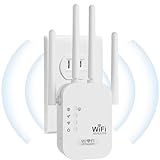


Top 3 picks at a glance
Quick Picks
| Product | Best For | Price |
|---|---|---|
| TP-Link RE550 | Balanced coverage and speed | $34.88 |
| TP-Link RE315 | Compact dual-band on a budget | $29.99 |
| Milky White Extender | Maximum claimed coverage | $23.99 |
| TP-Link RE715X | WiFi 6 performance | $79.97 |
| TP-Link RE220 | Smallest footprint, lowest price | $17.99 |
| NETGEAR EX6120 | Support-dependent buyers | $32.99 |
| 2026 New AC1200 Extender | Long-range repeater needs | $39.99 |
| TP-Link RE615X | Multi-device WiFi 6 on a mid-range budget | $59.89 |
How We Picked
Three criteria separate the worthwhile options from the forgettable ones in this category. First, real-world coverage relative to price — a unit that claims nine thousand square feet but throttles badly beyond two walls is not useful. Second, device capacity and the presence of an Ethernet port, because wired backhaul eliminates the halving penalty that wireless repeating introduces. Third, ecosystem compatibility: EasyMesh or OneMesh support matters if you already own a matching router and want single-network roaming rather than managing a separate extended network name.
The 8 Best Network Extender in 2026
TP-Link AC1900 RE550
The RE550 targets households that need more bandwidth than the entry-level AC1200 units provide without jumping to a premium WiFi 6 price tag. Its dual-band AC1900 rating and Gigabit Ethernet port give it headroom for mixed use — streaming on several TVs while a laptop runs updates and phones stay connected. Coverage up to 2200 square feet and a 32-device ceiling make it practical for most single-family homes.
- Pro: Gigabit Ethernet port supports wired backhaul, which preserves throughput far better than wireless repeating alone.
- Pro: APP Setup and EasyMesh compatibility mean you can add matching TP-Link routers or extenders later without rebuilding your network.
- Con: The unit’s physical size is substantial for a wall plug; owners in tight outlet spaces report it blocking adjacent sockets.
Skip it if your apartment is under 1200 square feet or you do not have any wired-backhaul scenario, since cheaper models cover that footprint adequately.
TP-Link AC1200 RE315
The RE315 is TP-Link’s value-oriented dual-band option, rated for up to 1600 square feet and 32 devices at a price well under thirty-five dollars. For a small-to-medium home that needs a modest signal lift in one or two rooms, it does the job without feature bloat. The single Ethernet port is a meaningful inclusion at this price point, enabling a wired connection to a distant desk or smart-TV panel.
- Pro: EasyMesh compatibility lets it pair with TP-Link routers for a unified network name and roaming.
- Pro: One Ethernet port at this price is uncommon; most sub-$30 extenders skip it entirely.
- Con: AC1200 throughput ceiling means it will feel sluggish if you backhaul several simultaneous 4K streams through it wirelessly.
Skip it if your household runs more than a dozen bandwidth-heavy devices concurrently or if you need WiFi 6 features like OFDMA.
Milky White Long-Range WiFi Extender
This unbranded unit makes the most aggressive coverage claim in the group: up to 9800 square feet, roughly triple the stated range of most competitors. For a buyer dealing with a sprawling single-story layout or a property where the router sits at one extreme, the headline number is tempting. Quick setup and an included Ethernet port add convenience. However, the lack of a recognizable brand and published firmware-update history introduces long-term uncertainty.
- Pro: The stated coverage area is far larger than anything else listed here, which may help in specific rural or multi-building scenarios.
- Pro: The lowest price in the roundup after the RE220, making it a low-risk experiment.
- Con: No named manufacturer, no mesh ecosystem, and no clear path for firmware security updates — a meaningful concern for any always-on network device.
Skip it if you value software support, mesh roaming, or predictable device-driver compatibility over raw advertised range.
TP-Link AX3000 RE715X
The RE715X is the premium WiFi 6 choice in this list, earning a PCMag Editor’s Choice designation. It pushes up to 2400 square feet of coverage and supports 64 connected devices — double the device ceiling of every AC-band unit here. Its AX3000 rating translates to noticeably higher sustained throughput when paired with a WiFi 6 router, particularly for multi-stream households. The Ethernet port is standard, and APP Setup keeps configuration simple.
- Pro: WiFi 6 features (OFDMA, Target Wake Time) reduce latency and improve efficiency with many modern smartphones, laptops, and consoles simultaneously online.
- Pro: EasyMesh support means seamless roaming when paired with compatible TP-Link routers, eliminating the “my phone won’t let go of the extender’s weaker signal” problem.
- Con: At nearly eighty dollars, it costs more than double the mid-range options; the WiFi 6 advantages vanish if your router is still AC-band.
Skip it if your existing router predates WiFi 6 or if you manage fewer than 20 devices in a compact space.
TP-Link RE220
The RE220 is the smallest and cheapest extender in this group at $17.99, rated for up to 1200 square feet and 30 devices. TP-Link claims it delivers up to 44 percent more bandwidth than single-band extenders at a similar price — a relative advantage that matters in practice for anyone still using older hardware. OneMesh compatibility ties it to TP-Link’s ecosystem for unified management.
- Pro: The lowest price in the roundup by a clear margin, making it ideal for a single dead-spot fix like a spare bedroom or home office.
- Pro: Compact wall-plug design fits behind furniture and does not crowd neighboring outlets.
- Con: The 1200-square-foot and 30-device limits mean it will saturate quickly in a busy family home; it is a spot-fix tool, not a whole-floor solution.
Skip it if your coverage gap spans more than one room or if you regularly exceed 15 active connections.
NETGEAR EX6120
NETGEAR positions the EX6120 as a straightforward AC1200 extender rated for up to 1500 square feet and 25 devices, with a compact wall-plug form factor. Its most distinctive selling point is bundled free expert help — NETGEAR’s support line handles configuration and troubleshooting at no extra cost, which lowers the barrier for less technical buyers who are uncomfortable with app-based setup flows.
- Pro: Free expert help differentiates it in a category where support quality varies wildly, especially for first-time network extender buyers.
- Pro: Compact design suits tight spaces; it does not block the second outlet on standard duplex plates.
- Con: The 25-device ceiling is the lowest in this list, and it lacks mesh compatibility, so it creates a separate network SSID rather than extending your existing one seamlessly.
Skip it if you want a single unified Wi-Fi name throughout the home or if you already have a compatible mesh system from another brand.
2026 New WiFi Extender AC1200 Long Range
This listing markets itself around recency and long-range performance with an AC1200 chipset. At $39.99 it sits above the mainstream dual-band options, and the “long range” positioning suggests an emphasis on signal sensitivity rather than raw throughput. Limited published specifications make it difficult to assess device capacity, Ethernet availability, or firmware-support commitments with confidence.
- Pro: The “long range” design emphasis may help in scenarios where the router sits far from the intended placement spot, such as a detached garage or barn office.
- Pro: AC1200 chipset means dual-band operation, which is more efficient under load than single-band alternatives at similar price points.
- Con: Sparse specification detail and no identifiable brand ecosystem make it hard to verify real-world coverage, device limits, or ongoing software support.
Skip it if you need transparent specs or rely on manufacturer firmware updates for security; the information gap is a liability.
TP-Link RE615X AX1800
The RE615X sits between the AC-band mid-range and the premium AX3000 option, offering WiFi 6 at a $59.89 price. It covers up to 2100 square feet and supports 64 devices — the same high device ceiling as the RE715X — while trading some peak throughput for a lower cost. An Ethernet port, APP Setup, and EasyMesh compatibility are all included.
- Pro: WiFi 6 with 64-device capacity at roughly half the price of the AX3000 option; a practical sweet spot for households with many modern gadgets.
- Pro: EasyMesh lets you deploy a mix of TP-Link routers and extenders under one SSID with automatic handoff.
- Con: AX1800 throughput is lower than AX3000; if you backhaul multiple wired-adjacent devices through it, the RE715X justifies its premium.
Skip it if your router is still AC-band — you lose the WiFi 6 efficiency gains and could save by choosing a cheaper AC1900 model instead.
Buying Guide
Coverage Rating vs. Your Actual Layout
Published square-footage numbers assume a clear, open floor plan. Walls with studs, metal ductwork, brick facades, and appliances all degrade signal meaningfully. A practical rule: treat the manufacturer’s stated range as roughly sixty percent achievable in a typical home with interior walls. If your router sits at one end of a 1400-square-foot single-story house and you need coverage at the other, look for an extender rated at least double your linear distance expectation.
Wired Backhaul and the Ethernet Port
A wireless extender must receive and retransmit on the same radio, which effectively halves available bandwidth to the extended zone. An Ethernet port breaks this limitation: you run a single Cat5e or Cat6 cable from router to extender location, the extender receives data over the wire and broadcasts it wirelessly at full rate. Every product in this list that includes an Ethernet port should be preferred in any scenario where you can run a cable, even temporarily through a ceiling or along a baseboard.
Mesh Compatibility and Device Ceiling
If your router supports EasyMesh, OneMesh, or a similar standard, choose an extender on the same protocol so both devices appear as one network. Your phone will roam automatically instead of clinging to a weak signal. Device ceiling matters most in smart-home-heavy households: cameras, sensors, plugs, and assistants can consume dozens of connections even when humans have only a few active streams. Anything under 30 devices is risky in that scenario; aim for 50-plus if your home is automation-dense.
Our Verdict
The TP-Link RE550 is the top pick for most buyers: it balances a Gigabit Ethernet port, strong coverage, app-based setup, and EasyMesh support at a price that leaves room for adding a second unit later. For the tightest budget, the RE220 at $17.99 solves a single-room dead spot without compromise on brand reliability. If you already own a WiFi 6 TP-Link router, the RE615X wins over the RE550 because the mesh handoff and device-capacity jump matter more than the small price premium.
FAQ
Does a network extender slow down my internet?
A wireless extender halves throughput on the extended side because it must receive and rebroadcast on the same radio channel. Using a wired backhaul via Ethernet eliminates this penalty almost entirely.
How many extenders can I use on one network?
Mesh-compatible systems like EasyMesh or OneMesh can link multiple extenders to a single router, with each node adding its own coverage zone. Non-mesh extenders create separate network names and do not coordinate handoff, so stacking more than one or two becomes impractical.
Will an extender work with any router?
All eight products here operate on standard 802.11 protocols, so they will connect to any modern router as a basic repeater. Mesh-specific features like seamless roaming and single-SSID management require router-side support for the matching protocol (EasyMesh, OneMesh, etc.).
Is WiFi 6 necessary for a home extender?
WiFi 6 is most beneficial when many devices are simultaneously active or when your router already uses the 6 standard. For a household with fewer than 15 devices and an older AC router, a well-chosen AC1900 extender like the RE550 delivers comparable everyday performance at a lower cost.