TV speakers are almost always the weakest component in any home entertainment setup. The built-in drivers in most flat-panel displays are engineered around chassis thickness and cost, not acoustic performance, so dialogue gets buried under bass-heavy action tracks and surround effects never materialize. A soundbar is the fastest fix: a single device that sits below the screen, connects through one cable, and dramatically improves clarity without requiring the receiver-and-speaker commitment of a full home theater.
What separates a worthwhile soundbar from a mediocre one is how well the manufacturer matched the product to a real use case. The best options in these soundbar reviews deliver clear vocals at moderate volume, handle spatial audio formats without distortion, and offer connectivity that actually works with the TV a buyer already owns. The worst ones add nothing beyond louder output, force you into proprietary ecosystems, or lose their bass driver at high volume. Price alone is a poor indicator, so we compared published specs, current pricing, and long-term owner feedback to identify the eight picks below for 2026.
As an Amazon Associate we earn from qualifying purchases at no extra cost to you. Product prices and availability are accurate as of the date shown and are subject to change.
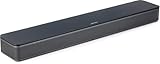




Top 3 picks at a glance
Quick Picks
| Product | Best for | Price |
|---|---|---|
| Bose TV Speaker | Dialogue clarity | $210.99 |
| Samsung B-Series HW B400F | One-remote simplicity | $89.99 |
| Assistrust Sound Bar | Multi-source switching | $49.99 |
| ULTIMEA Poseidon M60 | True surround on a budget | $158.58 |
| Amazon Fire TV Soundbar | Fire TV ecosystem users | $119.99 |
| RIOWOIS 17″ Sound Bar | Smallest spaces | $33.99 |
| Sony S100F | Home office and desk use | $98 |
| TCL S55H | Feature density per dollar | $119 |
How We Picked
We evaluated each product against four criteria: connectivity breadth (does it support the inputs your TV actually has?), channel architecture (a 5.1 system with real satellites outperforms a single-bar Dolby Atmos simulation for immersion), vocal clarity at conversational volume (the primary reason most people upgrade from TV speakers), and price-to-feature ratio relative to the current market. We cross-referenced published specifications with sustained owner feedback to flag products that look strong on paper but disappoint in daily use.
The 8 Best Soundbar Reviews in 2026
Bose TV Speaker
The Bose TV Speaker is for someone whose main frustration is muddy dialogue and who wants a near-effortless upgrade. Bose applies its proprietary voice-enhancement processing to lift speech above explosions and music without requiring a separate center channel. The compact all-in-one design fits under most media consoles without protruding, and Bluetooth handles music streaming from phones or tablets.
- Pro: Dialogue clarity is noticeably above what a similarly sized bar from lesser-known brands delivers.
- Pro: HDMI-ARC keeps everything on a single cable, and the included remote works without pairing apps.
- Con: At $210.99 it is the most expensive 2.0-channel bar on this list, and it lacks any surround or height processing.
Skip it if you want cinematic immersion or plan to watch content mixed for Dolby Atmos. This is a clarity tool, not an effects engine.
Samsung B-Series HW B400F
Samsung built this bar around a specific scenario: a buyer already owning a Samsung TV who wants better sound with zero extra remotes or apps. The One Remote Control feature lets the TV remote drive volume and modes, removing friction that defeats cheaper bars sitting idle in a drawer. Built-in subwoofers eliminate the separate wireless bass module that clutters floor space.
- Pro: Voice Enhance Mode lifts center-channel content without compressing dynamic range, useful for news and sitcoms.
- Pro: Surround Sound Expansion adds spatial width from a 2.0 configuration, making it feel less mono than competitors at this price.
- Con: The 2.0-channel layout limits low-end punch for movies with heavy score; no discrete subwoofer channel exists.
Skip it if your TV is not a Samsung, because the One Remote convenience disappears without that pairing.
Assistrust Sound Bar
The Assistrust targets buyers who juggle multiple sources: a smart TV, a laptop, a game console, or a projector in a shared room. Its four connectivity options—Bluetooth, ARC, optical, and AUX—let you leave every device plugged in simultaneously rather than re-cabling. The detachable split design doubles as a desktop speaker pair when pulled apart.
- Pro: Auto Volume Boost normalizes loudness across input sources, useful when switching between a console game and a streaming app.
- Pro: At $49.99 it costs less than most single-purpose bars while offering more connection paths.
- Con: Build quality and driver materials are clearly below the $89-and-above tier; bass output thins quickly at higher volumes.
Skip it if your primary use is movie watching in a large room, where underpowered drivers will expose their limits.
ULTIMEA Poseidon M60
The Poseidon M60 is the only true 5.1-channel system on this list, making it the obvious pick for anyone who wants rear satellites and a dedicated subwoofer without spending receiver-level money. Dolby Atmos processing adds height-layer simulation through the front array, giving it more spatial depth than any single-bar option here.
- Pro: Real rear channels create positional audio for games and films that no virtual-simulation bar can replicate convincingly.
- Pro: $158.58 is significantly below what a comparable 5.1 setup from mainstream brands costs.
- Con: Wiring five satellites plus a subwoofer requires floor space and cable management most compact-bar buyers want to avoid.
Skip it if your room layout or household aesthetics make multiple speakers impractical.
Amazon Fire TV Soundbar
This bar is the natural companion for anyone already streaming through a Fire TV Stick or Fire TV Cube. DTS Virtual:X and Dolby Audio handle spatial processing from a 2.0 configuration, and the Bluetooth passthrough means the Fire TV remote controls both the stick and the bar without extra setup steps. It is a system-integration play more than an acoustic one.
- Pro: Setup is essentially plug-and-play if you own any Fire TV device; no additional remote, no app pairing, no mode switching.
- Pro: DTS Virtual:X adds a believable sense of width for a single-bar design at $119.99.
- Con: Without a Fire TV device in your setup, the connectivity and convenience advantages shrink noticeably.
Skip it if your primary source is a cable box, game console, or non-Fire streaming device, where generic bars offer more flexible inputs.
RIOWOIS 17″ Sound Bar
At $33.99, the RIOWOIS is for the buyer who just wants louder, clearer TV audio in a bedroom, dorm, or kitchen without any learning curve. Its 17-inch width fits narrow consoles and desks where longer bars would overhang. No subwoofer, no wireless module, no app—just a power cable and a 3.5mm or optical input.
- Pro: The price undercuts nearly every competitor by a wide margin, making it a low-risk first soundbar purchase.
- Pro: Physical simplicity means nothing to configure, pair, or update; it works the same way every time you turn it on.
- Con: Output is adequate at moderate volume only; pushing it to fill a living room produces distortion that degrades dialogue.
Skip it if you watch movies regularly in a room larger than a bedroom or want any kind of bass response.
Sony S100F
The Sony S100F sits between TV use and desktop use, making it practical for home offices where a monitor serves as both a screen for shows and a productivity display. The integrated tweeter and bass-ref driver configuration is tuned for vocal intelligibility at desk distances rather than room-filling output. Bluetooth lets you stream music from a phone without unplugging from the TV.
- Pro: Compact footprint and clean aesthetic make it easy to position on a shelf or desk without visual clutter.
- Pro: Bass-ref driver design delivers more low-end presence than its size suggests, useful for podcasts and video calls.
- Con: At $98 you are paying a brand premium; feature-equivalent bars from this list offer more connectivity or power.
Skip it if your main use is immersive movie watching in a shared living room, where a 2.0 bar of this size will feel underpowered.
TCL S55H
The TCL S55H packs the most processing features into a single bar on this list: Dolby Atmos, DTS:X, auto room calibration, wireless subwoofer, app control, and 220W total power. For a buyer who wants flag-level feature labels without spending above $150, it represents the broadest spec sheet available at $119.
- Pro: Auto room calibration adjusts output to the acoustic characteristics of your specific space, which most bars in this price range simply cannot do.
- Pro: App control plus remote gives two ways to manage EQ, modes, and inputs, with more granular adjustment than basic button-only bars.
- Con: The 2.1-channel architecture means Atmos effects come from simulated height channels; rear immersion still requires the ULTIMEA or a more expensive system.
Skip it if you find app-based control unnecessary and prefer a bar that does everything from physical buttons.
Buying Guide
Match Connectivity to Your Source Devices
Check what outputs your TV has before choosing a bar. HDMI-ARC or eARC carries both audio and a return control signal on one cable and supports the most audio formats. If your TV lacks HDMI-ARC, optical (Toslink) is the fallback, but it caps you at compressed surround formats and cannot pass Atmos metadata. For buyers juggling multiple sources, a bar with simultaneous Bluetooth and wired inputs avoids the re-plug problem entirely.
Understand Channel Architecture
A 2.0 bar uses stereo drivers only; spatial effects are simulated through software processing like DTS Virtual:X. A 2.1 bar adds a dedicated subwoofer channel for bass. A 5.1 system includes rear satellite speakers, producing actual positional audio rather than a front-only illusion. Height channels in Atmos systems require either upward-firing drivers (single bar) or dedicated ceiling speakers. If rear immersion matters for gaming or films, only the ULTIMEA Poseidon M60 on this list delivers it from discrete drivers.
Prioritize Dialogue Clarity over Peak Volume
The most common complaint in soundbar reviews is that bars get louder without getting clearer. A voice-enhancement mode, a dedicated center driver, or a wide frequency response in the 300 Hz to 3 kHz range (where human speech concentrates) matters more than total wattage. When comparing specs, look for products that specifically mention vocal processing rather than just headline power figures.
Our Verdict
Our top pick is the TCL S55H. At $119 it delivers the widest feature set—Atmos, DTS:X, auto calibration, wireless sub, app control—without forcing a compromise on any single axis. For pure dialogue clarity in a compact form, the Bose TV Speaker earns a premium recommendation for buyers who value vocal intelligibility over spatial effects. The budget pick is the RIOWOIS 17″ at $33.99, because it solves the “my TV is too quiet” problem for the lowest possible financial risk. However, if your room layout accommodates satellites and you prioritize positional audio over simplicity, the ULTIMEA Poseidon M60 wins decisively regardless of price.
FAQ
Do soundbars improve TV audio for gaming?
Yes, particularly bars with low-latency Bluetooth or a direct wired connection like HDMI-ARC. Surround-capable systems such as the ULTIMEA Poseidon M60 with its rear satellites provide positional cues that help identify footstep direction in competitive games, though the effect is subtler than dedicated gaming headsets.
Is HDMI-ARC necessary, or does optical work fine?
Optical works for stereo and compressed surround formats like Dolby Digital. HDMI-ARC is required for lossless and object-based formats such as Dolby Atmos TrueHD and DTS:X. If your content library includes 4K Blu-rays or high-bitrate streaming titles in these formats, ARC or eARC is the only way to pass full metadata to the bar.
Can I connect a soundbar to a projector?
Yes, using the projector’s audio output (optical, 3.5mm, or HDMI-ARC if available). The Assistrust Sound Bar is particularly well-suited for projector setups because it accepts four simultaneous input types, letting you switch between a projector and a TV without re-cabling.
Do soundbars need a subwoofer?
A subwoofer matters most for movie watching, where low-frequency effects below 80 Hz are mixed separately in surround soundtracks. For dialogue-heavy TV shows, podcasts, and news, a 2.0 bar without a dedicated sub is usually sufficient. The Bose TV Speaker and Amazon Fire TV Soundbar demonstrate that compact bars can still deliver satisfying bass through driver tuning alone.