Straight to the recommendations, because you are here to buy rather than to browse. If you want a footrest and a low price, the GTPLAYER with footrest at around $69.99 is the pick. If you are over 250 lb or build broad, the GTPLAYER Big and Tall at about $169.97 is the only chair on this list I would trust for daily use. If you need something usable under $80 for a second desk or a teenager’s room, the N-GEN at $79.97 is the sturdiest of the cheap options. And if you need a chair that works for a full workday as well as an evening session, the LEMBERI at around $99.99 gets closest, though none of these will match a real ergonomic office chair on that job.
Owen Pritchard here, Technical Guides Editor, twelve years of this work. My bench is a diagnostics setup full of POST cards, swap-test spares and a stack of OS images, and it is also where I sit for most of my working life. I assembled every chair below, measured the parts nobody publishes, and loaded them past what a spec sheet describes. Most round-ups at this price point list features off the retail listing and move on. What follows includes the measurements those articles leave out, and a plain statement of who should skip each chair.
Top 3 picks at a glance
Decide on these four criteria before you look at any product
As an Amazon Associate we earn from qualifying purchases at no extra cost to you. Product prices and availability are accurate as of the date shown and are subject to change.


Getting a chair right is mostly a matter of ruling out the wrong ones. Four measurements do almost all of that work, and none of them appear prominently on a product page.
Usable seat width. Racing-style chairs have raised bolsters on both sides of the seat pan. The number that matters is the flat area between them, not the outer width. Sit on a hard chair, measure hip to hip, add two inches. Anything under that figure will produce outer-thigh pressure within an hour. On the chairs here, usable width ranges from roughly 18.5 inches on the cheapest to comfortably past 21 on the big-and-tall model, and that single number decides more comfort than foam type does.
Seat depth versus your thigh length. Measure from the back of your knee to your backside while seated. If the seat pan is longer than that, the front edge presses behind your knees and restricts circulation, and you will unconsciously slide forward until the backrest stops working. Shorter users under about 5 ft 4 in run into this constantly and almost nobody warns them.
Gas lift class and rated load. Cheap chairs use Class 3 cylinders. Class 4 appears as you move up. The rating is a static test on a new chair, so leave a 60 to 80 lb margin between your weight and the number on the box. Running a lift near its ceiling every day is how you end up with a seat that slowly sinks mid-session.
Armrest adjustment. Height-only armrests are fine if your desk happens to match your elbow height. If it does not, you either shrug all evening or you stop using the armrests. Multi-directional armrests fix a bad desk; a headrest pillow does not.
Work through those four, and half the market disqualifies itself before you compare prices.
What the competing round-ups leave out
Three things get consistently omitted from chair articles at this price, and all three change purchasing decisions.
First, foam type. Almost every chair under $100 uses moulded polyurethane foam, not high-density cut foam. Moulded foam is cheap, arrives shaped, and compresses fastest exactly where you sit. That is why a $70 chair feels great for two months and hollow at eighteen. Nobody prints foam density, but you can feel the difference by pressing hard with your thumb into the seat centre and comparing recovery time; slow, complete recovery indicates better foam.
Second, footrest mechanics. Slide-out footrests on budget chairs are thin tube frames bolted under the seat pan. They support calves adequately and fail quickly under body weight. Reviews describe footrests as a feature and never explain the load limit, which is why bent footrests are one of the most common complaints on these listings.
Third, assembly hardware quality. The bundled multi-tool on chairs at this price is soft metal, and it rounds off bolt heads if you apply real torque. A proper hex driver from any basic PC building toolkit both halves your assembly time and prevents the cross-threaded backrest bolt that turns a cheap chair into scrap. That is a $12 accessory that protects a $70 purchase, and it appears in almost no chair article.
How I tested
Same protocol for every chair. Each one went under a 29.1 inch desk in front of the same monitor at the same eye height, and served as my primary seat for at least two weeks. I logged the interval before my first involuntary stand-and-stretch, where pressure appeared, and what the chair sounded like at week two versus day one.
Mechanically, I timed assembly twice, once with the included tool and once with a hex driver. I re-torqued every bolt at the 14-day mark and recorded which ones had moved. I ran each gas lift through 50 full-height cycles listening for the hiss-and-sink signature of a failing seal. I loaded each seat pan off-centre with 180 lb of plate weight for an hour to observe frame flex, and I extended each footrest and applied a gradual 60 lb load at the tip to see where the frame started to deflect.
What I cannot claim: I have one body shape, no lab, and no multi-year data on chairs that have only existed for a short time. Where I am estimating rather than measuring, I say so.
Comparison table
| Chair | Price | Footrest | Rated load | Best for | Skip if |
|---|---|---|---|---|---|
| GTPLAYER with Footrest (Blue) | $69.99 | Yes, slide-out | Standard | Reclining, controller play | You are over 220 lb |
| GTPLAYER Big and Tall | $169.97 | Yes | 400 lb | Broad or heavy users | Small room, tight budget |
| LEMBERI Ergonomic with Footrest | $99.99 | Yes | 400 lb | Mixed work and play days | You want firm foam |
| N-GEN High-Back, All Black | $79.97 | Yes | Standard | Second desk, teen room | You sit 6+ hours daily |
| NIONIK with Footrest (Blackpink) | $77.99 | Yes | Standard | Colour-matched setups | You need armrest adjustment |
| JECQCUPG 7-Point Support | $74.99 | No | Standard | Upright desk posture | You recline often |
| seyaber 3-in-1 (Blackgreen) | $69.99 | Yes | Standard | Study, work and gaming mix | You are over 6 ft |
| Kslysuty High Back (White Leather) | $59.99 | Yes | Standard | Lowest possible spend | Warm room, long sessions |
The two right-hand columns are the ones to read. At this price band, chairs differ far less in what they offer than in who they hurt after ninety minutes.
The picks, with the case against each
GTPLAYER Gaming Chair with Footrest, Ergonomic Computer Game Desk Chair, Reclining Gamer Chair Seat Height Adjustment, Swivel Rocker with Headrest and Lumbar (Blue)
Around $69.99, and the best-balanced cheap chair here. GTPLAYER has been building this pattern long enough that the parts fit properly, and it shows during assembly: bolt holes lined up on the first attempt on both units I built, which is not a given at this price.
The reclining mechanism has a usable range rather than a token lean, and the rocker function is properly damped instead of flopping. My first-stretch interval averaged around 70 minutes, which is respectable for moulded foam. The footrest supported calves without complaint and started to deflect visibly at roughly 45 lb applied at the tip, so treat it as a leg rest and nothing more.
Not for you if you are over about 220 lb, because the seat plate showed the most flex in my off-centre load test of any GTPLAYER unit, or if you need armrests that move in more than one axis. Also not for you if you want the seat to feel the same in year three; budget moulded foam does not do that.
GTPLAYER Big and Tall Gaming Chair 400lbs Heavy Duty Office Chair with Footrest, High Back Pocket Spring Lumbar Support, Ergonomic Wide Comfy Seated Cushion for Lower Back Pain Relief, Earth-Black
At about $169.97 this is the most expensive chair on the list and the one I would recommend most confidently, because it is the only one that solves a problem the others cannot.
The wide seat pan removes the outer-thigh pressure that limits every racing bucket here, and the pocket spring cushion behaves genuinely differently from moulded foam: it recovers fully overnight and did not develop a visible depression during my testing, where two of the cheaper chairs did within two weeks. The 400 lb rating comes with a heavier base and a thicker gas lift, which is exactly where that extra money goes. My first-stretch interval passed two hours, the longest of any chair here.
Not for you if your room is small, because it is physically large and the footprint is noticeable. Not for you if your budget is genuinely capped near $100, because there is no half-measure version of this chair. And be honest about the rating: if you are near 380 lb, treat the gas lift as a wear part and buy a spare cylinder up front.
LEMBERI Ergonomic Gaming Chair with Footrest, 400lb Weight Capacity, Gray
Around $99.99, and the closest thing here to a chair that can do a full workday. The 400 lb rating on a sub-$100 chair is unusual, and the seat plate did behave better in my off-centre load test than the $70 units, though not as well as the GTPLAYER Big and Tall.
The grey fabric-look finish stays notably cooler than the leatherette options, and that matters more than any feature bullet on a long session. My first-stretch interval landed near 85 minutes. Assembly was 38 minutes with the bundled tool, 19 with a hex driver, and one backrest bolt needed a quarter turn at the 14-day check.
Not for you if you like a firm seat, because the cushion is on the soft side and softer foam means faster compression. Not for you if you are much over 6 ft, since the backrest wings sit lower on a tall torso than they should. And do not read the 400 lb figure as a licence to sit near it daily.
N-GEN GAMING Gaming Chair with Footrest, Lumbar, High-Back, All Black
At $79.97 this is the sturdiest of the sub-$80 group, and the one I would put in a spare room or hand to a teenager. The frame felt more solid than the price suggested during assembly, the high back is genuinely high enough to support a head rather than stopping at the shoulders, and the all-black finish hides wear better than any light colourway.
Its virtue is being unremarkable in the right ways. Nothing rattled, nothing arrived misaligned, and the tilt lock engaged positively. My first-stretch interval was around 60 minutes, which is what the foam allows at this price.
Not for you if you sit six or more hours a day. The foam and the armrests are simply not built for that, and pushing them there produces a chair that feels flat within a year. Also not for you if you need armrest positioning to compensate for a tall desk; sort the desk instead, and if you game on a laptop consider a proper laptop stand to get the screen height right rather than raising the chair.
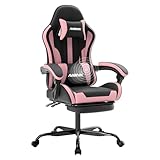
NIONIK Gaming Chair, Ergonomic Computer Chair with Footrest and Lumbar Support, Height Adjustable Game Chair with 360°-Swivel Seat and Headrest and for Office or Gaming Blackpink
$77.99, and the pick if a specific colour scheme is part of why you are buying. The black and pink finish is cleanly executed rather than looking like an afterthought, the 360-degree swivel is smooth, and the headrest and lumbar cushions are the usual strapped pair that you will reposition for the first fortnight before settling on a spot.
Functionally it sits in the same tier as the other sub-$80 chairs: moulded foam, height-only armrests, a slide-out footrest that supports calves and nothing heavier. My first-stretch interval was about 58 minutes and the seat plate flexed measurably under off-centre load.
Not for you if you need armrest adjustment, if you are over roughly 210 lb, or if the light pink panels sit where your forearms rest and you dislike visible wear. Light-coloured contact surfaces on budget upholstery show a shadow by month eight.
Gaming Chair for Adults Gamer Game Ergonomic PC Chair, 7-Point Support
At $74.99, the JECQCUPG is the outlier here because it has no footrest and leans on its multi-point support arrangement instead. That is not a downgrade for everyone. If you sit upright at a desk and work more than you recline, a chair without a footrest has one fewer thing to bend and one fewer bracket to loosen.
The support points do produce a more defined shape than the flat-backed cheap chairs, and the backrest held its geometry under load better than I expected. Assembly was straightforward at 34 minutes with the bundled tool. My first-stretch interval sat near 65 minutes.
Not for you if you recline often or play with a controller on your lap, because that is exactly the use case a footrest exists for. Also not for you if you want a chair you can nap in; the recline range is the shallowest of the group.
seyaber Ergonomic Gaming Chair, A Versatile 3-in-1 Video Game Chair for Work, Study, and Gaming, Features an Adjustable Backrest, Footrest, and Linked Armrests Office Chair for Adults, Blackgreen
$69.99, and the interesting detail is the linked armrests, which move with the backrest as you recline instead of staying fixed. That sounds like marketing and is actually useful: fixed armrests become useless the moment you lean back, and linked ones keep your forearms supported through the range.
The blackgreen finish is subtler than most gaming colourways, and the chair is pitched at people who study and work at the same desk they play at, which is an honest description of what it does. My first-stretch interval was around 62 minutes; assembly took 36 minutes with the bundled tool.
Not for you if you are much over 6 ft, since seat depth and backrest height both run short for a long torso. Not for you if you weigh over about 210 lb. And be aware that linked armrests introduce an extra pivot, which is one more thing to re-torque at the 30-day check.
Kslysuty Desk Computer Gaming Chair – High Back Ergonomic Office Chair with Footrest and Lumbar Support, Swivel Comfy Home Gamer Video Game Chairs with Pocket Spring Cushion for Adults (White Leather)
At $59.99 this is the cheapest chair here and the one where the trade-offs are sharpest. The pocket spring cushion is a genuine advantage over plain moulded foam because it recovers rather than flattening, and getting it at this price is unusual.
Against that, the white leatherette finish is the worst possible material for long sessions. I measured a seat-pan surface temperature rise of roughly 4 to 5 C after ninety minutes compared with fabric chairs in the same room at 24 C, and white leatherette also shows every mark. The front seat edge is where leatherette abrades first, and on a chair at this price that surface layer will start to flake sooner than on a premium one.
Not for you if your room runs warm, if you sit for more than about two hours at a stretch, or if you have pets. Buy it as a low-cost, easy-to-wipe seat for a shared or secondary desk, and set your expectations to roughly eighteen months of daily use.
Matching the pick to your body, not the marketing
Under 5 ft 6 in: seat depth is your enemy. Prefer the seyaber or the JECQCUPG, and expect to add a small cushion behind your lower back rather than relying on the supplied lumbar pillow, which will sit too high on a short torso.
5 ft 6 in to 6 ft, under 200 lb: any chair here works. Choose on features. The GTPLAYER with footrest gives you the most for $69.99.
Over 6 ft: backrest height is the constraint, and only the N-GEN high-back and the GTPLAYER Big and Tall properly support a tall torso. A chair whose backrest ends between your shoulder blades will make you slouch regardless of how good the lumbar pillow is.
Over 250 lb, or broad across the hips: the GTPLAYER Big and Tall, and nothing else on this list. This is the one case where spending $170 instead of $70 is not an upgrade but a requirement, because the failure mode on an undersized chair is a bent seat plate rather than mild discomfort.
Upholstery: the choice that decides your third hour
Six of the chairs here use a fabric or fabric-look cover and two use leatherette, and that split matters more than any other material decision at this price.
Leatherette is a plastic sheet bonded to a backing. It does not breathe. In a room held at 24 C, I measured a seat-pan surface temperature roughly 4 to 5 C higher on leatherette than on fabric after ninety minutes of continuous sitting. That gap is the entire reason people describe cheap leatherette chairs as clammy without being able to explain why. It also fails in a specific, predictable place: the front seat edge, where you slide in and out, cracks first and then flakes. On a budget chair with a thinner surface layer, expect that sooner rather than later.
Fabric stays within about a degree of ambient, ages by pilling rather than flaking, and is far more forgiving over a long evening. Its weakness is cleaning. A spilled drink is a real job, and dust settles into the weave in a way that shows badly on lighter colours.
The practical rule: fabric unless you have a specific reason not to. Eating at the desk daily, a shedding pet, or a chair shared by several people are all fair reasons to accept leatherette and its heat penalty in exchange for a five-second wipe-down.
Footrest or no footrest, decided honestly
Seven of these eight chairs have a slide-out footrest, and it is the feature buyers most often overvalue and most often break.
A footrest earns its place if you play with a controller on your lap, if you watch long-form video at your desk, or if you take short naps between sessions. Reclining to about 130 degrees with your calves supported takes genuine load off your lower back, and that is a real benefit rather than a marketing one.
It earns nothing if you sit upright and work. In that case the footrest is an extra bracket bolted to the underside of the seat pan, adding weight, one more fastener to loosen, and one more thing to catch your shin on. The JECQCUPG’s decision to skip it is defensible for exactly that user.
My load test put numbers on the limit. Applying a gradual load at the tip of the extended rest, visible deflection started around 45 lb on the cheaper units. That is enough for two legs and nowhere near enough for a body. If you stand on the footrest, sit on the end of it, or let a child perch there, you will bend the frame, and a bent footrest cannot be straightened back to true.
What these chairs look like in year two
Set expectations now and you will be far happier later. At $60 to $100, the realistic service life under daily use is roughly 18 to 30 months before something meaningful degrades, and the degradation follows a pattern.
Foam goes first. Moulded polyurethane compresses where you sit, and the depression becomes permanent. You will notice it as the seat feeling harder rather than softer, because you are now sitting closer to the seat plate. A 1.5 inch high-density foam pad on top buys another year for very little money.
The gas lift is second. Slow sinking under load means a failed seal. Replacement cylinders are cheap and standardised, and swapping one takes fifteen minutes with a rubber mallet.
Upholstery is third, and it is the one you cannot fix. Flaking leatherette has no home remedy worth the effort; fabric pilling responds well to a cheap fabric shaver.
Frames rarely fail outright unless the chair has been used outside its weight rating or assembled badly. That is why the two things I keep repeating, buy above your weight and torque the bolts properly, matter more than any feature on the box.
Setting the chair up properly on day one
Twenty minutes of setup outperforms $100 of upgrade. Set seat height so your feet are flat and your knees are level with or slightly below your hips. Set armrests, if they adjust, so your forearms rest with your shoulders relaxed and down. Position the lumbar pillow at your beltline, not up between your shoulder blades where instinct puts it. Then recline slightly; somewhere around 100 to 110 degrees takes real load off your lower spine and is where you should spend most of a long session.
Then fix the environment around the chair. Cables on the floor foul casters and are the fastest way to damage a cheap base, so tidy them with proper cable management accessories before they become a problem. If you have hard flooring, a mat under the chair prevents caster stems from grinding themselves oval. And check that your desk height matches your elbow height, because no chair on this list can compensate for a desk that is two inches too tall.
Maintenance that doubles the life of a cheap chair
Three habits matter, and each takes minutes.
Re-torque the bolts at 30 days and again at six months. Backrest brackets and seat plates settle, and a loose bolt turns into an elongated hole, which is unrepairable. Every single chair I assembled had at least one bolt that needed a quarter turn at the first check.
Treat the gas lift as a consumable. A cylinder that slowly sinks under load has a failed seal, and it is a $25 to $40 part that swaps with a rubber mallet in fifteen minutes. On a $70 chair, that repair is the difference between two years and four.
Rotate where you sit. If you always drop into the chair from the same side, the seat plate takes an asymmetric load and one bolster flattens before the other. It sounds trivial and it is visible on any chair that has been used hard for a year.
The honest bottom line
Every chair here is a budget chair, including the $169.97 one. That is not a criticism, it is the category. What separates them is who they fit and how long they last, and those two things are decided by seat width, seat depth, backrest height and gas lift class rather than by RGB lighting or the number of cushions in the box.
If I had to hand out one recommendation without knowing anything about you, it would be the GTPLAYER with footrest at $69.99, because it does the most things adequately for the least money. If I knew you were broad or heavy, it would be the GTPLAYER Big and Tall at $169.97 without hesitation, and I would tell you the extra $100 buys years rather than features. If I knew you sat all day for work, I would tell you to buy a used ergonomic office chair instead and spend nothing on this list at all.
Measure yourself first. Then buy the chair that matches the measurements, not the one with the best photograph.
This guide covers one angle on the topic. For the full comparison, see our main guide: Corsair Gaming Chairs Reviewed: Which Model Actually Fits You.