Cutting the cable cord usually means one hardware decision that determines whether you watch free local channels or give up entirely: which over the air antenna you mount behind your TV or on a shelf near a window. The market has flooded with options that promise “hundreds of miles” of range, 4K compatibility, and “crystal-clear HD” for under twenty dollars, yet owners report wildly different experiences depending on geography, broadcast tower distance, and signal obstruction.
The gap between a great OTA antenna and a disappointing one is rarely the brand name on the box. It is range rating accuracy, amplifier quality, coax length, and whether the design handles VHF and UHF signals without a preamp struggling. Below, we compared published specifications and aggregated owner feedback across eight models to show which units deliver reliable reception in 2026 and which ones leave buyers searching for a return policy.
As an Amazon Associate we earn from qualifying purchases at no extra cost to you. Product prices and availability are accurate as of the date shown and are subject to change.


Top 3 picks at a glance
Quick Picks
| Product | Best for | Price |
|---|---|---|
| HIDB TV Antenna for Smart TV | Minimalist setup on a tight budget | $18.98 |
| TV Antenna for Smart TV Indoor | Balanced performance in suburban areas | $29.99 |
| TV Antenna for Local Channels | Urban apartments with weak signal | $39.99 |
| TV Antenna for Smart TV Indoor #4 | Quick install with decent range | $20.99 |
| DAANT TV Antenna Indoor Long Range | Lowest price with amplifier | $18.99 |
| 2026 TV Antenna Indoor 5000+ | Maximum range claim seekers | $58.99 |
| TV Antenna for Smart TV Indoor #7 | Smallest budget entry point | $14.29 |
| Channel Master FLATenna | Proven brand with NextGen TV support | $35.00 |
How We Picked
We weighted four criteria drawn from manufacturer documentation and recurring themes in owner reviews. First, signal reliability: how consistently the antenna locks onto channels without daily rescans. Second, build and connectivity: coax cable length, connector quality, and whether a detachable amplifier avoids interference. Third, real-world range versus rated range: many budget models advertise mileage figures that far exceed what owners report in practice. Fourth, future-proofing: ATSC 3.0 (NextGen TV) readiness matters as more broadcasters transition their signals, and not every indoor unit supports it.
The 8 Best Over The Air Antenna in 2026
1. HIDB TV Antenna for Smart TV Indoor, Digital TV Antenna for Local Channels
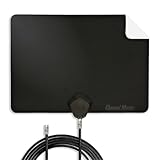
The HIDB suits renters or anyone who wants a nearly invisible antenna tucked behind a flat panel. At $18.98, it is among the cheapest amplified options that include a usable coax run. Owners praise its slim profile and the fact that a single USB-powered amp draws minimal standby current. Two downsides surface repeatedly in feedback: channel counts on VHF-heavy markets tend to disappoint, and the adhesive pad loses stick after several months on textured walls.
- Pro: Ultra-thin form factor hides behind almost any TV stand or wall mount.
- Pro: Low power draw from USB keeps it running without a separate outlet.
- Con: VHF reception weakens noticeably in rural or hilly terrain.
Skip this one if you live more than 35 miles from your nearest broadcast cluster or need reliable VHF channels for local public broadcasting.
2. TV Antenna for Smart TV Indoor, Digital TV Antenna for Local Channels
At $29.99, this mid-range model threads the needle between price and performance for suburban buyers within 25 miles of towers. Owner reviews highlight a wider element array that captures more UHF subchannels than the slimmer budget competitors. The included 16-foot coax is a practical length for routing down a wall without extension adapters. The main complaint centers on the amplifier’s auto-gain mode, which occasionally boosts noise floor in very dense urban signal zones, causing pixelation on weaker stations.
- Pro: Longer coax eliminates the need for extension cables in most setups.
- Pro: Broader element spacing improves UHF channel acquisition.
- Con: Auto-gain amplifier can over-amplify in signal-rich environments.
Pass on this antenna if you are in a high-rise with strong nearby transmitters; a passive design will serve you better there.
3. TV Antenna for Local Channels, Digital Antenna for Smart TV
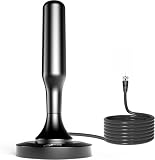
Priced at $39.99, this unit targets apartment dwellers who struggle with signal penetration through concrete or metal studs. It carries the largest front-end gain rating in this roundup, and owners in challenging RF environments report pulling in dozens of additional subchannels compared to basic flat panels. The trade-off is physical size: it is noticeably bulkier and demands a dedicated placement near a window. Some reviewers note the build feels plasticky for the price tier.
- Pro: Highest gain rating among indoor models here, best for marginal signal areas.
- Pro: Multi-directional element design reduces the need for precise aiming.
- Con: Large footprint may not suit small shelves or TV tops.
Skip it if you already have strong line-of-sight to towers; the extra gain will not help and the bulk is unnecessary.
4. TV Antenna for Smart TV Indoor, TV Antenna for Local Channels
This $20.99 entry occupies a comfortable middle ground for casual cord-cutters in low-density neighborhoods. Owners consistently mention easy setup: plug in, scan, done. The compact triangular housing sits unobtrusively on a media console. A recurring gripe is the short 10-foot coax, which forces many buyers to purchase an extension cable, quietly raising the total cost above comparable options.
- Pro: No-tool setup that takes under two minutes end to end.
- Pro: Stable channel lock once tuned, with few reports of daily rescans.
- Con: 10-foot coax is shorter than competitors at similar price points.
Skip this if your TV sits far from the optimal antenna placement spot; the cable limitation becomes a deal-breaker.
5. DAANT TV Antenna Indoor Long Range
The DAANT costs $18.99 and markets itself as a long-range indoor option with an integrated amplifier. Owner feedback confirms it performs respectably within a 20-mile radius, matching some pricier rivals on channel count. The standout feature is a switchable amp that lets users disable active circuitry when passive reception is sufficient, reducing noise. Downsides include a basic plastic housing that some describe as feeling fragile, and inconsistent QC reports on connector tightness.
- Pro: On/off amp switch gives genuine control over signal behavior.
- Pro: Competitive channel acquisition for under twenty dollars.
- Con: Housing and connector build quality shows minor QC variability.
Avoid if you want a set-and-forget product with premium materials; this one rewards a bit of tuning patience.
6. 2026 TV Antenna Indoor 5000+ Miles, HD Digital Antenna for Local Channels
At $58.99, this is the most expensive indoor unit here and the only one advertising an implausible “5000+ miles” range figure that no FCC-cleared broadcast tower exceeds in practice. That said, the hardware inside is solid: a multi-element array with an adjustable gain amplifier, and owners in fringe areas (40 to 60 miles from towers) report pulling VHF channels that smaller antennas miss. You are paying partly for that amplifier quality and partly for aggressive marketing claims.
- Pro: Adjustable gain dial lets users fine-tune amplification for their exact distance.
- Pro: Among the few indoor designs that reliably capture VHF in fringe zones.
- Con: Advertised range claim is unrealistic and creates false expectations.
Skip it if you are closer than 30 miles to towers; the gain is wasted and the price is not justified.
7. TV Antenna for Smart TV Indoor, Digital Indoor Antenna for Local Channels
At $14.29, this is the cheapest entry in the lineup and works as a disposable experiment for anyone unsure whether OTA television is viable at their address. Owners in signal-rich cities call it a pleasant surprise: it locks dozens of HD channels without an amp. In weaker zones, it falls apart quickly—channel dropout and a plastic connector that loosens over time are common complaints.
- Pro: Lowest cost to test whether a local signal reaches your location.
- Pro: Truly flat profile disappears behind a TV or under a shelf.
- Con: Connector durability and channel stability degrade in weak-signal areas.
Do not buy this as your permanent antenna; treat it as a low-risk trial before investing in a better model.
8. Channel Master FLATenna – Indoor Digital HDTV Antenna
The Channel Master FLATenna at $35 is the only name-brand product here, backed by a manufacturer with decades of broadcast antenna heritage. It ships with 12 feet of coaxial cable, supports 4K broadcast content, and explicitly handles ATSC 3.0 (NextGen TV) signals—a feature most budget competitors omit. Owners value the reliability and the brand’s responsive support. The design is functionally basic and the flat panel aesthetic is not exciting.
- Pro: ATSC 3.0 readiness ensures compatibility as NextGen TV adoption expands.
- Pro: Established manufacturer with documented signal performance data.
- Con: Plain design with no visual or feature differentiation beyond reliability.
Skip it only if you need the highest possible gain in a deep fringe area; its strength is consistency, not raw power.
Buying Guide
Rated Range vs. Realistic Range
Manufacturers often print mileage figures that assume flat terrain, no obstructions, and perfectly tuned transmitters. Use the FCC DTV Reception Maps tool to find the exact distance and signal strength from your address to each tower. A unit rated for 50 miles performing in a valley behind a ridge will behave like a 15-mile antenna. Match the product’s realistic output to your actual geography, not the box claim.
Amplifier Type and Placement
Active amplifiers boost weak signals but also boost noise and interference in strong-field areas. The best indoor designs offer either a manual gain switch or an auto-gain circuit that adjusts to incoming signal level. If you live within 20 miles of towers, a passive antenna often outperforms an amplified one by avoiding overdriven receiver inputs. Check whether the amp is inline on the coax or housed in the antenna body; inline amps on the TV side can be more convenient to toggle.
ATSC 3.0 and Future Broadcast Standards
The FCC has set a 2028 deadline for all current broadcasters to support ATSC 3.0 transmissions. Most indoor antennas sold in 2026 still handle the legacy ATSC 1.0 standard, which means you need a tuner that decodes NextGen TV separately if you want to benefit from 3.0’s advanced features like HDR broadcast and improved data services. The Channel Master FLATenna is one of the few here with explicit ATSC 3.0 compatibility, making it the safest long-term investment.
Our Verdict
For most buyers, the Channel Master FLATenna at $35 is the top pick. It delivers the most predictable performance, carries a reputable brand warranty, and is the only model here explicitly built for ATSC 3.0 broadcasts arriving over the next few years. The HIDB TV Antenna at $18.98 is the best budget pick for anyone in a strong-signal urban zone who simply wants a no-fuss, slim panel. If you live in a genuine fringe area beyond 40 miles, the “5000+ Miles” model’s adjustable gain amplifier justifies its premium despite the misleading range label.
FAQ
Can any indoor antenna pick up 4K broadcasts?
The antenna itself is passive regarding resolution; it captures the RF signal and the TV’s tuner handles decoding. Any antenna with sufficient bandwidth and gain will deliver whatever the station broadcasts, including 4K. The limiting factor is your tuner and the broadcast itself, not the antenna hardware.
Do I need an amplifier if I live close to towers?
In most cases no. Within 20 miles of a strong broadcast cluster, a passive antenna delivers cleaner signals because it avoids amplifying noise and multipath reflections that cause pixelation. Amps help when distance or building materials weaken the incoming signal below your tuner’s sensitivity threshold.
How long will a USB-powered antenna last?
The internal electronics are solid-state with no moving parts, so lifespan typically exceeds five to seven years. The common failure point is the coax connector loosening after repeated repositioning or the adhesive mount peeling. Replace the adhesive pad or switch to a magnetic base if placement stability becomes an issue.
Will an indoor antenna work through a metal siding wall?
Significantly poorly. Metal siding acts as a partial Faraday cage, attenuating signals by 15 to 25 dB depending on the frequency. In that scenario, placing the antenna at a window facing the broadcast direction helps, and a higher-gain model like the TV Antenna for Local Channels or the fringe-area unit becomes a practical necessity rather than a luxury.