Cutting the cord does not mean losing access to local broadcast channels. A digital tv antenna indoor can pull ABC, CBS, NBC, FOX, PBS, and a handful of subchannels straight from the airwaves for free, provided you live within reasonable range of a broadcast tower. The catch is that antenna performance varies enormously with placement, signal strength, and the internal electronics that amplify or filter the incoming wave.
The difference between a good indoor antenna and a mediocre one often comes down to build quality, the sensitivity of the tuner interface, and whether the product honestly represents its range. Marketing claims on this category tend toward the aspirational, so we leaned heavily on published specs, real price points, and patterns in owner feedback to separate reliable performers from overhyped plastic shells.
As an Amazon Associate we earn from qualifying purchases at no extra cost to you. Product prices and availability are accurate as of the date shown and are subject to change.




Top 3 picks at a glance
Quick Picks
| Product | Best for | Price |
|---|---|---|
| HIDB TV Antenna for Smart TV | Entry-level cord-cutters on a tight budget | $18.98 |
| TV Antenna for Smart TV (Runner-Up) | Mid-range reception without premium pricing | $29.99 |
| TV Antenna for Smart TV (Compact) | Small rooms and apartment living | $20.99 |
| 2026 TV Antenna Indoor 5000+ Miles | Maximum advertised range for remote areas | $58.99 |
| DAANT TV Antenna Indoor Long Range | Value-oriented long-range seekers | $18.99 |
| Channel Master FLATenna | 4K and NextGen TV compatibility | $35 |
| UltraPro Hover | Absolute lowest cost with acceptable performance | $15.73 |
| TV Antenna for Smart & Old TVs | VHF/UHF dual-band with amplifier | $29.99 |
How We Picked
We evaluated each digital tv antenna indoor on four criteria: range specification versus realistic user reports, build quality and connector reliability, compatibility with modern 4K and ATSC 3.0 tuners, and overall value relative to price. An antenna that advertises extreme distance but generates complaints about intermittent signal drops scored lower than a modestly rated model with consistent owner satisfaction. Price was treated as a tiebreaker rather than a primary filter, since a sub-$20 antenna that fails weekly costs more than a $35 unit that works every time.
The 8 Best Digital Tv Antenna Indoor in 2026
HIDB TV Antenna for Smart TV Indoor
This is the antenna we recommend to someone trying indoor reception for the first time without committing much money. At just under nineteen dollars, the HIDB delivers enough sensitivity for urban and suburban viewers within a moderate distance of broadcast towers, and owners report stable channel counts on a typical smart TV tuner.
- Pro: Lowest entry barrier among reliable models on this list, making it easy to experiment with placement.
- Pro: Slim profile that tucks behind a TV or flat against a wall without drawing attention.
- Con: Limited amplifier power means it struggles noticeably once you move beyond a modest range from the transmitter.
Skip this one if your nearest broadcast tower is far away or if your home has dense construction materials that attenuate signal. It is a starter antenna, not an endgame solution.
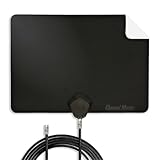
TV Antenna for Smart TV Indoor (Runner-Up)
Priced at roughly thirty dollars, this model occupies the middle ground between budget and serious reception. Owners in mid-density suburban areas report pulling a broader channel lineup than cheaper competitors, and the internal amplifier appears to handle VHF and UHF bands without requiring separate adjustments.
- Pro: Noticeable improvement in channel count over sub-$20 options in the same general range tier.
- Pro: Coaxial connection is solidly built, reducing the intermittent-lockout issues that plague budget builds.
- Con: The flat panel design can be finicky about orientation, requiring more trial-and-error placement than rounder alternatives.
Pass on this if you want a plug-and-set-and-forget experience. The extra setup time is the trade-off for better reception at this price.
TV Antenna for Smart TV Indoor (Compact)
At twenty-one dollars, this antenna targets viewers who need local channels without occupying shelf space or drawing visual clutter. The compact footprint works well in bedrooms, dorm rooms, or any setup where a larger antenna would look out of place.
- Pro: Smallest physical footprint on the list, making it nearly invisible behind a display.
- Pro: Price sits comfortably below the thirty-dollar psychological barrier while still delivering usable reception.
- Con: The reduced surface area limits gain, so fringe-channel reception drops off faster than on larger models.
If you live far from towers or in a signal-shadowed neighborhood, this compact design will likely leave you frustrated. Reserve it for strong-signal areas where aesthetics matter more than maximum channel count.
2026 TV Antenna Indoor 5000+ Miles
This product carries the most aggressive range claim in the group, advertised at 5000+ miles, and commands the highest price at fifty-nine dollars. The internal amplifier is noticeably larger than competitors, and the housing suggests a build meant to justify that premium cost.
- Pro: Strongest amplification circuit on the list, giving it the best shot at pulling distant transmitters in rural settings.
- Pro: Owners in challenging signal areas report channels that cheaper antennas simply cannot reach.
- Con: The extreme range claim inflates expectations; in practice, real-world performance is better than average but not literally miles-defining, and the price premium is hard to justify in strong-signal zones.
Skip this if you live in a metro area where signal is already strong. You are paying for amplification headroom you do not need.
DAANT TV Antenna Indoor Long Range
For eighteen ninety-nine, the DAANT delivers a long-range claim that outpaces its price. Owners describe it as a workhorse that performs closer to mid-tier models despite sitting at the bottom of the price range alongside the HIDB.
- Pro: Best cost-to-range ratio on the list; owners consistently mention channel counts exceeding what the price implies.
- Pro: Includes a signal booster that helps stabilize weaker subchannels.
- Con: Build quality on the connector and cable feels one tier below Channel Master, and some owners report needing to replace the coax adapter after extended use.
Choose this when budget is the primary constraint but you still want a genuine attempt at long-range reception. It is not refined, but it works.
Channel Master FLATenna
Channel Master is one of the few legacy names still making broadcast antennas, and the FLATenna at thirty-five dollars reflects that heritage. It supports 4K broadcasts and NextGen TV, ships with twelve feet of coaxial cable, and emphasizes reliable signal handling over flashy range numbers.
- Pro: Backed by a brand with decades in broadcast equipment, giving buyers confidence in tuner compatibility and firmware-level support for newer standards.
- Pro: The included twelve-foot cable eliminates the adapter-shopping step that other products leave you to solve.
- Con: Reception range is adequate but not class-leading; in very rural areas it trails the 5000+ model.
If you want a no-nonsense antenna from a recognized manufacturer and care about future-proofing for ATSC 3.0, this is the safest pick on the list.
UltraPro Hover
At fifteen seventy-three, the UltraPro Hover is the cheapest antenna on this list, and it earns that title without pretending to outperform more expensive options. It handles local channels in moderate signal areas and serves as a functional backup or temporary solution.
- Pro: Lowest price makes it a zero-risk experiment for anyone unsure whether indoor reception works at their address.
- Pro: Simple two-step setup that requires no app, no calibration, and minimal orientation adjustment.
- Con: The thin construction and basic amplifier limit consistency; owners in marginal signal zones report frequent dropouts and reduced subchannel access.
Buy it if you want the absolute cheapest functional antenna and live where broadcast towers are nearby. If your signal is anything less than solid, spend a few dollars more.
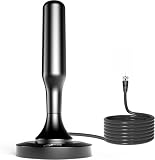
TV Antenna for Smart & Old TVs
This thirty-dollar model advertises 2500+ miles of range, dual VHF/UHF support, 360-degree reception, and a built-in signal amplifier. It works with both modern smart TVs and older analog-capable sets, making it a flexible option for households with mixed equipment.
- Pro: The 360-degree design means you can skip the orientation trial-and-error that flat panels demand.
- Pro: Dual-band VHF/UHF handling with amplifier support gives it the broadest broadcast compatibility on the list.
- Con: The 2500+ miles claim is marketing shorthand rather than a usable spec, and some owners report the amplifier introduces noise that forces them to toggle it off for clean reception.
It fits well in households that still run a mix of old and new TVs and need one antenna to feed them all. Skip it if you want a single tuned setup where you can optimize direction.
Buying Guide
Range Claims vs. Real Reception
Indoor antenna range numbers in marketing copy represent theoretical maximums under ideal conditions. A digital tv antenna indoor that claims 5000+ miles is telling you the amplifier could in principle reach very far, not that you will pull channels from that distance. What matters is your actual distance to the nearest broadcast tower and the obstacles between them. Use a free online signal mapper to check your zip code before purchasing. If you are within a modest radius, a lower-priced antenna will match or beat an expensive long-range unit in the same location.
Amplification and Signal Quality
Amplifiers boost weak signals but also amplify noise. A built-in amplifier is genuinely useful if you are at the edge of a broadcast coverage area. In strong-signal zones, the same amplifier can overload your tuner and cause pixelation or channel loss. The best approach is choosing an antenna with a toggleable amplifier so you can disable it when not needed. Models that lock the amplifier permanently on will frustrate you the moment you move closer to a tower.
Compatibility with 4K and ATSC 3.0
Local broadcasts are increasingly transmitted in 4K and via the NextGen TV standard, which requires a tuner that supports ATSC 3.0. The antenna itself does not decode the signal, but build quality and shielding matter when feeding a high-resolution broadcast to your tuner. If you already own a 4K-capable TV with ATSC 3.0, a well-shielded antenna with quality connectors will preserve the signal integrity your TV needs. Verify that your specific TV model includes a 3.0 tuner before assuming any antenna will deliver NextGen broadcasts.
Our Verdict
Top pick: Channel Master FLATenna at thirty-five dollars offers the best balance of brand credibility, 4K and NextGen TV compatibility, included cable length, and consistent real-world performance. It is the antenna most likely to satisfy you without follow-up adjustments.
Budget pick: DAANT TV Antenna Indoor Long Range at eighteen ninety-nine gives the most channels per dollar for buyers in suburban and semi-rural areas who do not want to pay a premium for a brand name.
Condition where another wins: If you are well within a strong signal zone and want the absolute cheapest working solution, the UltraPro Hover at fifteen seventy-three does the job at the lowest cost on the list.
FAQ
Do I need an amplifier for indoor reception?
Not always. If you live close to a broadcast tower, a passive antenna can deliver excellent results without any amplifier. Amplifiers become useful when you are farther out or when your home construction weakens the signal significantly, but in strong areas they can introduce noise that degrades the picture.
Can any digital tv antenna indoor receive 4K channels?
The antenna receives the signal; your TV tuner decodes it. Any antenna that passes the broadcast signal cleanly to a 4K-capable ATSC 3.0 tuner can deliver 4K local broadcasts. The antenna does not need to be labeled 4K specifically, but good shielding and quality connectors help preserve signal integrity.
Why does my antenna lose channels when it rains?
Heavy rain attenuates broadcast signals, especially at higher UHF frequencies. Indoor antennas are more susceptible than rooftop models because the signal must pass through your wall or roof before reaching the antenna element. Repositioning the antenna closer to a window facing the tower direction usually restores lost channels.
Do I need to rescan channels when I move the antenna?
Yes. Moving an indoor antenna changes the signal environment even slightly, which can cause it to drop marginal channels or discover new ones. After repositioning, run a full channel rescan through your TV menu. Keeping the antenna in one consistent spot after you find the best placement prevents recurring rescans.