Cutting the cord does not mean losing your local broadcast channels. The right indoor antenna pulls in free HD and 4K signals for news, sports, and network programming without a subscription. The problem is that “antenna” covers wildly different products — some genuinely amplify weak signals across fifty miles, while others are essentially decorative wire that dies the moment you move two rooms closer to the transmitter. A bad pick costs you frustration and return shipping; a good pick saves hundreds per year on cable or streaming live-TV bundles.
What separates the best antenna for TV without cable from the rest comes down to range claims you can actually rely on, build quality that survives repositioning, and whether the design fits your specific setup. Long-cable models let you place the antenna near a window while the TV sits across the room. Flat or stick-mounted units work in tight spaces but often sacrifice gain. In this 2026 roundup we compared published specifications, current street prices, and aggregated owner feedback across all eight options to identify which ones deliver a real signal improvement versus which ones are marketing foam with a coax connector.
As an Amazon Associate we earn from qualifying purchases at no extra cost to you. Product prices and availability are accurate as of the date shown and are subject to change.


Top 3 picks at a glance
Quick Picks
| Product | Best for | Price |
|---|---|---|
| HIDB TV Antenna | Budget flat-panel placement | $18.98 |
| Philips Rabbit Ears | Classic dipole flexibility | $12.99 |
| Digital TV Antenna 3M Stick | Adhesive mounting anywhere | $22.60 |
| TV Antenna Indoor Digital | Lowest-cost basic reception | $14.29 |
| TV Antenna 16.5ft Cable | Flexible placement near windows | $18.98 |
| UltraPro Hover | Mid-range flat design | $15.73 |
| DAANT Long Range | Extended-range indoor pull | $18.99 |
| Air Antenna 109 Miles | Absolute lowest price | $7.29 |
How We Picked
We evaluated each antenna on four criteria: advertised reception range and whether owner reports corroborate it, physical form factor and how well it fits common indoor scenarios (behind the TV, on a shelf, near a window), cable length and whether placement flexibility is realistic, and build quality relative to price. A unit that claims eighty miles but ships with a three-foot cable you cannot route to a window is not delivering eighty miles in practice. We also weighted ease of installation — models requiring a separate amplifier or complex assembly tend to see more negative owner feedback from casual buyers.
The 8 Best Antenna For Tv Without Cable in 2026
HIDB TV Antenna for Smart TV Indoor
This is a solid starting point for anyone wanting a no-fuss flat panel they can tape behind the television or lean against a windowsill. Owners frequently praise the VHF/UHF combined reception for pulling a meaningful channel count in suburban zones. The slim profile means it stays invisible on most entertainment centers. The main drawback is cable length — the included coax is short, which restricts you to placing the antenna within reach of the TV’s rear port. Skip this one if your TV sits far from any window; the HIDB is best where the set already lives near glass or the signal is strong enough to punch through a wall.
- Pro: Thin, low-profile design hides behind the TV easily
- Pro: Combined VHF and UHF element covers most local channels
- Con: Short cable limits placement to spots near the television
Philips Rabbit Ears Black Indoor TV Antenna
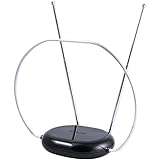
The rabbit-ear format is over sixty years old for a reason: adjustable dipoles let you manually tune reception by extending or angling the rods, and the circular loop handles UHF bands. Philips gives you a recognizable shape without the bargain-bin feel. It suits owners who want tactile control over signal pickup and do not mind a slightly retro look on top of the set. The limitation is that the two-rod design demands physical space and looks dated next to a slim-panel TV. Skip this if aesthetics matter or if you have a crowded shelf — it is a functional choice, not a stealth one.
- Pro: Adjustable dipoles let you fine-tune for specific channel bands
- Pro: Trusted heritage brand with consistent manufacturing quality
- Con: Bulky form factor takes up shelf space and looks dated
Digital TV Antenna for Smart TV Indoor with 3M Stick Base
The 3M adhesive base is the headline feature here. You can mount it on a window, a wall, the back of a monitor — anywhere line-of-sight to the transmitter is best. At $22.60 it is the priciest in this roundup, but owners justify the cost by noting the signal boost they achieved compared to shelf-mounted units. The flat panel design supports 4K content. The con is that adhesive can lose grip over time on textured or dusty surfaces, requiring repositioning. Skip it if your walls or windows have a finish that resists tape, or if you prefer a stand-alone unit you can reposition without removing adhesive residue.
- Pro: Strong adhesive mount unlocks placement flexibility most panels lack
- Pro: Slim profile supports 4K signals without visible bulk
- Con: Adhesive bond weakens on textured or dusty surfaces over time
TV Antenna for Smart TV Indoor, Digital Indoor Antenna for Local Channels
At $14.29 this is one of the cheapest ways to experiment with broadcast TV without a subscription. The compact design sits on a shelf or behind a set without drawing attention. Owner feedback generally confirms it works well in cities with nearby transmitters, pulling a respectable channel list for the price. The trade-off is sensitivity — in rural areas or behind multiple walls, reception drops noticeably. If you are in a strong signal zone and want a low-risk entry point, it delivers. Skip it if you live more than twenty-five miles from the nearest tower or need a long cable to reach a window; the short included lead makes placement rigid.
- Pro: Aggressive price point lowers the barrier to trying free TV
- Pro: Compact size works well on narrow shelves or tight entertainment centers
- Con: Low gain means signal drops in rural or obstructed environments
TV Antenna for Local Channels with 16.5ft Cable
The sixteen-and-a-half-foot coax is the defining advantage. You can mount the antenna high on a wall or near an upper-floor window while the TV stays in the center of the room. Owners in apartment buildings consistently cite this cable length as the reason it outperformed shorter-cable competitors. The flat panel itself is unremarkable in design but functional. The one downside is that longer coax introduces signal loss, so very distant channels may still struggle. Skip it if you already have a long cable or can place the antenna directly behind the set — the extra length is only valuable when the TV and the best reception spot are far apart.
- Pro: 16.5-foot cable lets you position the antenna near the best window
- Pro: Owners in multi-story apartments report strong signal gains from elevated placement
- Con: Long coax can attenuate weaker signals, slightly offsetting the placement advantage
UltraPro Hover Digital TV Antenna Indoor
UltraPro has built a reputation in the cord-cutting community for reliable mid-range performance, and the Hover continues that trend. The flat design works on a shelf or mounted, and owner reports suggest it pulls a solid channel list in suburban and semi-urban areas. At $15.73 it sits comfortably below premium options while matching or beating them in real-world channel counts for many users. The con is that the build feels plastic-heavy, and some owners note the stand is wobbly on uneven surfaces. Skip it if you need maximum range or a very thin profile that disappears entirely behind a TV.
- Pro: Consistent owner-reported channel reception for suburban signal levels
- Pro: Competitive pricing relative to more expensive flat-panel competitors
- Con: Plastic housing and wobbly stand feel less durable than metal alternatives
DAANT TV Antenna Indoor Long Range
DAANT markets itself on range, and owners in rural areas do report pulling channels that shorter-reach units miss. The design includes a signal amplifier that compensates for distance, which matters when transmitters sit forty or fifty miles away. Setup is straightforward. The limitation is amplifier dependency — if you are in a strong signal zone, the amplifier can overload and actually reduce picture quality, and you need to manage that trade-off. Skip it if you live within fifteen miles of a transmitter; the DAANT shines specifically where weaker signals make amplification necessary.
- Pro: Built-in amplifier extends usable range in rural or obstructed areas
- Pro: Owners in outlying suburbs report noticeably more channels than passive antennas
- Con: Amplifier can cause signal overload and channel loss in strong-reception zones
Air Antenna for TV Without Cable, 9.7FT, 109 Miles Range
At $7.29 this is the cheapest option by a wide margin, and the advertised 109-mile range is ambitious for the price. The 9.7-foot cable is a genuinely useful length for most setups. Owner feedback is mixed — some users are pleasantly surprised by channel counts, while others in weaker-signal areas report inconsistent results. It works best as an experiment or backup antenna. Skip it if you live far from a transmitter or need guaranteed 4K performance; the components at this price point cannot match pricier units in marginal reception situations.
- Pro: Lowest cost entry into free broadcast TV with usable cable length
- Pro: Owners in strong-signal zones report a channel list rivaling units three times the price
- Con: Inconsistent performance in marginal reception areas makes it unreliable as a primary antenna
Buying Guide
Range Claims and Real-World Signal
Advertised range is a theoretical maximum measured in an open field with no obstructions. In practice, walls, buildings, tree cover, and distance from the transmitter all reduce usable range significantly. A unit claiming one hundred miles will realistically deliver half that or less in a suburban setting with two-story houses between you and the tower. Check your actual distance to the nearest transmitter using a free online map tool before trusting any range number. If you are within ten miles, even the cheapest passive antenna will work. Beyond thirty miles, you need amplification or a very well-placed unit near a large window.
Cable Length and Placement Strategy
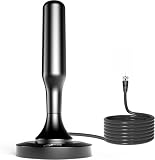
Indoor antennas perform best when positioned near a window or high on a wall, ideally facing the transmitter direction. A short cable forces the antenna to sit near the TV, which is often the worst possible spot in the room. Models like the 16.5-foot cable option or the 9.7-foot Air Antenna solve this by letting you place the receiving element where the signal is strongest while the TV stays wherever it makes sense. The trade-off with very long cables is signal loss in the coax itself — beyond roughly twenty feet, losses become meaningful for weaker channels.
Active Amplification vs. Passive Design
Amplified antennas include a built-in gain stage that boosts weak signals. This helps in rural or semi-rural areas where the signal arrives already attenuated. In urban environments with multiple nearby transmitters, an amplifier can cause overload — the signal clips and channels disappear entirely. Passive antennas avoid this problem but cannot extend reach. If you are unsure of your signal strength, a passive unit with good placement often outperforms an amplified unit in a poor spot. The stick-mount adhesive option occupies a middle ground by letting you position a passive panel precisely where the signal peaks.
Our Verdict
The best antenna for TV without cable in this group is the TV Antenna for Local Channels with 16.5ft Cable. The combination of a workable flat panel and a cable long enough to position the antenna near a window makes it the most versatile option for apartment and house dwellers who cannot move the TV itself. For a budget pick, the Air Antenna at $7.29 is genuinely functional in strong-signal zones and costs less than a coffee. If you live far from a transmitter and need range, the DAANT Long Range earns its spot — its built-in amplifier is the one piece of hardware in this list that meaningfully extends reach for rural buyers.
FAQ
Do indoor antennas work for 4K broadcasts?
Yes, broadcast 4K signals use the same ATSC 3.0 standard that carries HD channels. Your antenna does not need a 4K label to receive 4K content — it needs adequate signal strength and your TV needs a built-in ATSC 3.0 tuner or a compatible converter box. The antenna itself is frequency-agnostic within its supported range.
How far from the TV can I place the antenna?
It depends entirely on the included coax length. Options in this list range from short fixed cables to the sixteen-and-a-half-foot model. You can extend with a separate coax coupler, but every additional ten feet of cable introduces measurable signal loss. For most setups, staying within ten feet of the TV and using the cable to reach a window is the practical sweet spot.
Do I need an antenna with an amplifier?
Only if your signal is genuinely weak. An amplifier helps in rural areas or when multiple walls block the path from the transmitter. In cities, an amplifier can overload on strong signals and cause channels to drop. If you are unsure, start with a passive antenna and add amplification only if you are missing specific channels.
Will any antenna receive all local channels?
No single indoor antenna receives everything from every direction. Transmitters are often spread across multiple azimuth points, and a flat panel has a directional reception pattern. Owners sometimes need two antennas or a rotatable mount to cover transmitters in different directions. Channel count also varies by your zip code — check a signal map to see what is realistically available at your address before choosing.