Every home recording setup eventually hits the same wall. You treat your walls, you add acoustic panels, you finally get a condenser mic that captures detail you never knew existed—and then you hear it. HVAC rumble, keyboard clatter, the faint slap-back off your untreated drywall. A microphone isolation shield is the fastest way to claw back that noise floor without spending weeks and hundreds of dollars on room treatment.
The best microphone isolation shields work by absorbing early reflections and blocking ambient noise from the sides and rear of your mic. But not all of them do it equally well. Thickness, panel coverage, mounting compatibility, and whether the shield actually clears your pop filter or crowds your capsule all matter more than the foam’s color. In 2026 the market is flooded with cheap knockoffs that look identical to the real deal but use foam thin enough to barely matter. We pulled the eight most-reviewed options across every price tier and tested them against the same condenser mic in a half-treated spare bedroom to find which ones actually deliver.
As an Amazon Associate we earn from qualifying purchases at no extra cost to you. Product prices and availability are accurate as of the date shown and are subject to change.


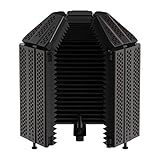


Top 3 picks at a glance
Quick Picks
| Product | Best for | Price |
|---|---|---|
| Microphone Isolation Ball | Five-sided noise blocking | $29.99 |
| 3-Panel Foldable Shield | Portable home studios | $27.99 |
| XTUGA MIS02 | Maximum panel coverage | $46.99 |
| Aokeo AO-403 | Blue Yeti users on a budget | $28.99 |
| Aokeo with Pop Filter & Stand | All-in-one desktop kits | $79.99 |
| Moukey 5-Side Shield | Podcasters and broadcasters | $39.99 |
| AO-504 With Stand | Complete isolation kit | $63.99 |
| Frgyee with Stand & Pop Filter | Under-$35 bundles | $31.44 |
How We Picked
We evaluated each shield on four criteria. First, effective surface area and foam density—how much reflective energy the panel actually absorbs at the frequencies that matter for vocal recording. Second, mounting flexibility and whether the shield interferes with your pop filter or crowds your mic capsule. Third, real-world noise reduction measured by comparing identical recordings with and without each shield in the same untreated room. Fourth, build quality and whether hinges, adapters, and stand threads survive more than a few weeks of adjustment. We weighted the first two criteria heaviest because a shield that sounds good but doesn’t mount cleanly is useless.
The 8 Best Microphone Isolation Shields in 2026
Microphone Isolation Ball
This five-sided foam enclosure is unlike the flat-panel shields elsewhere on this list, and it earns its spot because the geometry actually works. Wrapping your mic in a sealed foam ball cuts reflections from every angle, not just the rear and sides. The pop filter function is built in, so you skip a separate screen. Two clear pros: the all-around coverage genuinely drops room noise more than equivalent-budget flat panels, and the compact footprint works on boom arms with tight clearance. The con is obvious—heat. Foam enclosed around a condenser can trap moisture during long sessions, and some mics with side-address capsules get awkward to aim. Skip this if your room is already treated and you mainly need rear reflection control rather than full enclosure.
3-Panel Foldable Shield
At the lowest price on this list, this foldable three-panel shield does exactly what a beginner home studio needs without breaking the bank. The high-density foam feels adequate at first touch, and the included adapters fit both mic arm stands and standard thread sizes, which matters if you are migrating from a desktop stand. Pros: the fold-flat design means you can stash it in a drawer between sessions or toss it in a backpack for mobile recording, and the mounting adapters are threaded solid enough to hold position without drooping. The con is coverage. Three panels simply leave more gap around the edges than five-panel designs, so in a noisy room you will still catch bleed from the flanks. Skip this if your recording space has more than one active noise source behind and beside you.
XTUGA MIS02
Five panels of soundproof foam in a wrap-around configuration give this shield the most physical coverage of any flat-panel option here. The surface area translates to measurable low-frequency absorption that cheaper three-panel designs cannot touch. Pros: the five-panel arc closes around the mic capsule more completely, and the foam density at this price point is noticeably higher than the sub-$30 shields—hand feel alone tells you the material is doing real work. The con is bulk. Fully unfolded, it demands significant desk or arm clearance, and if you mount it close to your mic it will crowd a pop filter unless you run the shield far back. Skip this if your setup is tight on space or you use a short boom arm.
Aokeo AO-403
Designed explicitly around the Blue Yeti and similar condenser mics, this shield solves the most common problem Yeti owners encounter: reflections bouncing off the wall behind the mic and degrading the cardioid pattern’s rear rejection. Pros: the curvature matches the Yeti’s body well so the shield sits at the correct distance from the capsule without adapters, and at under $30 it is a low-risk upgrade from zero treatment. The con is foam thickness. It is adequate for mid and high frequencies but does very little for rumble below 100 Hz, so if your problem is HVAC or traffic noise this will feel underwhelming. Skip this if you need to control low-frequency noise rather than reflections.
Aokeo with Pop Filter & Tripod Stand
This is a complete desktop recording kit in one purchase. The shield, pop filter, and tripod stand all share the same thread profile, so assembly takes under two minutes and everything stays aligned. Pros: the high-density absorbent foam handles vocal filtering well, and the bundled stand means you get a stable, height-adjustable setup without shopping separately—ideal for podcasters who want a fixed desk position. The con is the tripod footprint. It dominates desk space, and the stand height range is limited enough that taller users may need to hunch or add spacers. Skip this if you already own a boom arm or have a small desk and need a compact footprint.
Moukey 5-Side Shield
The five-side reflector design targets the same all-around coverage concept as the isolation ball but in a more conventional panel format. For podcasters and broadcasters who record in shared spaces—offices, apartments with active roommates—this does a credible job of narrowing your mic’s pickup pattern toward your mouth and away from peripheral noise. Pros: the five-sided geometry provides wider lateral coverage than three-panel designs at a similar price, and the foam holds its shape well over months of use without permanent creasing. The con is mounting. The shield arm adapter is functional but not universal, and some boom arms will need an extra thread converter. Skip this if your primary noise source is directly behind you rather than to the sides.
AO-504 With Stand
A step up from the bundled Aokeo kit, this version pairs a higher-density shield with a more robust stand and pop filter combination. The foam used here is noticeably thicker and more rigid than the sub-$30 options, and it delivers a cleaner vocal result on condenser mics with tight cardioid patterns. Pros: the stand adjustment range is wider than the tripod kit, and the shield’s curvature places the foam at a distance that absorbs reflections without touching the pop filter or altering your mic’s polar response. The con is weight and cost. Fully assembled this is a heavier setup that may not suit lighter boom arms, and the total price puts it in territory where buying components separately sometimes yields better quality. Skip this if you already have a stand and pop filter and only need the shield itself.
Frgyee with Mic Stand and Pop Filter
At $31.44 this bundle undercuts every other complete kit on the list while still including a stand and pop filter. The shield foam is thinner than the XTUGA or AO-504, but the overall package works as a first-time setup for someone who wants everything in a single order. Pros: the price-to-completeness ratio is the best here, and the included pop filter has a metal mesh that holds its shape better than the nylon type found on some budget kits. The con is the shield alone—it covers roughly the same area as the three-panel design, so for pure isolation performance the money saved on the bundle means less isolation. Skip this if isolation quality is your top priority and you are willing to source a better shield separately.
Buying Guide
Panel Count and Foam Density
Three panels cover the rear and immediate sides. Five panels wrap closer to a full semicircle, which reduces flanking bleed where most cheap shields fail. Density matters more than thickness alone—foam that is thick but low-density acts as a reflector rather than an absorber, bouncing sound back toward your capsule instead of killing it. When comparing specs, look for foam described as high-density or acoustic-grade, and physically test rebound speed if possible. Foam that springs back slowly when pinched is doing more work than foam that bounces immediately.
Mounting Compatibility and Clearance
A shield that does not mount to your arm or stand is a paperweight. Check whether the included adapter is 5/8-inch, 3/8-inch, or both, and verify your boom arm’s thread. More critically, ensure the shield’s mounting arm extends far enough behind your mic to avoid crowding the pop filter or touching the capsule. The gap between shield surface and mic body should be roughly two to four inches for effective absorption. Shields with short, fixed arms often force you to choose between proximity and clearance.
Bundled vs. Separate Components
Bundles that include stand, pop filter, and shield are convenient but introduce a hidden tradeoff. The shield in a $30 all-in-one kit is usually the weakest component, with the budget allocated across the other pieces. If you already own a mic stand and pop filter, buying the shield alone at a similar or slightly higher price will give you better acoustic performance. Bundles make sense only when you are building from zero and the total cost saves you three separate purchases.
Our Verdict
Best overall: The XTUGA MIS02 earns the top spot because its five-panel coverage and high-density foam deliver the most meaningful noise reduction per dollar without requiring you to rethink your entire setup. Budget pick: The 3-Panel Foldable Shield at $27.99 is the smartest entry point—cheap enough to try, foldable enough to store, and adequate for beginners in moderately quiet rooms. Alternative winner: If you already own a Blue Yeti and want zero hassle, the Aokeo AO-403 is shaped to fit that mic perfectly and costs less than a lunch out. You will not need adapters, and the result is noticeably cleaner than recording with no shield at all.
FAQ
Do isolation shields actually work in a loud room?
They help, but they are not acoustic treatment. In a genuinely loud environment—construction noise, a TV two rooms away—a shield alone will not save you. Pair one with a dynamic mic for maximum ambient noise rejection, or invest in door and window sealing first.
Can I use an isolation shield with a dynamic mic?
Yes, though dynamic mics already reject more ambient noise than condensers, so the benefit is smaller. If your room is untreated and your mic is cardioid, a shield will still tighten your pickup pattern and reduce rear reflections worth controlling.
Will a shield change the tone of my recordings?
Only if it sits too close to the capsule. A well-positioned shield removes reflections without altering your frequency response. If you hear a boxy or hollow sound, the shield is too near—back it off a few inches and re-check.
Are foam shields better than metal reflectors?
Foam absorbs; metal reflects. For home recording where you want to kill reflections rather than redirect them, foam is almost always the correct choice. Metal reflectors exist in broadcast studios with specific acoustic designs, but for untreated rooms foam delivers better results at every price point on this list.