The cord-cutting problem is simple: you want ABC, NBC, CBS, FOX, PBS, and a stack of subchannels in crisp HD without paying a cable or satellite bill that grows every year. A quality HD antenna solves that problem for most viewers living within reasonable broadcast range of local towers. The complication is that the antenna market is littered with products whose marketing wildly overstates real-world performance. Some antennas pull in dozens of channels from a shelf six feet from a window; others drop signal the moment the wind shifts, even with towers only fifteen miles away.
The factors that actually separate reliable performers from underwhelming ones are amplifier design, element geometry, connector quality, and—perhaps most importantly—how honestly the manufacturer describes effective range. A $6 antenna and a $59 antenna can sometimes deliver similar results depending on where you live relative to the broadcast towers. This roundup compares eight indoor options based on published specifications, listed prices, and aggregated owner feedback to help you narrow down the right choice for your setup without falling for inflated claims.
As an Amazon Associate we earn from qualifying purchases at no extra cost to you. Product prices and availability are accurate as of the date shown and are subject to change.




Top 3 picks at a glance
Quick Picks
| Product | Best for | Price |
|---|---|---|
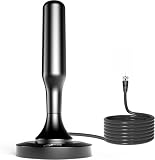
| HIDB TV Antenna | Smart TV users on a tight budget | $18.98 |
| TV Antenna for Smart TV Indoor | Balanced performance and build quality | $29.99 |
| DAANT TV Antenna Indoor Long Range | Viewers far from towers on a budget | $18.99 |
| TV Antenna for Local Channels | Simple setup with solid signal | $20.99 |
| TV Antenna with 16.5ft Cable | Flexible placement behind cabinets or high shelves | $18.98 |
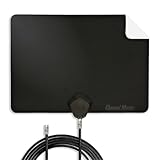
| Channel Master FLATenna | 4K and NextGen TV compatibility | $35.00 |
| TV Antennas for Smart TV Indoor | Absolute lowest entry cost | $5.99 |
| 2026 TV Antenna Indoor 5000+ Miles | Aggressive range claims for suburban/rural areas | $58.99 |
How We Picked
We evaluated each antenna against four criteria that matter most in this category: realistic signal range versus advertised range, build quality and connector reliability, cable length and placement flexibility, and overall value relative to price. We also weighed patterns in owner feedback—how consistently channels hold, whether the unit survives minor adjustments without losing reception, and whether the amplifier (if included) adds genuine benefit or just inflates the price.
The 8 Best Hd Antenna in 2026
HIDB TV Antenna for Smart TV Indoor
This model targets viewers who want a no-fuss antenna paired with a smart TV, avoiding the need for a separate converter box. Owners report solid reception within roughly thirty miles of broadcast towers, and the compact flat-panel design sits unobtrusively on a media console.
- Pros: Includes an amplifier that measurably improves marginal signals; slim profile hides well behind a TV or on a shelf.
- Cons: The amplifier requires a USB power source, which can clutter ports on some TV models.
Skip it if you already have a powered USB hub situation resolved and want something simpler without extra cabling. At $18.98 it is a reasonable first antenna for anyone under thirty miles from towers who wants a plug-and-play experience.
TV Antenna for Smart TV Indoor, Digital TV Antenna for Local Channels
Sitting at $29.99, this unit occupies the middle tier and earns its premium through a more robust coaxial connector and a wider-band design that owners report handles VHF and UHF more evenly than sub-$20 alternatives. The form factor is slightly larger, which translates to more surface area for the internal elements.
- Pros: Better connector quality reduces signal loss at the cable joint; more consistent channel lineup than cheaper models in comparable locations.
- Cons: Nearly double the price of the entry-level options without a dramatic jump in channel count for viewers already within strong signal range.
Skip it if you live within ten miles of towers—a cheaper antenna will likely pull the same channels. It earns its keep in the twenty-to-forty-mile zone where signal consistency matters more than raw channel quantity.
DAANT TV Antenna Indoor Long Range
At $18.99, this antenna explicitly markets itself toward longer-range reception. The design prioritizes gain, and owner reports suggest it holds channels beyond the typical indoor-antenna comfort zone—provided it is placed correctly near a window facing the towers. It is not magic, but it is a solid budget option when distance is your main concern.
- Pros: Noticeably better performance at extended distances compared to similarly priced alternatives; lightweight enough to mount on a wall or window frame.
- Cons: Placement is sensitive; small position changes can drop marginal channels, which frustrates users who want a set-and-forget solution.
Skip it if your broadcast towers are close and your signal is already strong. You do not need the extra gain, and a less directional design would give you more stable reception.
TV Antenna for Smart TV Indoor, TV Antenna for Local Channels
Priced at $20.99, this option threads the needle between bargain and mid-tier. Owners describe it as a dependable daily driver—fewer surprises than ultra-budget models but without the premium connector build of the $30 tier. The flat panel design and moderate cable length make it easy to integrate behind a modern flat-screen TV.
- Pros: Reliable channel retention without requiring precise placement; straightforward coaxial connection with no USB power dependency.
- Cons: No amplifier means it will struggle if you are at the outer edge of reception range or behind thick exterior walls.
Skip it if you need amplified signal or sit far from towers. For urban and close-suburban viewers within twenty miles, it delivers a clean picture and consistent channel lineup at a fair price.
TV Antenna for Local Channels, TV Antenna for Smart TV Indoor – 16.5ft Cable
The standout feature here is the included 16.5-foot coaxial cable, which gives you placement options that shorter-cable antennas simply cannot offer. At $18.98, the value proposition is clear: you are paying for flexibility. That cable length lets you position the antenna high on a wall, behind an entertainment center, or even near a ceiling to capture a better signal path.
- Pros: Extra-long cable enables creative and effective placement away from the TV; no amplifier dependency keeps the setup minimal.
- Cons: Longer cable introduces more signal attenuation, which slightly offsets the benefit of optimal antenna positioning.
Skip it if your TV sits directly in the best signal path and you do not need to run cable any distance. For anyone whose ideal antenna spot is far from their TV, this is one of the most practical choices at this price.
Channel Master FLATenna – Indoor Digital HDTV Antenna
Channel Master has built a reputation on broadcast equipment, and this $35 unit reflects that pedigree. It supports 4K over-the-air broadcasts and NextGen TV (ATSC 3.0), making it future-proof in a way that budget alternatives are not. The 12-foot coaxial cable is a practical length, and the overall build quality feels a step above the rest of this list.
- Pros: NextGen TV compatibility means it will work with ATSC 3.0 broadcasts as they expand; proven brand with consistent owner satisfaction.
- Cons: Highest price among non-premium-tier options, and its performance advantage over a $20 antenna is modest for viewers already in strong signal areas.
Skip it if you want a purely cost-driven purchase or have no interest in future-proofing for NextGen TV. If you want the most reliable option in this roundup and care about compatibility with newer broadcast standards, it justifies the premium.
TV Antennas for Smart TV Indoor, HD Digital TV Antenna for Local Channels
At $5.99, this is the absolute floor of the indoor antenna market. It is not the most refined design, but owner reports confirm it pulls channels effectively in urban environments with strong signal coverage. If you are close to towers and want to prove to yourself that over-the-air TV works before committing more money, this removes almost all risk.
- Pros: Lowest cost by a wide margin—less than a fast-food meal; adequate performance within short-range urban zones.
- Cons: Build quality is noticeably minimal; connectors and housing feel disposable, and long-term durability is a gamble.
Skip it if you live in a rural area, are more than fifteen miles from towers, or want something that will last years. For testing the concept or for a dorm-room setup, it is a sensible one-time experiment.
2026 TV Antenna Indoor 5000+ Miles, HD Digital Antenna for Local Channels
This is the most expensive option on the list at $58.99 and the one with the most aggressive range claim. Indoor antennas do not reach 5,000 miles—broadcast towers operate at fixed power levels, and no antenna can overcome the curvature of the Earth. What it can do is deliver strong amplified reception, and owners report channel counts that compete with mid-tier alternatives. The marketing is over the top; the underlying hardware is decent for suburban and rural users.
- Pros: Powerful amplifier helps hold distant channels; robust cable length and connector support flexible installation.
- Cons: Range claims are misleading, and the price premium over the $19–$35 tier is hard to justify unless you are genuinely at the edge of reception.
Skip it if you are within thirty miles of towers or already have a strong signal. The extra money buys you a marketing story more than a performance advantage over well-built cheaper options.
Buying Guide
Understanding Realistic Range
Indoor antenna range is governed by three things: your distance from the broadcast towers, the terrain and building materials between you and those towers, and whether the antenna has an active amplifier. Websites like RabbitEaze or AntennaWeb let you look up tower distances and recommended antenna types for your exact address. An unamplified indoor antenna typically performs well within twenty miles in open areas. Beyond that, an amplifier becomes necessary. Claims of 100, 200, or 5000 miles for indoor units are marketing fiction—real-world reception depends on signal strength at your location, not on an arbitrary range number printed on packaging.
Cable Length and Placement Strategy
Coaxial cable carries signal loss, measured in decibels per foot. A three-foot cable loses less signal than a fifteen-foot one, but a fifteen-foot cable lets you place the antenna near a window or high on a wall where it actually receives a strong signal. The smarter trade-off is often a longer cable paired with a well-placed antenna rather than a short cable with the antenna stuck behind a TV. If you expect to experiment with placement, choose a model with at least ten feet of cable.
Build Quality and Connector Compatibility
Look at the connector type and cable jacket quality before purchasing. Cheap antennas sometimes ship with thin, poorly shielded coaxial cable that introduces interference from nearby electronics. The F-connector should thread onto your TV or tuner smoothly without cross-threading. If you plan to swap antennas while testing, a model with a solid connector and a detachable or replaceable cable section saves frustration. NextGen TV (ATSC 3.0) support is worth considering if you want to be ready as broadcasters gradually roll out the newer standard.
Our Verdict
The Channel Master FLATenna is our top pick overall. Its combination of proven brand reliability, NextGen TV support, practical 12-foot cable, and consistent owner satisfaction makes it the safest recommendation for the widest range of buyers. For the budget-conscious, the TV Antenna for Local Channels with 16.5ft Cable at $18.98 offers the best balance of price, placement flexibility, and real-world performance. If you live in a strong-signal urban zone and simply want to cut the cord with minimal investment, the $5.99 TV Antennas for Smart TV Indoor is a perfectly adequate starting point—just temper expectations on long-term durability.
FAQ
Do indoor HD antennas work with smart TVs?
Yes, and most smart TVs from the past several years include a built-in digital tuner, meaning you connect the antenna directly via coaxial cable without a converter box. You will run the TV’s channel scan to discover available stations.
How many channels can I expect from an indoor HD antenna?
It depends almost entirely on your distance from broadcast towers and the number of stations transmitting in your market. Urban viewers near a city center often receive sixty to ninety-plus channels; suburban viewers may see thirty to fifty; rural viewers far from any tower might struggle to reach twenty regardless of antenna price.
Is an amplified antenna always better than a passive one?
No. Amplifiers help when signal is weak or marginal, but if you are close to towers with strong signal, an amplifier can actually overdrive the tuner and cause picture dropouts. Passive antennas often perform better in urban environments where signal is already strong.
What is NextGen TV and should I care?
NextGen TV (ATSC 3.0) is the new broadcast standard replacing the older ATSC 1.0 standard, offering better picture quality, improved data casting, and integration with internet-delivered content. It is rolling out gradually, so a NextGen-compatible antenna like the Channel Master FLATenna future-proofs your setup without requiring a replacement purchase in a few years.