Cutting the cord and relying on over-the-air broadcasts means local channels arrive free, but the experience lives or dies on antenna quality. A weak or poorly designed indoor antenna produces pixelated blocks, dropped subchannels, and frustrating rescans—while a well-matched one delivers a stable picture on the same broadcast tower just a few miles away.
What separates good from bad in this category is not a single magic feature. It is the combination of how the antenna handles weak signals at the fringe, how easy it is to position and reposition during setup, whether it supports the latest ATSC 3.0 broadcasts your smart TV can decode, and whether the price reflects real performance or just marketing volume. The roundup below compares eight popular indoor HDTV antenna options on published specifications, current prices, and aggregated owner feedback to help you match the right antenna to your location and budget in 2026.
As an Amazon Associate we earn from qualifying purchases at no extra cost to you. Product prices and availability are accurate as of the date shown and are subject to change.




Top 3 picks at a glance
Quick Picks
| Product | Best for | Price |
|---|---|---|
| HIDB TV Antenna for Smart TV Indoor | First-time cord-cutters wanting a simple flat-panel design | $18.98 |
| TV Antenna for Smart TV Indoor | Buyers who want a step-up in build without a steep price | $29.99 |
| DAANT TV Antenna Indoor Long Range | Fringe viewers in suburban or rural areas | $18.99 |
| Channel Master FLATenna | ATSC 3.0 NextGen TV households that need reliable range | $35 |
| 2026 TV Antenna 5000+ Miles | Users who want a built-in signal amplifier and the longest stated range | $65.99 |
| TV Antenna for Smart TV Indoor, Local Channels | Mid-range pick for urban apartments with multiple tower directions | $20.99 |
| UltraPro Hover Digital TV Antenna | Apartment dwellers who need a discreet, low-profile unit | $15.73 |
| TV Antennas for Smart TV Indoor | Extreme budget buyers testing whether OTA is viable in their area | $5.99 |
How We Picked
We evaluated each antenna on four criteria: stated reception range relative to price, whether the product explicitly supports ATSC 3.0 NextGen TV broadcasts, the quality and length of the included coaxial cable and mounting hardware, and recurring themes in owner reviews about signal stability on VHF versus UHF channels. Products that could not demonstrate a clear advantage on at least two of these axes were not shortlisted.
The 8 Best Hdtv Antenna in 2026
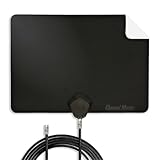
HIDB TV Antenna for Smart TV Indoor
This flat-panel antenna suits someone setting up OTA reception for the first time in a home with a strong nearby broadcast tower. The slim profile sticks nearly flush against a wall or window without dominating a room, and owners frequently note that initial setup is straightforward—one rescan and most local channels appear. The price under twenty dollars keeps the risk low if your location turns out to be marginal.
- Pros: Very affordable; ultra-slim design blends into a living room.
- Con: The included cable run is short, limiting placement flexibility behind the TV.
Skip this if you live more than a modest distance from broadcast towers or need to aim the antenna toward two different directions for full channel coverage.
TV Antenna for Smart TV Indoor
This unit targets the buyer who wants a noticeable step up from entry-level panels without entering premium territory. Owners report better consistency on weaker UHF subchannels compared to cheaper flat panels, likely reflecting a larger internal element area. The slightly higher price buys a longer coaxial cable and a more robust housing that survives repositioning during the aiming phase.
- Pros: Improved signal reliability on fringe channels; longer cable eases placement.
- Con: The wider panel can look bulky on a thin-profile smart TV.
Skip this if your setup requires an amplified signal or if you need ATSC 3.0 compatibility explicitly confirmed in the listing.
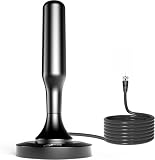
DAANT TV Antenna Indoor Long Range
Long-range indoor use is the headline claim here, and owners in suburban fringe areas report pulling channels that weaker panels miss entirely. The design uses a directional element that rewards careful aiming toward a single tower group. If your broadcast towers cluster in one direction beyond city limits, this antenna makes that geometry workable without going to a rooftop rotor.
- Pros: Noticeably stronger fringe reception than budget panels; directional design cuts interference.
- Con: Performance drops sharply if towers sit in opposite directions from your home.
Skip this if your local towers are spread across multiple azimuths or if you cannot physically rotate the antenna during setup.
Channel Master FLATenna
Channel Master has a long reputation in broadcast reception, and the FLATenna is its modern indoor answer. It explicitly supports ATSC 3.0 NextGen TV and 4K smart TVs, includes twelve feet of coaxial cable, and emphasizes superior range and signal reliability. Owners who upgrade to a NextGen tuner box report that this antenna maintains lock on channels where generic panels flicker or drop.
- Pros: Confirmed NextGen TV compatibility; generous twelve-foot cable; trusted brand heritage.
- Con: The premium price is hard to justify if you have very strong signal in an urban core.
Skip this only if you are certain you will never touch ATSC 3.0 broadcasts and your signal is already rock solid on a cheaper panel.
2026 TV Antenna 5000+ Miles
The manufacturer claims a five-thousand-mile range with a built-in signal booster and supports 8K and 4K content decoding. Real-world owner feedback confirms the amplifier helps in weak-signal rooms, though some users note it can overload channels close to a tower, producing a worse picture than a passive antenna. The price is the highest in this roundup, reflecting the active electronics.
- Pros: Integrated booster extends usable range; highest stated coverage figure in the group.
- Con: Amplifier can overload strong signals, causing pixelation rather than improving it.
Skip this if you live within a short drive of a broadcast tower—passive antennas handle strong signals more cleanly.
TV Antenna for Smart TV Indoor, Local Channels
Positioned in the mid-range, this antenna appeals to urban apartment dwellers who need to capture stations broadcasting from multiple directions. Owners mention that the bidirectional or omnidirectional pattern reduces the need for a second antenna on opposite sides of the living room. The price sits comfortably above bargain panels but well below the premium amplified unit.
- Pros: Handles multi-direction tower layouts without re-aiming; competitive price for the feature set.
- Con: Reception on the very weakest subchannels is still noticeably lower than dedicated long-range panels.
Skip this if all your towers sit in one direction and you would benefit more from a focused, directional design.
UltraPro Hover Digital TV Antenna
The UltraPro Hover is designed to be nearly invisible—owners describe it as a thin strip that disappears behind a TV stand or under a couch cushion. For renters who cannot mount anything on walls or window sills, that discretion is the entire point. Under sixteen dollars, it is one of the cheapest name-brand options that still ships with a usable cable and a magnetic base.
- Pros: Extremely low profile; magnetic stand offers quick repositioning without adhesives.
- Con: Physical size limits element area, so fringe channels require a very close tower.
Skip this if you need more than local strong-signal channels or if your apartment layout puts the TV far from any window.
TV Antennas for Smart TV Indoor
At under six dollars, this is the entry-level lottery ticket. It exists for buyers who want to test whether over-the-air reception is even possible in their location before committing more money. Owners in dense urban cores with a tower within a short drive report decent results, while those on the fringe often get a handful of channels at best. The cable is short and the housing is thin plastic.
- Pros: Nearly disposable price removes all financial risk from the experiment.
- Con: Limited element area means noticeably weaker performance than any other unit on this list.
Skip this entirely if you already know your signal is moderate or weak—spending a little more up front saves a frustrating second purchase.
Buying Guide
Match Antenna Type to Your Signal Strength
Use the FCC DTV Maps or a similar coverage tool to locate the distance and bearing to your nearest broadcast towers. If the map shows a strong signal (many green bars), a passive flat panel under twenty dollars will lock onto every available subchannel. If the signal reads as weak or moderate, look for an antenna with a longer element area or an integrated amplifier. Amplified antennas help at the fringe but can overload channels within a short drive of a tower, causing the picture to break up on signals that a passive panel handles perfectly.
Check ATSC 3.0 and Cable Length Before You Buy
The industry transition to NextGen TV means broadcasters are slowly migrating to ATSC 3.0. If your smart TV already includes an ATSC 3.0 tuner or you plan to add a set-top box, buy an antenna that explicitly lists NextGen TV support to avoid mismatched expectations. Equally practical: measure the distance from your TV’s coaxial input to where you intend to place the antenna. Many budget panels ship with six to ten feet of cable, which is enough for a window shelf but not for a high attic mount. A twelve-foot run, like the Channel Master FLATenna provides, covers most indoor scenarios without an extension connector.
Directionality Matters More Than Raw Range Numbers
Manufacturer range claims are often optimistic and measured under ideal conditions. The more useful specification is whether the antenna is omnidirectional (picks up towers in all directions) or directional (must be aimed). If your towers sit within a narrow azimuth span, a directional antenna gives cleaner reception by rejecting off-axis noise. If they span opposite sides of the city, an omnidirectional model or a small outdoor rotor is more practical than trying to juggle two indoor units.
Our Verdict
Top pick: the Channel Master FLATenna. It is the only product in this group with a confirmed brand reputation for broadcast engineering, explicit ATSC 3.0 support, and a generous cable length—making it the safest long-term investment as the NextGen transition completes.
Budget pick: the UltraPro Hover at just under sixteen dollars offers the best name-brand quality-to-price ratio for urban renters who need a discreet, no-mess antenna and already have strong local signal.
Alternative winner: if all your towers sit beyond the typical fringe and you can physically aim the antenna, the DAANT TV Antenna Indoor Long Range outperforms every passive panel here for under twenty dollars.
FAQ
Do indoor antennas work without an internet connection?
Yes. Over-the-air broadcasts are independent of Wi-Fi or broadband. Once the antenna is connected to your TV’s coaxial input and a channel scan is complete, local channels arrive regardless of internet service.
Will a signal amplifier help if I already have a strong local signal?
No, and it may hurt. Amplifiers boost the incoming signal before it reaches the tuner, so a already-strong signal can overload the tuner’s front end, producing pixelation or dropped channels. Amplified antennas are best reserved for fringe or weak-signal locations.
Can one antenna receive channels from towers in different directions?
An omnidirectional antenna can, but it captures everything including off-axis interference. A directional antenna provides a cleaner picture when aimed but cannot see behind itself. Multi-direction setups often require either a wide-beam antenna, a rotor, or a second unit combined through a signal combiner.
Do I need a new antenna for ATSC 3.0 NextGen TV?
The antenna itself does not decode the signal; your TV or set-top box does. However, some broadcasters shift channel allocations during the ATSC 3.0 transition, which can change which frequencies carry your local stations. An antenna with good VHF and UHF coverage handles either scenario, which is why specs like cable length and element area matter more than NextGen branding on the box.