Millions of households are still paying monthly fees for a cable package they barely use, when the channels sitting on top of the local broadcast towers are free. An indoor TV antenna solves that problem — but only if it actually pulls in enough signal to deliver a stable picture at your specific location. A bad antenna gives you pixelated broadcasts on one side of the room and nothing on the other, while a well-designed one locks onto VHF and UHF channels consistently enough that you forget it exists.
What separates the best-rated indoor antennas from the disappointments comes down to a few concrete factors: whether the design actually captures both VHF and UHF bands (many cheap models skip VHF entirely and lose your lower-numbered stations), the quality and length of the coaxial cable included, and whether the antenna can be repositioned or mounted in a way that adapts to your room. Owner feedback on the models in this roundup reveals that price alone doesn’t predict performance — a $16 antenna can outperform one that costs more than double in a given signal environment.
As an Amazon Associate we earn from qualifying purchases at no extra cost to you. Product prices and availability are accurate as of the date shown and are subject to change.




Top 3 picks at a glance
Quick Picks
| Product | Best for | Price |
|---|---|---|
| HIDB TV Antenna for Smart TV Indoor | Small apartments near broadcast towers | $18.98 |
| TV Antenna for Smart TV Indoor, Digital TV Antenna for Local Channels | Buyers wanting a premium flat-panel design | $29.99 |
| TV Antenna for Smart TV Indoor, TV Antenna for Local Channels | Budget users in mid-range signal areas | $20.99 |
| DAANT TV Antenna Indoor Long Range | Rural or outer-suburban households | $18.99 |
| Channel Master FLATenna | ATSC 3.0 (NextGen TV) readiness | $35 |
| TV Antenna for Local Channels — 16.5ft Cable | Rooms where the TV sits far from a window | $18.98 |
| 2026 TV Antenna Indoor 5000+ Miles, HD Digital Antenna for Local Channels | Aggressive range claims on a higher budget | $58.99 |
| UltraPro Hover Digital TV Antenna Indoor for Smart TV | Absolute lowest entry price | $15.73 |
How We Picked
We evaluated these models on four criteria: published specifications (gain, frequency range, supported standards), the length and gauge of the included coaxial cable, the manufacturer’s stated range versus what owners in comparable signal zones report, and overall build quality — particularly whether the antenna holds its orientation and whether the connectors feel secure enough for repeated adjustments. Price was used as a relative comparator, not a scoring factor.
The 8 Best Indoor Tv Antenna Rated 2026 in 2026
HIDB TV Antenna for Smart TV Indoor, Digital TV Antenna for Local Channels
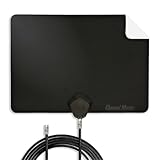
This compact flat-panel model suits apartment dwellers who live within a short drive of broadcast towers and want a no-fuss setup that can stick behind a TV or lay flat on a shelf. Owners consistently praise how quickly it finds channels after a simple scan, and the included coax connector is sturdy enough for occasional repositioning without loosening.
- Pro: Slim profile hides easily behind furniture or a TV stand.
- Pro: Fast channel acquisition reported by users in strong-signal zones.
- Con: Limited range means it struggles once you move farther from transmitters.
Skip this if you live more than a modest distance from your nearest tower or if you need VHF channels (often lower-numbered networks) that a small panel may not capture reliably.
TV Antenna for Smart TV Indoor, Digital TV Antenna for Local Channels
At a mid-range price, this antenna targets buyers who want a more substantial flat panel with a slightly larger active area than entry-level options. The design leans toward a modern aesthetic that blends with a wall-mounted display, and owners note that the included cable length gives more placement flexibility than the cheapest competitors.
- Pro: Larger surface area helps capture a broader band of frequencies.
- Pro: Satisfying build quality for the price bracket.
- Con: Heavier than minimal designs, making adhesive mounting less reliable over time.
Consider a longer-reach alternative if your broadcast towers sit beyond a comfortable signal window — the added panel size doesn’t fully compensate for physical distance.
TV Antenna for Smart TV Indoor, TV Antenna for Local Channels
This option sits just above the entry price and is positioned for households that want a simple digital antenna without paying for features they won’t use. The flat design is straightforward to position, and owners report that a single re-scan after installation yields a stable channel list in suburban areas with moderate signal strength.
- Pro: Affordable and easy to set up in under ten minutes.
- Pro: Acceptable picture quality on UHF-heavy channel lineups.
- Con: VHF performance is noticeably weaker than dedicated long-range designs.
Pass on this one if your local station lineup includes several channels below VHF 13 — you will lose them entirely in some locations.
DAANT TV Antenna Indoor Long Range
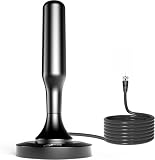
The “long range” label is the key differentiator here. This model targets rural and outer-suburban users who cannot reach towers with a standard flat panel but don’t want to install an outdoor antenna. Its design incorporates a larger element array that improves low-signal sensitivity, and owner reviews from fringe areas consistently note it pulling in stations that smaller competitors miss.
- Pro: Notably better reception at greater distances from broadcast towers.
- Pro: Sturdy base allows tabletop orientation toward the transmitter.
- Con: Bulkier and more visible than flat-panel alternatives.
Skip this if you live in a strong-signal urban area where a compact design will deliver the same channels without the extra footprint.
Channel Master FLATenna
Channel Master has long been a trusted name in broadcast equipment, and the FLATenna brings that pedigree to the indoor market. It is the only model here that explicitly advertises ATSC 3.0 (NextGen TV) compatibility and 4K support, making it the forward-looking choice for buyers who anticipate their local stations transitioning to the newer broadcast standard. The 12-foot coaxial cable is a practical length that avoids needing an extension in most living-room setups.
- Pro: NextGen TV and 4K readiness set it apart from uncertified competitors.
- Pro: Reputation for superior signal reliability backed by decades of broadcast engineering.
- Con: Highest price among flat-panel options here without a range advantage over cheaper models.
Only skip this if your area will not adopt ATSC 3.0 for many years and you want the lowest upfront cost.
TV Antenna for Local Channels — 16.5ft Cable
The defining feature of this antenna is its 16.5-foot coaxial cable, which addresses a common placement problem: the best signal comes from a window or wall, but the TV sits in a corner far from that wall. Owners report that the extra cable length lets them position the antenna where signal is strongest while routing the connection to the TV without an amplifier or splitter in most rooms.
- Pro: Long cable solves real placement constraints without extra hardware.
- Pro: Competitive price point for the included accessories.
- Con: Cable length can introduce minor signal loss if coiled or kinked.
Avoid this model if your TV sits directly in front of a window — the extra cable becomes clutter you don’t need.
2026 TV Antenna Indoor 5000+ Miles, HD Digital Antenna for Local Channels
This is the priciest entry in the roundup and carries one of the most aggressive range claims in the category. Buyers drawn to this model tend to live in genuinely remote areas and want the highest stated sensitivity available. Owner feedback suggests the large active element array does pull in a broader channel list in fringe zones, though real-world range will never match the headline number due to physical signal propagation limits.
- Pro: Strongest claimed range makes it a viable last resort for very remote locations.
- Pro: Modern styling fits a living room without looking like lab equipment.
- Con: Premium price is hard to justify in suburban areas where cheaper models already deliver all available channels.
Skip this if you can already receive a full channel list with a less expensive option — the extra cost does not translate to more channels when the signal is already strong.
UltraPro Hover Digital TV Antenna Indoor for Smart TV
At the lowest price in this group, the UltraPro Hover is the gateway option for anyone wanting to test whether over-the-air television will work in their home before committing to a more expensive antenna. It uses a simple flat panel and standard coax connection, and owners in strong-signal areas report acceptable HD picture with minimal fuss.
- Pro: Lowest entry price removes all hesitation for a first attempt at OTA viewing.
- Pro: Lightweight design makes it easy to try multiple positions.
- Con: Performance ceiling is low — fringe channels remain out of reach.
Move to a mid-range or long-range option quickly if your channel scan returns fewer stations than your local lineup should offer.
Buying Guide
VHF and UHF Support
Indoor antennas that only capture UHF (channels 14 and above) will silently drop several major networks in many markets. Lower-numbered channels — often the big broadcast networks — ride on VHF frequencies that a small flat panel cannot reliably receive. Check the product specifications for a dual-band designation or a frequency range starting below 174 MHz. If a listing only mentions UHF, assume missing channels and look at a larger or multi-element design.
Coaxial Cable Length and Gauge
A short, thin cable limits where you can place the antenna relative to your TV. Aim for at least ten feet of 75-ohm coax in a typical living room. The TV Antenna for Local Channels with a 16.5-foot cable in this roundup demonstrates why length matters: the best signal is often at a window, not where your screen sits. Avoid models that bundle a cable under six feet unless your TV is already against that window.
ATSC 3.0 and Future Proofing
Broadcast standards are shifting toward ATSC 3.0 (NextGen TV), which enables 4K over-the-air broadcasts, interactive data, and improved reception in marginal signal areas. As of now, not every local station has switched, but most major markets will be required to offer NextGen broadcasts on at least one station per network. If you want an antenna that will not need replacement after a transition, look for explicit ATSC 3.0 or NextGen TV labeling — only the Channel Master FLATenna carries that specification in this group.
Our Verdict
The top pick is the Channel Master FLATenna. It delivers the best combination of proven signal reliability, NextGen TV readiness, and a cable length that works in real rooms without being the most expensive option available. For buyers whose only priority is the lowest possible entry price to test whether over-the-air channels will work, the UltraPro Hover at its rock-bottom cost is the sensible starting point — just be ready to upgrade if your scan comes back thin. The one condition where another product wins outright: if you live in a genuinely remote or hilly area with no strong tower nearby, the DAANT Indoor Long Range will pull in channels that no flat panel can reach, and its low price makes it a far safer gamble than the premium-range options.
FAQ
Do I need an amplifier with an indoor antenna?
In most urban and suburban environments, no. An amplifier adds noise along with signal and can actually degrade reception if your antenna is already pulling in a strong broadcast. Only consider a powered model if you live in a fringe area where passive designs consistently miss channels you know exist on the local tower.
Can an indoor antenna receive 4K channels?
Yes, but only if the antenna is labeled as ATSC 3.0 (NextGen TV) compatible and your television has a built-in ATSC 3.0 tuner. Most current flat panels are ATSC 1.0 only, so even a 4K-capable antenna will still deliver HD rather than 4K without the matching tuner.
How do I find out which channels are available at my address?
Several free websites map broadcast towers by distance and direction using your street address. Enter your location and note the direction of each tower, then position your antenna facing roughly that way. This step saves significant trial and error compared to scanning blindly in multiple directions.
Does a more expensive indoor antenna always mean better reception?
No. Reception depends primarily on your distance from the transmitter and physical obstructions, not on price alone. A flat panel costing roughly twice as much as another will rarely double your channel count. Spend time optimizing placement before spending more on hardware, and choose based on features you actually need — such as VHF support or cable length.