When your vehicle’s engine runs hot, the temptation is to jump online, input your vehicle’s year, make, and model, and buy the first cheap replacement that pops up. But choosing a radiator for cooling is not a one-size-fits-all transaction. Many vehicle owners make the mistake of assuming that all radiators with the same exterior dimensions cool equally, or that a “four-row” radiator is automatically superior to a “two-row” unit. In reality, modern cooling engineering relies on a delicate balance of surface area, material thermal conductivity, fin density, and airflow integration.
Buying the wrong radiator leads to immediate headaches: transmission lines that do not line up, mounting brackets that require custom fabrication, or worse, an engine that still boils over during summer traffic or under heavy towing loads. To get the most cooling performance for your dollar, you must look past marketing buzzwords and evaluate the physical specs, construction methods, and system compatibility of the radiator.
As an Amazon Associate we earn from qualifying purchases at no extra cost to you.



Our Top Picks


Top 3 picks at a glance
Decide These 3 Things First
Before comparing tube diameters or fin counts, you must define the scope of your cooling upgrade. Answering these three foundational questions will instantly narrow your search and prevent costly return shipping fees.
1. Daily Driving vs. High-Performance/Towing: Determine if your vehicle needs a standard Original Equipment Manufacturer (OEM) spec replacement or a heavy-duty upgrade. If you drive a stock 4.3L V6 commuter truck, an affordable plastic-tank, single-row aluminum radiator is highly efficient, lightweight, and cost-effective. However, if you are running a high-horsepower V8 conversion, towing heavy trailers, or idling in extreme heat, you require a multi-row, all-aluminum performance radiator that can dissipate heat rapidly under sustained engine loads.
2. Transmission Type and Cooler Integration: Automatic transmissions require an external fluid cooler, which is traditionally built directly into one of the radiator’s end tanks. If you drive an automatic, you must ensure the radiator features integrated brass or copper cooling lines with the correct thread pitch (such as 5/16-inch or 3/8-inch inverted flare fittings). For manual transmissions, these ports are unnecessary, though you can still use an automatic radiator by leaving the internal cooler ports plugged and dry.
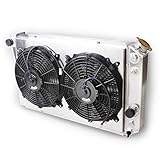
3. Standalone Radiator vs. Complete Fan and Shroud Assembly: A radiator cannot cool your engine without adequate airflow. Decide whether you are reusing your vehicle’s stock mechanical clutch fan and plastic shroud, or upgrading to an integrated electric fan kit. Purchasing a matched set—including an all-aluminum radiator, a custom-fit aluminum shroud, and high-CFM (cubic feet per minute) electric fans—ensures 100% of the radiator core receives active airflow, preventing hot spots and maximizing low-speed cooling efficiency.
1. Core Size and Physical Dimensions
The core is the center portion of the radiator consisting of the tubes and cooling fins. When shopping, do not rely solely on “overall dimensions,” which include the top and bottom tanks or side mounting brackets. You must measure the core height, width, and thickness independently. For standard passenger cars, core thicknesses range from 1.0 inch to 1.25 inches. Performance applications and V8 conversions require thicker cores, typically ranging from 1.75 inches up to 2.75 inches.
Additionally, pay attention to fin density, measured in Fins Per Inch (FPI). A higher FPI (around 14 to 18 FPI) provides more surface area for heat dissipation but requires a more powerful fan to pull air through the dense core. A lower FPI (10 to 12 FPI) allows easier airflow but offers less surface area for cooling. For street-driven vehicles, a balanced density of 12 to 16 FPI is ideal.
2. Material: Aluminum vs. Copper-Brass vs. Plastic Tanks
The materials used in your radiator dictate its heat transfer efficiency, weight, and overall durability. Modern cooling systems have largely moved away from heavy copper-brass configurations in favor of aluminum and plastic composites.
- Plastic Tank with Aluminum Core: This is the standard OEM configuration. These radiators are lightweight (typically weighing between 10 and 15 pounds) and highly affordable, ranging from $80 to $130. They cool exceptionally well for daily driving but are prone to cracking at the plastic inlet and outlet necks over years of thermal cycling.
- Full Aluminum (TIG-Welded): These radiators feature aluminum cores and aluminum end tanks welded together. They are highly durable, impervious to the cracking issues of plastic, and offer superior heat dissipation. A 3-row full aluminum radiator weighs between 18 and 28 pounds depending on the size, and can handle much higher cooling pressures. They are the gold standard for performance builds, classic car restorations, and heavy towing.
3. Construction: Brazed vs. Epoxied Cores
How the tubes are joined to the header plate (the frame at the top and bottom of the core) is a critical indicator of long-term reliability. Cheap radiators often use industrial epoxy to seal the tube-to-header joints. Over time, the constant expansion and contraction from engine heat cycles will cause the epoxy to crack, leading to catastrophic coolant leaks.
High-quality radiators use a process called vacuum brazing. In this process, the entire aluminum core is heated in a specialized furnace, fusing the metals together without the use of solder or epoxy. Vacuum-brazed cores are incredibly strong, offer better thermal transfer at the joints, and can withstand vibration and high-pressure cooling caps (up to 20–30 PSI) without failing.
4. Cooling Capacity and Airflow Integration
As we look ahead to 2026, cooling demands for modern engine swaps and high-output builds continue to push the boundaries of radiator design, making airflow integration more critical than ever. A thicker radiator core is useless if air cannot pass through it. If you are upgrading to an all-aluminum radiator with a built-in shroud and electric fan, you must verify the electrical and airflow ratings of the fan assembly.
Look for electric fans rated between 1,500 and 3,000 CFM depending on your engine size. A typical 12-inch or 16-inch electric fan should draw between 10 to 15 amps of current and run on a 12V system, pulling around 120 to 180 watts of power. Ensure the fan shroud covers the entire back surface of the radiator core; a poorly designed shroud that leaves open gaps allows air to bypass the core, severely reducing cooling efficiency when the vehicle is idling.
5. Price Tiers and What You Get
Radiator pricing is highly dependent on materials, construction quality, and whether the unit is sold as a standalone piece or a complete cooling kit.
- Budget ($70 – $120): In this price range, you will find OEM-style replacements featuring aluminum cores and plastic tanks. These are perfect for restoring stock performance to daily drivers, such as a standard V6 Blazer or commuter sedan. They rarely include caps, hoses, or fans.
- Mid-Range ($150 – $280): This tier consists of multi-row (2-row or 3-row) full aluminum radiators. These units feature TIG-welded aluminum tanks and often come packaged with a matching aluminum shroud and electric cooling fans. They are designed for modified street cars, light towing, and common engine swaps (such as putting an LS V8 into a compact truck chassis).
- Premium ($300 – $700+): Premium radiators feature highly engineered double-pass or triple-pass designs, ultra-high-grade aluminum (such as aircraft-grade 6061-T6), and high-performance brushless electric fans. These are built for competitive racing, extreme off-roading, and heavy-duty commercial towing where failure is not an option.
6. Warranty and Brand Support
Because a radiator failure can lead to a destroyed engine, the manufacturer’s warranty is a major factor to consider. Budget radiators typically carry a 90-day to 1-year limited warranty. Mid-range and premium all-aluminum brands often offer a 3-year or limited lifetime warranty against manufacturing defects and weld leaks.
Ensure the manufacturer performs pressure testing on 100% of their units before they leave the factory. Reputable brands will explicitly state that their radiators are pressure tested up to at least 20 to 30 PSI to ensure the integrity of the welds and tube-to-header joints under extreme operating temperatures.
7. Delivery, Packaging, and Installation Prep
Radiators are highly delicate components; the aluminum cooling fins are paper-thin and can be easily crushed or bent during shipping. Look for brands that ship their radiators in form-fitting foam packaging or heavy-duty double-walled cardboard boxes with protective plastic covers over the inlet and outlet ports.
Before installing, check for pre-drilled mounting holes that line up with your vehicle’s factory core support. A true “drop-in” radiator should require no drilling or cutting. Additionally, verify that the package includes essential accessories, such as a brass petcock drain valve, mounting bushings, and a properly rated radiator cap (usually 1.1 to 1.3 bar, or 16 to 19 PSI).
Spec Checklist
Use this quick-reference table to compare radiator specifications across different budget and performance tiers before making your final purchase decision.
| Specification | Budget Tier | Mid-Range Tier | Premium Tier |
|---|---|---|---|
| Core Construction | Single-row aluminum core with crimped plastic tanks. Often utilizes epoxy seals. | 2-row or 3-row full aluminum core. 100% TIG-welded tanks. No epoxy. | Multi-row or dual-pass high-grade aluminum. Precision robotically welded. |
| Core Thickness | 1.0″ to 1.25″ | 1.75″ to 2.25″ | 2.5″ to 3.0″ |
| Cooling Fan System | None (reuses factory mechanical clutch fan or stock electric fan). | Includes aluminum shroud and single/dual 12V electric fans (1,500–2,200 CFM). | High-output dual electric fans (2,500–3,500+ CFM) with integrated relay harnesses. |
| Transmission Cooler | Internal copper or brass heat exchanger (automatic models only). | Integrated high-efficiency brass cooler with standard threaded fittings. | Heavy-duty external plate-and-fin cooler or high-pressure internal billet cooler. |
| Typical Pricing | $70 – $130 | $150 – $280 | $300 – $700+ |
Red Flags
When shopping for a cooling radiator, avoid products that exhibit any of these warning signs:
- Visible Epoxy Residue: Inspect the seam where the core tubes meet the header plate. If you see yellow, clear, or black pooling glue, the radiator is epoxied rather than brazed. It is highly likely to leak within a few years of heat cycling.
- Poorly Aligned or Thin Mounting Brackets: Cheaply made radiators often feature flimsy, thin aluminum brackets that bend under the weight of the coolant. Brackets should be at least 1/8-inch thick to support the radiator securely.
- Low Fin Count (Under 10 FPI): If you can see straight through the radiator core with ease because the zig-zag fins are spaced too far apart, the radiator lacks the surface area needed to cool effectively, regardless of how thick the core is.
- Mismatched Port Sizes: Always verify the inlet and outlet diameters. Standard passenger cars and light trucks generally use 1.25-inch, 1.5-inch, or 1.75-inch ports. Avoid radiators with non-standard port sizes that require custom hose adapters.
FAQ
Is a 3-row radiator always better than a 2-row radiator?
No, not necessarily. The overall thickness of the core and the width of the individual tubes matter more than the quantity of rows. A 2-row radiator utilizing wide 1-inch tubes offers more surface-area contact than a 3-row radiator utilizing narrow 0.5-inch tubes. Additionally, fewer wider tubes allow better coolant flow and less restriction than many small, narrow tubes.
Can I use an automatic transmission radiator in a manual transmission vehicle?
Yes, you can. The internal transmission cooler built into the radiator tank is a completely sealed, independent chamber. If your vehicle has a manual transmission, you can simply install the radiator and leave the transmission cooler ports open and unused. It will have absolutely no impact on your engine’s cooling performance or coolant flow.
What type of coolant should I run in a new all-aluminum radiator?
You should always use the coolant type recommended by your vehicle’s manufacturer, but ensure it is compatible with aluminum. Most importantly, always mix your coolant with distilled water rather than tap water. Tap water contains minerals that cause scale buildup and accelerate electrolysis, a chemical reaction that can eat holes through aluminum radiator tubes in a matter of months.
Why is my new radiator leaking at the weld seams?
Leaking at the weld seams is typically caused by one of three things: poor manufacturing quality control, stress cracks from transport damage, or improper mounting. If a radiator is bolted too tightly to the chassis without rubber mounting bushings, the natural twisting and flexing of the vehicle’s frame as you drive will stress the aluminum welds, eventually cracking them.
Related guides
- Best Gaming PC for Overwatch 2: Ten Prebuilts Matched to Your Monitor (2026)
- Best Gaming PC for Baldur’s Gate 3: Matching CPU, VRAM and Storage to the Game (2026)
- Best Gaming PC for Apex Legends: Which Listings Fit a High-Refresh Setup (2026)
- Best RTX 3060 Gaming PCs: Eight Prebuilt Listings Compared by CPU, RAM and Cooling (2026)