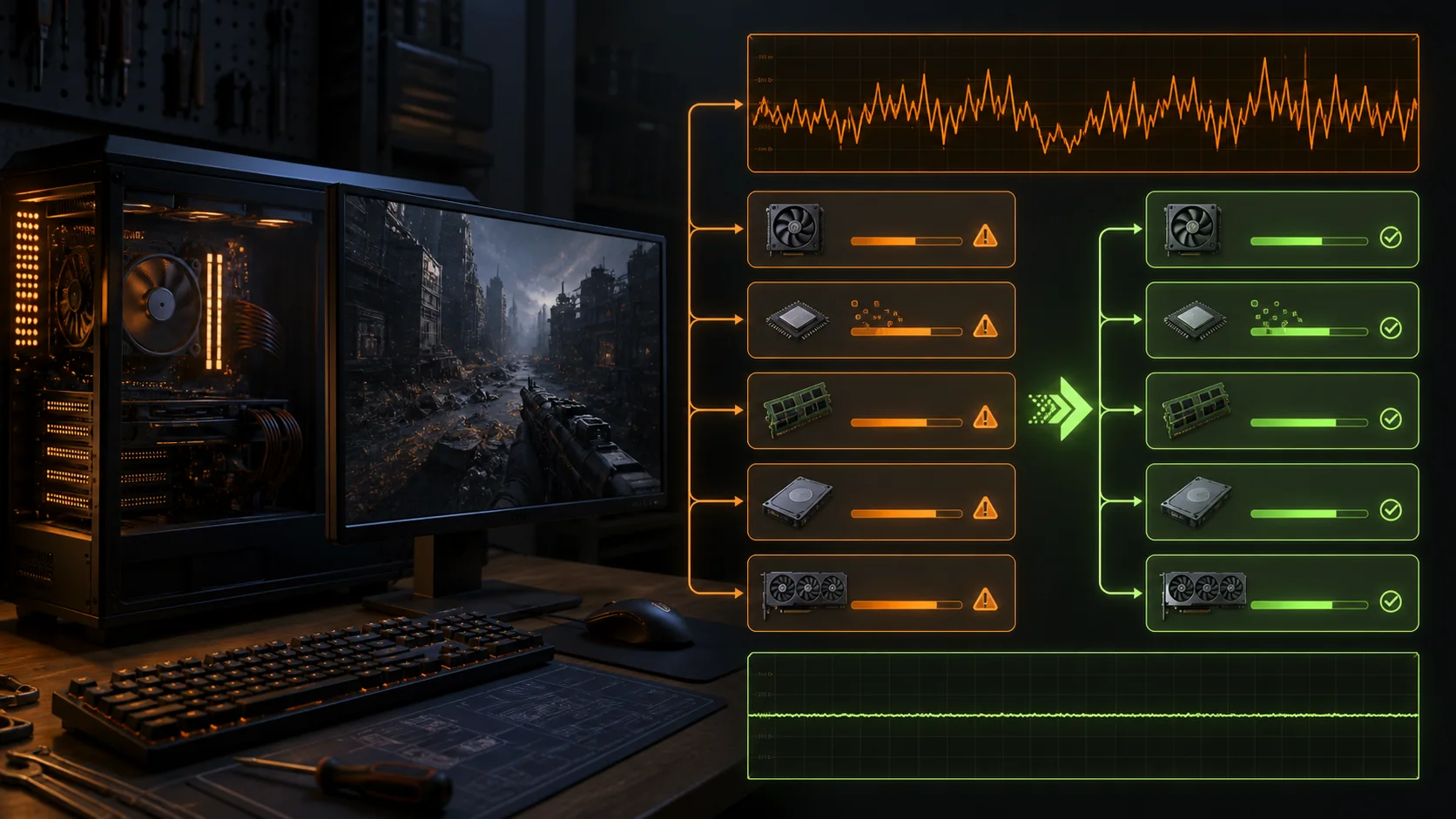
Optimizing Windows for gaming means working through power plan settings, startup process trimming, GPU driver configuration, storage health, and network tuning in that rough order of impact — most of it takes under an hour total and requires no paid software, just settings that are already built into Windows and your GPU control panel but frequently left at conservative defaults.
I’m Owen Pritchard, Technical Guides Editor, and the order below reflects what actually moves the needle based on time spent on a diagnostics bench with POST cards, spare parts for swap-testing and multiple OS images, testing before-and-after benchmarks on systems coming in with vague “feels slow” complaints from an IT repair bench background.
As an Amazon Associate we earn from qualifying purchases at no extra cost to you. Product prices and availability are accurate as of the date shown and are subject to change.





Top 3 picks at a glance
Power Settings and Game Mode
Windows’ power plan, found in Control Panel’s Power Options or the newer Settings > System > Power & battery menu, defaults to Balanced on most systems, which throttles CPU clock speed more conservatively than a dedicated gaming desktop needs, since Balanced is tuned as a general-purpose compromise rather than for sustained gaming load.
Switching to High Performance, or Windows 11’s “Best Performance” slider under the updated power settings, removes this conservative throttling on desktops where power draw isn’t a concern the way it would be on a battery-powered laptop, and it’s one of the lowest-effort changes with a measurable, if modest, impact on sustained frame rate consistency.
Game Mode, found in Settings > Gaming > Game Mode, deprioritizes background processes and certain driver-related background tasks in favor of whatever game is currently in focus, and works alongside Hardware-Accelerated GPU Scheduling (Settings > System > Display > Graphics) to reduce latency between your CPU and GPU.
Both Game Mode and GPU Scheduling are enabled by default in current Windows versions, so the practical step here is usually just confirming neither has been disabled by a prior system image, a “gaming optimization” tool that misconfigured something, or manual experimentation — checking both settings explicitly takes under a minute.
Sleep and USB selective suspend settings, found deeper in the advanced power plan options, can occasionally cause peripherals like a mouse or headset to briefly disconnect or lag during idle moments in a game — disabling USB selective suspend specifically for gaming peripherals removes this as a variable if you’ve noticed intermittent input issues.
Trimming Startup Programs and Background Apps
Open Task Manager’s Startup tab (or Startup Apps in Windows 11’s Settings) and review everything marked to launch automatically — manufacturer utility software, cloud sync clients, chat apps, and update checkers accumulate over the life of a Windows install and each adds to both boot time and ongoing background resource usage.
Disable startup items you don’t need running constantly rather than uninstalling the software outright if you still use it occasionally — most launchers and utilities can be opened manually when needed without running in the background at all times, which is the better middle ground for software you use weekly rather than daily.
Task Manager’s “Startup impact” column gives a rough indication of which programs affect boot time most, but for ongoing gameplay impact, check the Processes tab while idle on the desktop (game closed) to see what’s still consuming CPU, memory, or disk in the background even after startup has finished.
Browser windows left open with multiple tabs, particularly any playing video or running JavaScript-heavy web apps, are a frequently overlooked background resource drain that persists during gameplay if you alt-tab or run the game in windowed/borderless mode rather than exclusive fullscreen.
Scheduled tasks, distinct from startup programs, can also trigger background activity mid-session — antivirus scans, backup software, or manufacturer update checkers scheduled for a specific time can coincide with a gaming session and cause an unexpected resource spike; reviewing Task Scheduler for anything set to run during your typical play hours is worth the few minutes it takes.
GPU Driver Settings for Gaming
Beyond simply having an up-to-date driver, both Nvidia’s app and AMD’s software include a control panel with per-game or global settings that affect performance and visual quality — power management mode (“Prefer maximum performance” over “Adaptive” on Nvidia, similarly named on AMD) keeps the GPU at higher clock speeds proactively rather than ramping up reactively as load increases.
Low Latency Mode (Nvidia) or Radeon Anti-Lag (AMD), both settings in the respective GPU control panels, reduce the render queue depth between your CPU and GPU, cutting input latency at a small cost to maximum theoretical frame rate — worth enabling for competitive or fast-paced titles where responsiveness matters more than squeezing out a few extra frames.
Texture filtering quality settings in the driver control panel, separate from in-game texture settings, default to a balance between quality and performance on both Nvidia and AMD — setting this to performance-favoring on an older or budget GPU frees up a small amount of headroom without a dramatic visual quality loss in most games.
Shader cache size, adjustable in Nvidia’s control panel specifically, controls how much disk space is reserved for storing compiled shaders between sessions — increasing this from the default on a system with ample free SSD space can reduce the shader compilation stutter that’s especially noticeable in the first few sessions after installing a new game or driver.
Frame rate limiters within the GPU driver itself (distinct from in-game caps) are worth setting a few frames below your monitor’s max refresh rate if you’re using V-Sync, since this avoids the driver-level V-Sync’s tendency to add input lag when the GPU is right at the edge of your display’s refresh ceiling.
Storage Cleanup and Drive Health
A boot and game drive with less than roughly 10-15% free space shows measurably worse performance on most SSDs, since the drive’s controller needs free blocks to manage wear leveling and garbage collection efficiently — a nearly full drive forces it to work harder for the same read and write operations, adding latency that shows up as stutter in games streaming assets.
Windows’ built-in Disk Cleanup or Storage Sense (Settings > System > Storage) automatically clears temporary files, old Windows Update caches, and other reclaimable space, and scheduling Storage Sense to run automatically rather than relying on manual cleanup keeps this from becoming a recurring problem.
Check drive health with a tool like CrystalDiskInfo periodically, since a drive nearing end-of-life shows degraded performance well before outright failure, and this degradation often first appears as exactly the kind of intermittent stutter that gets misattributed to a game or driver issue rather than aging storage.
Defragmentation is unnecessary and can actually reduce lifespan on SSDs, which handle data differently than traditional spinning hard drives — Windows automatically runs the appropriate optimization (TRIM for SSDs, defrag for HDDs) on its own scheduled maintenance, so manual defragmentation of an SSD is a legacy habit worth dropping rather than a helpful practice.
For anyone considering a storage upgrade or planning to clone an existing drive to a faster one as part of a broader optimization pass, our best SSD cloning tools guide covers software that migrates a full Windows install without a fresh reinstall.
Network Tweaks for Lower Ping
A wired ethernet connection remains the single most reliable network optimization for gaming, since it eliminates the interference-related latency spikes that Wi-Fi is inherently more prone to from neighboring networks, household devices, and physical obstructions between your PC and router.
If Wi-Fi is unavoidable, connecting to the 5GHz band rather than 2.4GHz reduces interference substantially, since fewer household devices compete on 5GHz and it’s less prone to the congestion common on the more crowded 2.4GHz band in dense apartment buildings specifically.
Router Quality of Service (QoS) settings, available on most modern routers, let you prioritize your gaming PC’s traffic over other household devices — useful in a shared household where someone streaming video or running a large download can otherwise introduce latency spikes during your session.
Windows’ own network adapter settings include a few gaming-relevant options worth checking: disabling “Large Send Offload” has resolved intermittent latency spikes for some users on specific network adapter models, though this is a more situational fix worth trying only if you’ve already ruled out the more common causes above.
For a more permanent upgrade path if network stability continues to be a limiting factor, our best network gear for gaming and best WiFi adapter for gaming PC guides cover router and adapter options specifically evaluated for gaming latency consistency rather than just peak throughput numbers.
Visual Effects and Windows Overhead
Windows’ built-in visual effects — window transparency, animations when minimizing or maximizing, and shadow effects under windows — carry a small CPU and GPU overhead that’s more noticeable on integrated graphics or older discrete GPUs than on a modern mid-range or higher card, but it’s a free, low-risk change regardless of hardware tier.
Adjust these through Control Panel’s “Adjust the appearance and performance of Windows” (searchable directly from the Start menu), which offers a preset “Adjust for best performance” option that disables all effects at once, or a custom list letting you selectively disable transparency and animations while keeping ones you specifically prefer.
Transparency effects specifically (the frosted-glass look on the taskbar and Start menu) have a measurable, if small, GPU compositing cost that runs continuously in the background regardless of what game or application is in focus, making this one of the more consistently recommended individual toggles to disable.
Background wallpaper slideshows and lock screen Spotlight images that periodically download and change also add minor background disk and network activity — disabling these through Settings > Personalization removes another small, easily overlooked source of background system activity.
None of these individually produce a dramatic frame rate jump, and it’s worth setting realistic expectations here — the value is in removing several small, stacking sources of overhead rather than any single change delivering a large, standalone improvement.
Windows Update Scheduling Around Play Sessions
Windows Update running an active download or, worse, an installation and restart during a gaming session is a genuinely disruptive interruption, and scheduling active hours (Settings > Windows Update > Advanced options) to cover your typical gaming windows prevents this without disabling updates entirely, which would leave your system without security patches.
Metered connection settings, available under network adapter properties, can throttle or defer large background downloads including Windows Update and Microsoft Store app updates — setting your primary connection as metered during periods you want to guarantee full bandwidth for gaming is a more aggressive but effective option if active hours alone aren’t sufficient.
Delivery Optimization, Windows’ peer-to-peer update distribution feature that can use your bandwidth to help distribute updates to other PCs on the internet (not just your local network by default), is worth reviewing in Settings > Windows Update > Delivery Optimization, since its default configuration can consume more upload bandwidth than expected during a gaming session if it’s actively serving updates to other systems.
Checking for and installing updates manually on your own schedule, rather than leaving fully automatic updates running, gives more predictable control over exactly when the disruption of a restart happens, at the cost of needing to remember to check periodically rather than relying on Windows to handle it entirely hands-off.
Driver updates specifically pushed through Windows Update (as opposed to manufacturer sites) occasionally install an older or more generic driver version over a newer one you’d manually installed from Nvidia or AMD directly — reviewing installed optional updates periodically catches this before it silently reverts a driver you’d specifically chosen.
Peripheral and USB Settings
USB polling rate for your mouse and keyboard, adjustable through most gaming peripheral manufacturer software, determines how often the device reports its position or input state to Windows — higher polling rates (500Hz or 1000Hz versus the USB default of 125Hz) reduce input latency but add a small amount of CPU overhead, generally negligible on any reasonably modern CPU.
USB selective suspend, mentioned earlier under power settings, can cause peripherals to briefly go idle and reconnect during moments of low activity, occasionally perceived as minor input lag or a brief disconnect — disabling this specifically for gaming peripherals through Device Manager’s power management tab removes it as a variable.
Bluetooth peripherals, including some wireless mice, keyboards, and headsets, share limited 2.4GHz spectrum with Wi-Fi and other wireless devices, and can introduce more input latency variability than a wired or dedicated 2.4GHz USB dongle connection — worth switching to a wired connection specifically for competitive titles where consistency matters most.
If you’re running multiple USB peripherals (mouse, keyboard, headset, capture card, webcam) through a single hub, especially an unpowered one, bandwidth contention between devices can occasionally introduce latency — a powered USB hub, or spreading devices across multiple native motherboard USB ports rather than a single hub, resolves this for setups with several simultaneous USB devices. Our best USB hubs for gaming setup guide covers hubs tested specifically for this kind of multi-device gaming use.
Audio device sample rate and buffer size settings, found in Windows’ Sound settings and often duplicated in a dedicated audio driver control panel, can introduce audio latency or occasional crackling if mismatched with your game or headset’s expected settings — matching your output device’s sample rate to a standard value like 48000Hz resolves most of these mismatches.
Monitoring Tools to Confirm Gains
Benchmark before making changes, not just after, since without a baseline you’re relying on subjective impression rather than a measurable comparison — running the same benchmark or the same in-game section with an FPS counter both before and after your optimization pass confirms whether specific changes actually helped.
MSI Afterburner paired with its RivaTuner Statistics Server overlay is a widely used free combination for real-time FPS, frame time, and temperature monitoring during actual gameplay rather than just synthetic benchmarks, letting you see the practical effect of a settings change in the specific games you actually play.
1% and 0.1% low frame rates — the average frame rate during your worst-performing moments, rather than the overall average — are often a more meaningful metric for perceived smoothness than average FPS alone, since a high average with frequent brief stutters feels worse to play than a slightly lower but more consistent frame rate.
Windows’ own built-in Game Bar (Win+G) includes a basic performance overlay showing CPU, GPU, and memory usage without needing third-party software, a reasonable starting point for casual monitoring even if it’s less detailed than dedicated tools like Afterburner or HWiNFO64 for deeper diagnostic work.
For a more structured before-and-after comparison across multiple optimization passes over time, dedicated benchmarking software that logs and exports results is worth the setup time — our PC diagnostic and benchmarking tools guide covers tools built specifically for tracking this kind of change over repeated test runs.
Frequently asked questions
Does optimizing Windows settings actually improve FPS?
Yes, though the gains vary by system — power plan and background process fixes typically add a few percent to average FPS but can meaningfully improve 1% low frame rates (the stutter-prone moments), which is often more noticeable than a small average FPS gain during normal play.
Should I disable Windows Update completely for gaming?
No, fully disabling it leaves your system without security patches. Instead, schedule active hours to cover your typical gaming time so updates install and restart outside those windows, giving you the same protection without an update interrupting a session.
Is Game Mode in Windows actually useful?
Yes, it deprioritizes background processes and driver-related tasks in favor of your active game, and works alongside Hardware-Accelerated GPU Scheduling for a modest but measurable improvement. It’s enabled by default in current Windows versions, so most users just need to confirm it hasn’t been turned off.
How much does disabling visual effects help gaming performance?
Windows’ own visual effects (transparency, animations) have a small but real CPU and GPU overhead, generally more noticeable on lower-end integrated graphics or older hardware than on a modern discrete GPU. It’s a low-risk change worth making, though don’t expect a dramatic frame rate jump from it alone.
Do I need third-party optimization software for gaming?
Not usually. Most genuine gains come from settings already built into Windows and your GPU driver’s control panel, covered in this guide. Many third-party “game booster” tools duplicate these same changes while adding background processes of their own, which can offset any benefit.