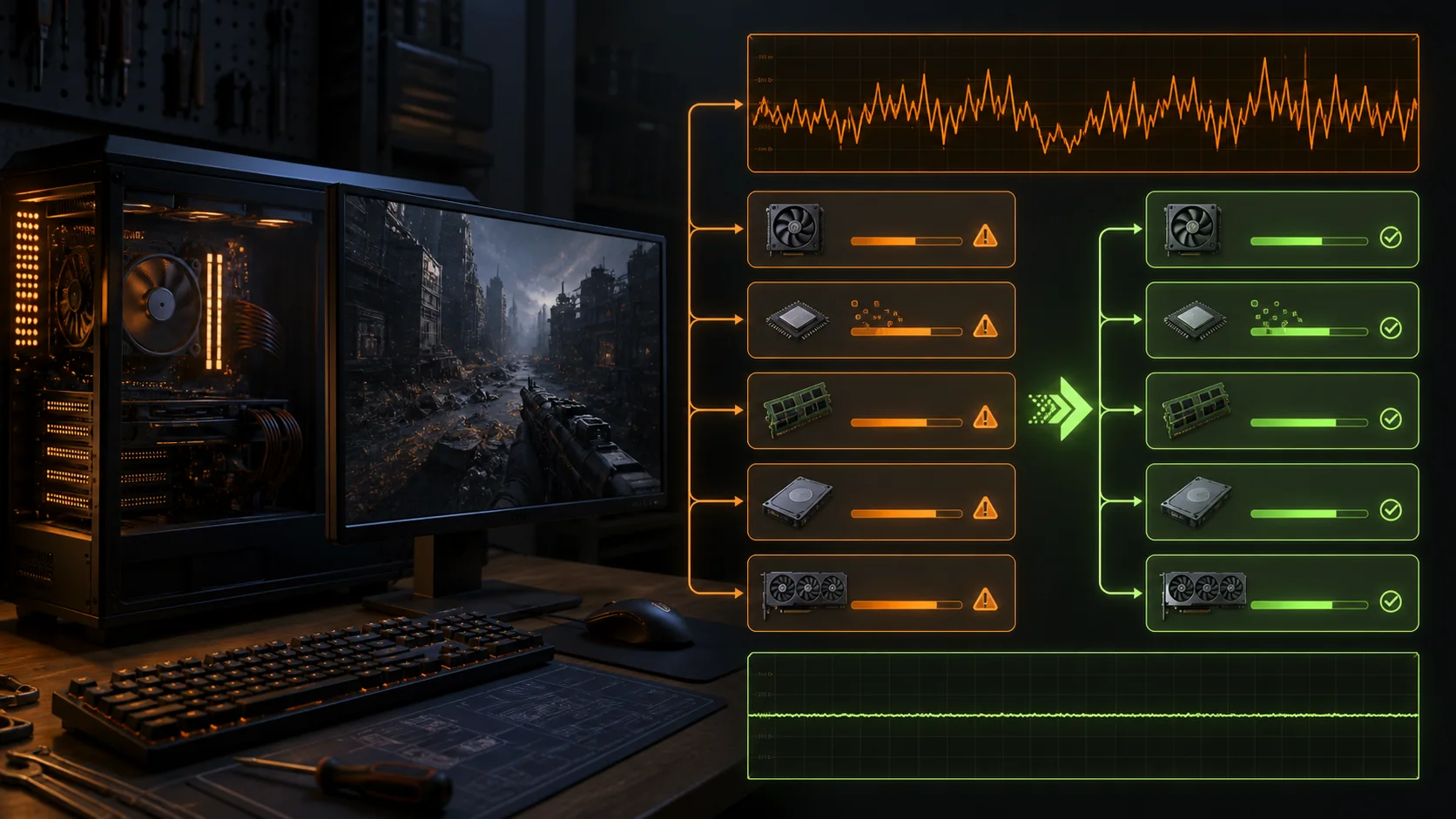
The most useful free PC optimization tools for gaming aren’t all-in-one “booster” apps that promise a universal speed-up — they’re focused utilities that each do one job well: monitoring hardware, cleanly managing GPU drivers, or checking storage health. This guide covers the specific, verifiable tools worth having installed, what each one actually changes under the hood, and skips the bundled “cleaner” software that tends to do more harm than good.
Top 3 picks at a glance

Quick answer
Install HWiNFO64 for hardware monitoring, MSI Afterburner for GPU monitoring and control, Display Driver Uninstaller (DDU) for clean driver reinstalls, and CrystalDiskInfo for storage health checks. Each is free, widely used, and does something specific rather than making broad, unverifiable performance claims.
As an Amazon Associate we earn from qualifying purchases at no extra cost to you. Product prices and availability are accurate as of the date shown and are subject to change.
![DeskFX Free Audio Effects & Audio Enhancer Software [PC Download]](https://m.media-amazon.com/images/I/41fXbDohyuS._SL160_.jpg)
![WavePad Audio Editing Software - Professional Audio and Music Editor for Anyone [Download]](https://m.media-amazon.com/images/I/B1fcLEGCs6S._SL160_.png)




| Tool | Purpose | Use frequency |
|---|---|---|
| HWiNFO64 | Full system monitoring | As needed or continuous |
| MSI Afterburner | GPU monitoring, overlay, mild overclocking | Continuous during gaming |
| DDU | Clean driver removal before reinstall | Before driver updates |
| CrystalDiskInfo | Drive health checks | Monthly or when troubleshooting |
HWiNFO64 for full system monitoring
HWiNFO64 provides detailed real-time readouts for CPU, GPU, motherboard, and storage sensors — temperatures, clock speeds, voltages, and power draw — pulled directly from hardware sensors rather than estimated. It’s a diagnostic tool first and foremost, useful for confirming whether a performance issue is actually thermal or power-related before assuming it’s something else.
Its sensor panel can run as a compact overlay alongside games, and its logging feature records data over time, which is useful for catching an intermittent thermal throttling event that only happens during long sessions rather than showing up in a quick check.
HWiNFO64 also exposes per-VRM (voltage regulator module) and per-rail power draw on many motherboards and GPUs, which is more detail than most players need day to day, but becomes genuinely useful if you’re trying to diagnose whether a random crash correlates with a power delivery spike rather than a thermal or clock speed issue — a distinction a simpler monitoring tool without that sensor depth can’t help you make.
Unlike some simpler monitoring tools, HWiNFO64 exposes a large number of individual sensors, which can be overwhelming at first — most users only need to watch CPU and GPU temperature, clock speed, and power draw for general gaming troubleshooting, with the rest available for deeper diagnosis when needed.
It pairs well with our guide to fixing PC overheating, since confirming actual temperatures with real sensor data is the first step before assuming a cooling problem based on guesswork.
Its sensor list is organized by component — motherboard, CPU, GPU, storage, network — which makes the full list reasonably navigable once you know roughly which category a value you’re looking for falls under, even though the total number of exposed sensors can look overwhelming at first glance before you’ve spent any time in the interface.
A concrete way to use its logging feature, useful for both CPU and GPU monitoring together: set a session log running before a multi-hour play session, then review the CSV output afterward for the maximum recorded temperature, any sudden clock-speed cliffs (a sign of throttling), and how long it took for temperatures to plateau. A system that keeps climbing without leveling off well before the CPU or GPU’s rated maximum is a stronger warning sign than a single high reading, since a well-cooled system should stabilize rather than climb indefinitely.
A mistake worth avoiding: running HWiNFO64’s more aggressive polling interval settings alongside several other monitoring tools simultaneously can itself add a small amount of background CPU overhead, which is counterproductive if your goal is precisely measuring a performance change — for a benchmark comparison specifically, a single monitoring tool at a moderate polling rate gives cleaner, more representative numbers than several tools stacked on top of each other.
MSI Afterburner for GPU monitoring and control
MSI Afterburner is one of the most widely used GPU utilities available, and despite its branding it works with graphics cards from any manufacturer, not just MSI. Its core features are a monitoring overlay (via its bundled RivaTuner Statistics Server component), fan curve control, and GPU overclocking or undervolting.
The on-screen overlay shows real-time FPS, frame time, and hardware utilization during gameplay, making it a practical way to verify whether a change you made elsewhere — a driver update, a Windows setting — actually affected performance rather than just assuming it did.
For players interested in undervolting to reduce temperatures without losing performance, Afterburner is the standard tool for that process. It requires testing and patience rather than a single guaranteed setting, since safe and stable values vary by individual GPU silicon.
Afterburner’s overlay can occasionally conflict with other overlay software running simultaneously, similar to the Game Bar conflicts covered in our Game Bar troubleshooting guide — if you run multiple overlay tools, test them individually if you notice display issues.
Beyond monitoring, Afterburner’s fan curve editor is worth setting up even if you never touch the overclocking sliders, since a custom curve tuned to your specific case airflow can often achieve a similar temperature at meaningfully lower noise than the GPU’s stock automatic curve, which tends to be tuned conservatively for a wide range of case environments rather than your specific one. Testing a gentler ramp starting a few degrees earlier than stock, rather than a dramatic jump, is a reasonable starting point for a quieter custom curve.
Display Driver Uninstaller (DDU) for clean driver management
Display Driver Uninstaller removes a currently installed GPU driver along with its associated files and registry entries more thoroughly than Windows’ standard uninstall process, which can leave remnants that cause instability with a subsequently installed driver.
DDU is meant to be run in Safe Mode, then followed immediately by installing a fresh driver download — it’s not a permanent removal tool, and running it without a plan to reinstall a driver afterward will leave your GPU without proper driver support.
This tool is most valuable when troubleshooting driver-related instability, switching GPU vendors (removing NVIDIA drivers before installing an AMD card, for example), or doing a clean install as part of the process covered in our graphics driver update guide.
For routine driver updates where the current driver isn’t causing problems, a standard update over the existing installation is usually sufficient — DDU is a troubleshooting and clean-slate tool, not a required step for every driver update.
Our dedicated DDU driver uninstaller guide covers the full Safe Mode process, common mistakes, and troubleshooting in more depth if you’ve decided a clean install is warranted for your specific situation rather than a routine update.
CrystalDiskInfo for storage health
CrystalDiskInfo reads the SMART (Self-Monitoring, Analysis, and Reporting Technology) data built into modern drives and translates it into a simple health status, flagging concerning values like reallocated sectors or rising temperatures without requiring you to interpret raw SMART data manually.
A failing or aging drive can cause symptoms that look like a game or software problem — stutter, long load times, occasional crashes — so checking drive health is a reasonable step when troubleshooting unexplained performance issues, particularly on a drive that’s been in use for several years.
The tool also displays basic drive information like total power-on hours and total bytes written, useful context for understanding how much wear an SSD has accumulated relative to its rated endurance.
If CrystalDiskInfo flags a drive as failing, back up its data immediately and plan a replacement — our guide to SSD cloning tools covers migrating to new storage without a full reinstall.
CrystalDiskInfo also reports the drive’s current interface and transfer mode, which is worth glancing at if you’ve recently installed or moved a drive, since an NVMe SSD accidentally running at a slower PCIe generation than it supports, or a SATA SSD connected through a port sharing bandwidth with another device, can silently underperform in a way that looks like a drive health problem but is actually a configuration or connection issue instead.
As a rough frame of reference for the total bytes written figure: most consumer SSDs are rated for a total write endurance somewhere in the range of hundreds of terabytes for typical drive capacities, and a normal gaming and general-use workload accumulates write volume gradually enough that hitting that rated limit within a drive’s practical service life is uncommon — the more common real-world failure mode is a controller or NAND defect rather than genuinely wearing out the rated endurance, which is exactly the kind of early warning sign CrystalDiskInfo’s health status is designed to catch before it becomes a full failure.
What to skip: bundled “booster” and “cleaner” suites
Many free all-in-one PC optimization suites bundle a registry cleaner, a “junk file” remover, and a one-click game boost feature into a single install, often alongside browser extensions or additional software you didn’t specifically ask for during setup.
Registry cleaning in particular has limited evidence of meaningful performance benefit on modern Windows versions, and carries a small risk of removing an entry something else depends on, unlike the targeted tools covered above which each address a specific, verifiable issue.
If a tool’s core pitch is a single button that claims to “boost” performance without explaining specifically what it changes, that’s a reasonable signal to skip it in favor of the built-in Windows settings covered in our guide to optimizing Windows for gaming performance, which accomplish the same underlying changes transparently.
A useful test for evaluating any optimization tool before installing it: check whether its marketing materials or in-app claims describe specifically what setting or file it changes, in terms you could verify yourself, versus vague claims like “boosts FPS by up to 50%” with no explanation of the mechanism. Tools in the second category are far more likely to be measuring against an artificially degraded baseline or making a claim that doesn’t hold up under independent testing.
Reading recent user reviews on the download source rather than only the vendor’s own description is another quick way to sanity-check a tool before installing it, since a pattern of complaints about unexpected bundled software or misleading performance claims tends to surface fairly clearly in community feedback even when the marketing page itself is polished and convincing.
Building a minimal, purposeful toolkit
You don’t need every tool covered here running simultaneously — HWiNFO64 or Afterburner’s overlay for day-to-day monitoring, with DDU and CrystalDiskInfo used situationally when troubleshooting a specific problem, is a reasonable working setup for most gaming PCs.
Installing tools only when you have a specific use for them, rather than accumulating a large collection of monitoring and cleanup software running in the background simultaneously, keeps your own system closer to the lean, low-overhead state these tools are meant to help you achieve in the first place.
Checking for updates to each tool periodically is worth doing, since driver and Windows changes occasionally require corresponding updates to monitoring software to keep reading sensors correctly.
A reasonable order of operations for a new gaming PC: install HWiNFO64 first and run a baseline check of temperatures and clock speeds at idle and under a short synthetic load, before you’ve made any other changes, so you have a genuine “stock” reference point. Add Afterburner next specifically for its overlay if you want ongoing in-game monitoring, and only reach for DDU and CrystalDiskInfo later, situationally, when troubleshooting a specific symptom rather than installing them preemptively on day one.
Uninstalling a tool cleanly matters more than it might seem, particularly for Afterburner and its bundled RivaTuner component — if you ever switch to a different monitoring overlay tool, leaving a previous tool’s background service running alongside the new one is a common, avoidable source of the exact overlay conflicts described elsewhere in this guide. A full uninstall of the old tool, not just closing its window, avoids this.
Troubleshooting common tool issues
HWiNFO64 shows missing or zeroed-out sensor values: this can happen if another monitoring tool is already accessing the same sensors — close other monitoring software (including a second instance of Afterburner’s RivaTuner component) and relaunch.
Afterburner’s overlay doesn’t appear in a specific game: some games with strict anti-cheat block overlay hooks by design, similar to the Game Bar conflicts covered elsewhere in our guides — this isn’t unique to Afterburner and doesn’t always have a workaround for that specific title.
DDU gets stuck or won’t complete in Safe Mode: ensure no other software is trying to access GPU-related files during the process, and confirm you’re running DDU with administrator privileges, which it requires to remove driver-level files properly.
CrystalDiskInfo shows a “caution” or “bad” status on a relatively new drive: don’t panic immediately — check the specific flagged attribute, since some values are more critical than others, and cross-reference with the drive manufacturer’s own diagnostic tool if available for a second opinion.
Multiple tools report conflicting temperature or clock speed readings for the same component: minor discrepancies between tools are normal due to differences in sampling method and polling interval, but a large, consistent gap is worth investigating by checking each tool’s documentation for which specific sensor it’s reading, since a motherboard can expose several different temperature sensors near a component that don’t always agree.
A monitoring tool suddenly stops updating mid-session while the game keeps running fine: this usually means the monitoring tool’s own process crashed or lost its connection to the sensor drivers, rather than anything wrong with your hardware — simply relaunching the monitoring tool resolves this in the large majority of cases without needing to restart the game or the whole system.
Frequently asked questions
Are one-click “PC booster” or “game booster” apps worth using?
Most of what these tools do — closing background apps, tweaking power plans — you can do yourself for free with built-in Windows settings, and some bundle unwanted extra software or make exaggerated performance claims. The tools recommended in this guide each do one specific, verifiable thing well instead.
Is HWiNFO64 safe to leave running in the background all the time?
Yes, HWiNFO64 is a widely used, well-regarded monitoring tool with minimal resource overhead, and many users run it continuously in a minimized state or as a sensor panel without issue.
Do I need MSI Afterburner if I don’t own an MSI graphics card?
Yes, despite the branding, MSI Afterburner works with graphics cards from any manufacturer, not just MSI. It’s one of the most widely used GPU monitoring and overclocking tools regardless of your card’s brand.
Will Display Driver Uninstaller (DDU) delete my GPU driver permanently?
DDU removes the currently installed driver and its associated files and registry entries, but it doesn’t prevent you from installing a driver again afterward — it’s meant to be used immediately before installing a fresh driver, not as a permanent removal tool.
How often should I run a storage health check like CrystalDiskInfo?
Checking every month or two, or whenever you notice unusual stutter or slow loading, is reasonable for most users. It’s a quick, non-intrusive check rather than something that needs frequent, scheduled monitoring for a typical gaming PC.