ChimeraOS is a Linux distribution built around a single, narrow goal: turn a PC into a dedicated, console-style gaming device rather than serve as a general-purpose desktop operating system. It boots directly into a unified, controller-navigable library that combines Steam with other launchers, which is its main differentiator from broader gaming distros. It’s a strong fit for a purpose-built living-room gaming box, and a poor fit if you want the machine to also be a real desktop.
Quick answer
Install ChimeraOS if you’re building a dedicated living-room or handheld gaming machine and want a simple, console-style interface that unifies multiple game launchers into one library. Skip it if you want a general-purpose desktop that also happens to game well, where a traditional distro like Nobara or Pop!_OS, or a more flexible atomic option like Bazzite, fits better.
| Factor | ChimeraOS | Bazzite |
|---|---|---|
| Primary focus | Dedicated console-style gaming box | Gaming plus flexible desktop mode |
| Launcher support | Unified library across multiple launchers | Individually installed launchers |
| Desktop use | Minimal, secondary | More capable secondary desktop mode |
| Best for | Single-purpose living-room PC | Handhelds and multi-purpose gaming PCs |
What ChimeraOS is and who built it
ChimeraOS grew out of an earlier community project aimed at replicating a console-like experience on generic PC hardware, well before Valve’s own SteamOS became widely available on non-Steam-Deck devices. Its build is based on an Arch Linux foundation, layered with a purpose-built interface and system configuration aimed entirely at the console-style use case rather than general desktop computing.
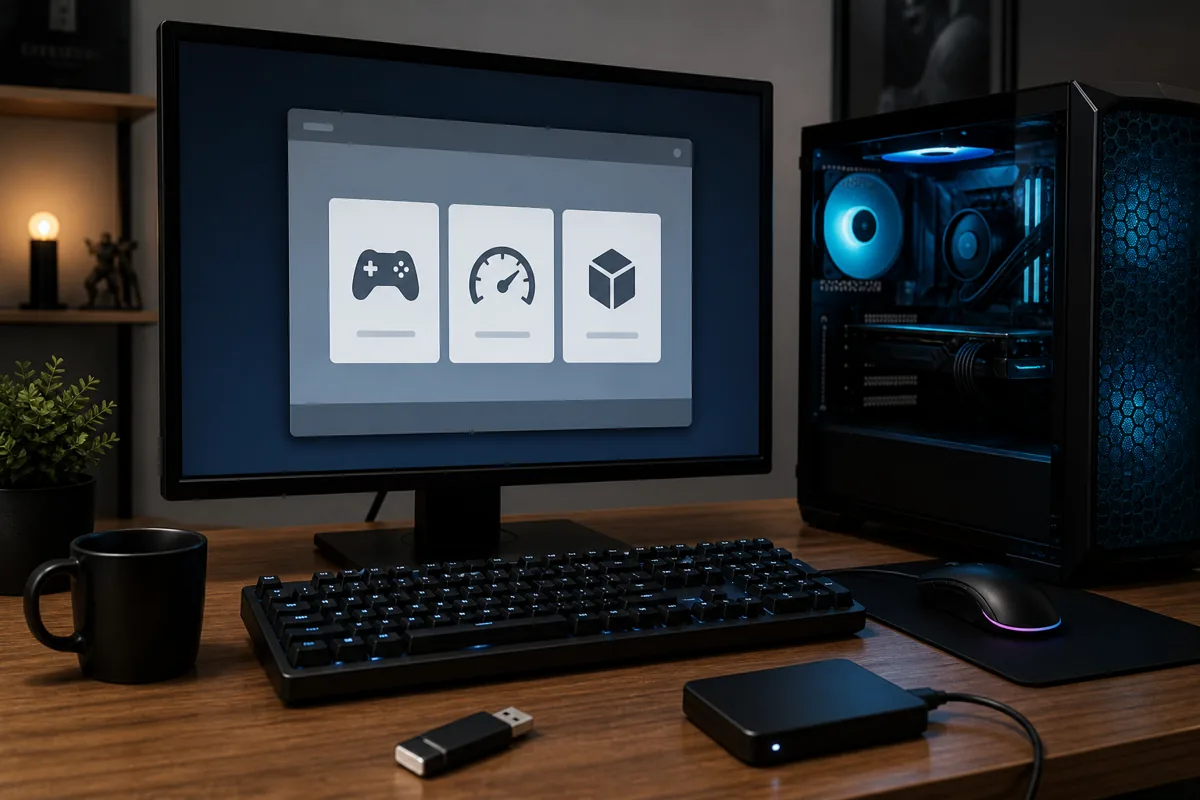
The core idea is straightforward: rather than asking you to install and configure Steam, Epic Games Store, GOG, and other launchers separately and then jump between their individual interfaces, ChimeraOS presents one unified, big-picture-style library that pulls games from multiple supported platforms into a single controller-navigable view. This is arguably its single most distinctive feature compared to other Linux gaming distros.
The system itself is intentionally minimal outside of that gaming shell. There’s a basic desktop mode available for tasks that need it, but it’s clearly a secondary interface rather than the primary experience, reinforcing that ChimeraOS expects the machine it’s installed on to function as a dedicated gaming appliance rather than a daily-driver computer.
This narrow focus is both ChimeraOS’s biggest strength and its biggest limitation. It does the single-purpose console-replacement job with less overhead and fewer decisions to make than a broader distro, but it offers noticeably less flexibility if your plans for the machine extend beyond gaming.
Day-to-day navigation is built around a gamepad from first boot to launching a game, which is the point of the whole project. Menus, settings screens, and the unified library are all laid out for directional navigation and a confirm button rather than assuming a mouse cursor is available, and text entry, account sign-ins, search fields, and similar, is handled through an on-screen keyboard you control with the same controller. A keyboard and mouse still work if you plug them in, but you’re not required to reach for one for normal day-to-day use the way you would be on a traditional desktop distro.
Dropping into desktop mode is available for the tasks the console-style shell doesn’t cover, adjusting a setting that isn’t exposed in the gaming interface, or troubleshooting a launcher issue directly. The exact shortcut for exiting to desktop is worth checking in ChimeraOS’s own current documentation rather than assuming it matches another console-style distro, since these bindings can change between releases. Once in desktop mode, a mouse and keyboard become genuinely necessary again, since the desktop environment underneath isn’t optimized for controller navigation the way the gaming shell is.
The unified library: ChimeraOS’s core feature
The unified library is what most reviewers and users point to as ChimeraOS’s defining strength. Instead of separately launching Steam’s big-picture mode, then backing out to launch a non-Steam game through a different launcher’s own interface, ChimeraOS aggregates supported launchers into one consistent, controller-friendly view, closer to how a physical game console presents its library regardless of publisher.
This matters most for users whose game library spans multiple storefronts, since jumping between separate launcher interfaces on a controller-first, TV-connected setup is a genuinely awkward experience on most other platforms, Windows included. ChimeraOS removes that friction by design rather than through a third-party workaround layered on top of an otherwise standard desktop.
Launcher support depth varies by platform, with Steam naturally getting the most seamless integration since it’s also the primary source of the Proton compatibility layer used to run Windows games. Other supported launchers work through the same general Proton-based approach, with integration quality that’s generally solid but occasionally shows more rough edges than Steam’s own native support.
If your library is concentrated almost entirely within Steam already, this unification benefit matters less, since Steam’s own big-picture mode already provides a comparable single-launcher experience on other distros and even on Windows. For online multiplayer titles across any of these launchers, a wired connection still beats Wi-Fi for consistency; our guide on reducing ping and latency covers the general setup steps regardless of which OS is running the game.
Update model and system maintenance
ChimeraOS uses a simplified, image-oriented update approach aimed at minimizing the maintenance burden on a machine that’s meant to just work as a gaming appliance rather than demand regular administrative attention. This is conceptually similar in spirit to the atomic update model used by Bazzite, prioritizing reliability and low friction over the flexibility of a fully traditional, package-by-package Linux system.
Because the system is scoped narrowly around the gaming use case, there’s comparatively less surface area for updates to break something, simply because there’s less installed and configured by default than on a general-purpose distro. This narrower scope is a deliberate tradeoff: less flexibility, but also fewer moving parts that can go wrong on a machine you want to just turn on and use.
Update frequency and turnaround on fixing newly discovered issues depends on the project’s contributor activity rather than a company’s formal release schedule, similar to other community-maintained Linux gaming distros. Checking release notes before a major update, particularly if the machine is set up in a shared living-room context where downtime is inconvenient for other household members, is a reasonable habit.
Owen Pritchard, our Technical Guides Editor, has run ChimeraOS on a dedicated test unit in his testbench specifically to check how cleanly the unified-launcher update process handles version changes across Steam and non-Steam titles simultaneously, and the narrower scope compared to a full desktop distro has generally meant fewer places for an update to introduce a new problem.
Hardware and installation considerations
ChimeraOS is designed to run on a wide range of generic PC hardware rather than targeting a specific certified device list the way some handheld-focused distros do, which makes it a reasonable option for repurposing an existing PC into a dedicated living-room gaming box. That said, GPU driver support still follows the same general Linux hardware support landscape as any other distro, so very new or unusual hardware can still hit rough edges shortly after release.
Installation follows the general pattern common to most alternative operating systems: downloading an installer image, writing it to a USB drive, and booting from that drive to begin setup on your target machine. Because ChimeraOS is intended to be the sole operating system on a dedicated gaming box in most setups, rather than dual-booted alongside another OS, back up anything on the target drive before starting, since the installer will typically use the entire disk.
If you’re repurposing an older PC that’s been running Windows, cloning or backing up anything you want to keep first is worth the extra step; our guide on SSD cloning tools covers options for preserving a drive’s contents before wiping it for a fresh install.
Controller support is a priority given the project’s console-style focus, with broad compatibility across common wireless and wired gamepads, though exact button mapping behavior can vary slightly by controller brand and connection method. Since a living-room build like this is usually left plugged in and powered on for long stretches, a basic surge protector for a gaming PC is worth adding to the setup alongside the console itself.
Who ChimeraOS fits
ChimeraOS makes the most sense for a specific, well-defined use case: a dedicated living-room PC, connected to a TV, controlled primarily with a gamepad, whose only job is launching and playing games across multiple storefronts without you manually juggling separate launcher interfaces. If that description matches what you’re building, ChimeraOS does that specific job with less overhead than a general-purpose distro configured to behave similarly.
It also suits users repurposing an older PC specifically as a console replacement, where the narrower software scope and console-style interface reduce the temptation, and the risk, of the machine slowly turning into a general-purpose desktop that then needs the broader maintenance a full desktop distro requires.
ChimeraOS is a weaker fit if you want the same machine to double as a real desktop computer for work, browsing, or content creation between gaming sessions, since its minimal secondary desktop mode isn’t built or optimized for that kind of general use the way Nobara or Pop!_OS is. It’s also less suited to handheld hardware specifically compared to Bazzite, which has more dedicated handheld hardware compatibility work behind it.
The practical limits show up quickly if you try to stretch the machine beyond gaming. Desktop mode doesn’t come with a curated selection of everyday productivity software the way a general-purpose distro does, so office work, photo editing, or general browsing means installing and configuring that software yourself in an environment that wasn’t designed around that workflow. Anyone who wants occasional browser-based tasks, checking email or streaming a video, can usually get by through desktop mode without much friction, but treating the machine as a full replacement for a second computer tends to expose exactly the gaps ChimeraOS’s narrow scope was built to avoid worrying about in the first place.
ChimeraOS versus SteamOS and Bazzite
Compared to official SteamOS, ChimeraOS covers a gap Valve’s own software doesn’t fully address: broad support for generic PC hardware rather than Steam Deck and a small number of officially licensed devices. Where SteamOS is Valve’s tightly controlled, single-vendor product, ChimeraOS is a community project aiming at a similar experience on hardware Valve hasn’t certified.
Compared to Bazzite, the difference comes down to scope and flexibility. Bazzite offers a more capable desktop mode, broader Distrobox-based software flexibility, and dedicated handheld hardware compatibility work, making it the better choice if you want some general-purpose flexibility alongside the console-style gaming experience. ChimeraOS trades that flexibility for a narrower, more focused, arguably simpler console-replacement experience with its standout unified multi-launcher library.
If unifying Steam with other storefronts into a single console-style library is your primary motivation, ChimeraOS is built specifically around that use case. If you want more day-to-day desktop flexibility alongside the gaming experience, Bazzite is generally the better-rounded option.
Anti-cheat and game compatibility
Like every Linux gaming distro, ChimeraOS’s compatibility with anti-cheat-protected games depends entirely on decisions made by individual game publishers and their anti-cheat vendors, not on anything ChimeraOS itself controls. Kernel-level anti-cheat systems that haven’t enabled Linux support will refuse to launch on ChimeraOS exactly as they would on SteamOS, Bazzite, or any other Linux distribution.
Given ChimeraOS’s multi-launcher focus, it’s worth checking anti-cheat compatibility separately for titles across each storefront you plan to use, since Linux support status isn’t necessarily consistent between a game’s Steam version and its version on another launcher, even for the same title. Check a current community compatibility tracker on a per-game, per-launcher basis before committing your living-room setup entirely to ChimeraOS.
Single-player and non-competitive multiplayer titles generally have a much better success rate across all supported launchers than competitive titles relying on kernel-level anti-cheat, which remains the most consistent limitation across every Linux gaming option currently available.
When ChimeraOS doesn’t work well
ChimeraOS isn’t the right choice if you want a single machine that comfortably handles both serious desktop work and gaming, since its minimal secondary desktop mode isn’t built for that dual role. If your household or personal setup genuinely needs a flexible general-purpose computer that also games, a traditional distro or a more capable atomic option like Bazzite serves that need better.
It’s also not the ideal pick for handheld hardware specifically, where Bazzite’s more extensive handheld compatibility work and hardware-specific tuning generally produce a smoother experience. And as with every Linux gaming option, if your library leans heavily on anti-cheat-protected competitive titles without Linux support, no distro-level choice resolves that limitation.
If you want deep control over system configuration and package management, ChimeraOS’s narrow, appliance-style scope will feel restrictive compared to a traditional distro built for general-purpose flexibility.
Troubleshooting common ChimeraOS issues
A non-Steam launcher won’t sync its library correctly: confirm you’re signed into the correct account for that specific launcher and that the launcher’s integration is current, since unified-library syncing depends on each launcher’s own account session staying valid.
Controller isn’t recognized correctly: try a different connection method if available, such as switching from Bluetooth to a wired or dongle-based connection, since some controllers have more reliable Linux support over one connection type than another.
A specific game refuses to launch: check whether the title uses kernel-level anti-cheat first, since that’s the most common cause across every launcher. If it doesn’t, try adjusting the Proton compatibility version assigned to that title through the relevant launcher’s settings.
System feels sluggish after connecting a display with a different refresh rate: confirm the display’s supported resolution and refresh rate combination is correctly detected, since mismatched display timing settings are a common source of stutter on Linux gaming setups generally, not specific to ChimeraOS.
GPU underperforming compared to expectations: confirm the correct driver is active for your specific GPU vendor and that no thermal throttling is occurring in a poorly ventilated living-room enclosure. Our guide on fixing a GPU that isn’t detected covers general diagnostic steps worth running through if the card seems to be underperforming or not fully recognized.
Frequently asked questions
What is ChimeraOS designed for?
ChimeraOS is designed specifically to turn a PC into a dedicated, console-style gaming device that boots directly into a controller-navigable big-picture interface rather than a general-purpose desktop. It’s built for living-room or handheld setups where the machine’s only job is running games.
Is ChimeraOS the same as SteamOS?
No. ChimeraOS is an independent project, not built by Valve, though it targets a similar goal: a console-like experience on non-Steam-Deck hardware. It combines Steam with other launchers into one unified library view, which official SteamOS handles differently.
Can I use ChimeraOS as my main desktop operating system?
You can drop into a desktop mode for basic tasks, but ChimeraOS isn’t designed or optimized as a daily-driver desktop replacement the way a general-purpose distro is. It’s built around the assumption that the machine’s primary job is launching and playing games, not everyday desktop work.
Does ChimeraOS support multiple game launchers?
Yes. One of ChimeraOS’s core features is combining Steam, Epic Games Store, GOG, and other supported launchers into a single unified big-picture-style library, so you’re not switching between separate console-style interfaces for each platform.
Does ChimeraOS run games with anti-cheat protection?
Anti-cheat support depends entirely on whether the specific game’s publisher has enabled Linux compatibility for their anti-cheat vendor, not on ChimeraOS itself. Many kernel-level anti-cheat systems still block Linux entirely, ChimeraOS included.