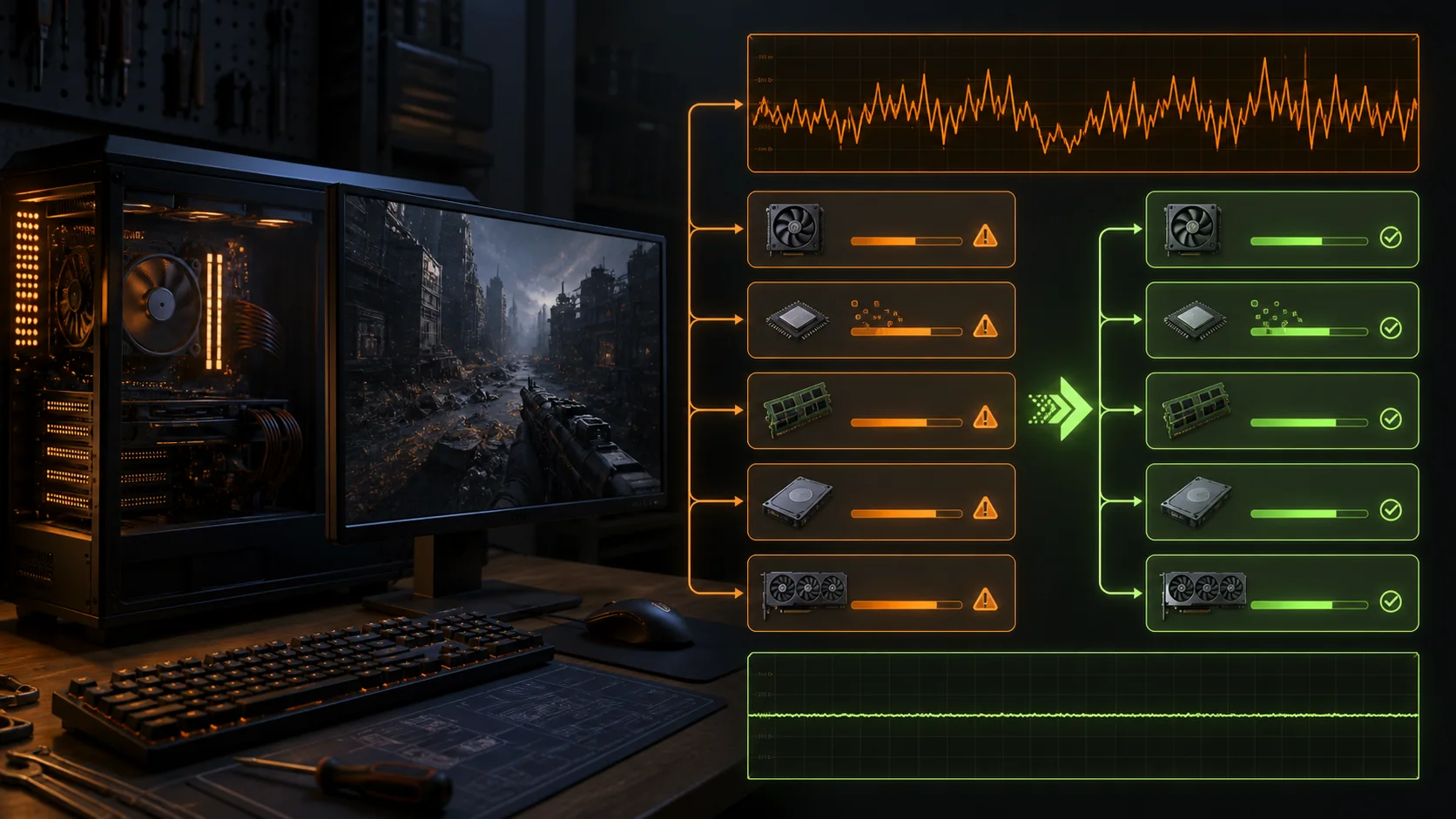
Input lag is the total delay between a physical action — moving your mouse, pressing a key — and that action appearing on screen, and it’s made up of several stacked sources rather than one single cause: your display’s response characteristics, GPU rendering and sync settings, peripheral polling rate, and Windows-level processing overhead. Reducing it means addressing each layer rather than expecting one setting change to fix everything.
Top 3 picks at a glance

Quick answer
The two changes with the biggest measurable impact are turning off traditional V-Sync (using a sync alternative like G-Sync or FreeSync instead if available) and confirming your peripherals are set to their fastest polling rate. After those, Windows-level tweaks like Game Mode and background app cleanup provide smaller, additional gains that are worth doing but won’t match the display and peripheral changes on their own.
As an Amazon Associate we earn from qualifying purchases at no extra cost to you. Product prices and availability are accurate as of the date shown and are subject to change.



| Source | Typical contribution | Fix |
|---|---|---|
| Display / V-Sync | Largest single factor | Disable V-Sync or use G-Sync/FreeSync |
| Peripherals | Moderate | Higher polling rate, wired or low-latency wireless |
| Windows / background load | Small but stacks | Game Mode, close background apps |
Display settings: V-Sync, refresh rate, and sync technologies
Traditional V-Sync synchronizes frame delivery to your monitor’s refresh cycle to prevent screen tearing, but it does this by holding completed frames in a buffer, which adds a noticeable amount of delay between a frame being rendered and it actually appearing on screen. For competitive or fast-paced games, most players disable V-Sync specifically for this reason.
G-Sync (NVIDIA) and FreeSync (AMD) are adaptive sync technologies that let the monitor’s refresh rate match the GPU’s frame output dynamically, reducing tearing without V-Sync’s buffering penalty. If your monitor and GPU both support one of these, enabling it with V-Sync turned off in the game’s settings gives you tear-free output without the full input lag cost of traditional V-Sync.
Refresh rate itself is a direct, physical contributor to input lag independent of any software setting — a 60Hz display has a maximum possible frame interval of about 16.7 milliseconds, while a 144Hz display’s interval is closer to 6.9 milliseconds, meaning less time a completed frame can wait before display regardless of other settings.
Confirm your monitor is actually running at its maximum supported refresh rate within Windows’ display settings, since some displays default to a lower refresh rate after a cable change, driver update, or Windows reinstall without it being obvious at a glance.
To put the full stack of display-related numbers in context: traditional double-buffered V-Sync can add somewhere in the range of one to two additional frame intervals of delay (roughly 8-33 milliseconds depending on refresh rate), while triple buffering can reduce that penalty somewhat compared to double buffering without eliminating it entirely. A 240Hz or higher display combined with V-Sync off and a low-latency GPU setting active represents close to the practical floor achievable through display and sync configuration alone.
A common mistake is checking refresh rate once at setup and never again — a Windows update, a new HDMI or DisplayPort cable that doesn’t support the same bandwidth as the old one, or reconnecting to a different port can silently drop a display back to 60Hz even on a monitor capable of much more, and this goes unnoticed unless you specifically check the display settings after any cable or driver change.
GPU driver settings that affect input lag
Both NVIDIA and AMD’s control panels include a low-latency mode setting (NVIDIA calls this Low Latency Mode / Ultra Low Latency; AMD calls its equivalent Anti-Lag) designed specifically to reduce the render queue depth between your CPU and GPU, cutting a source of lag that exists even with V-Sync off. Enabling this in your GPU’s control panel for the specific game, or globally, is one of the more impactful single-setting changes.
Frame rate caps set slightly below your monitor’s maximum refresh rate can paradoxically reduce input lag in GPU-bound scenarios by preventing the render queue from backing up, though this is workload-dependent and won’t help in CPU-bound scenarios where the cap isn’t the limiting factor.
Because GPU control panel layouts change between driver versions and differ between NVIDIA and AMD, look for the low-latency or anti-lag feature within your installed panel’s gaming or 3D settings section rather than a fixed menu path, and apply it per-game if the option is available rather than only globally.
If you haven’t updated your GPU driver recently, do that first — our guide on updating graphics drivers safely covers the clean-install process, and low-latency features have been refined across driver generations, so an outdated driver may be missing recent improvements.
The measured latency benefit of enabling low-latency mode varies by how GPU-bound your specific game and settings combination is — in a heavily GPU-bound scenario where the render queue would otherwise back up several frames deep, the reduction can be substantial, commonly cited in the range of one or more full frame intervals; in a CPU-bound or already well-under-100%-GPU-usage scenario, the queue was never backing up significantly to begin with, so the measurable benefit shrinks toward negligible. Checking your GPU usage percentage during the game you’re optimizing, covered in our guide to checking GPU bottlenecks, tells you which category you’re in.
Peripheral polling rate and connection type
A mouse or keyboard’s polling rate determines how often it reports its position or state to the PC, measured in Hz — a 1000Hz mouse reports every millisecond, versus every 8 milliseconds for a 125Hz device. Higher polling rates reduce the delay between a physical movement and the PC registering it, though the practical difference above 1000Hz is small for most players.
Most gaming mice let you set polling rate through the manufacturer’s own configuration software, and confirming it’s set to its maximum supported rate (commonly 1000Hz, with some newer high-end mice supporting even higher) is a quick check worth doing if you haven’t touched it since setup.
Wireless gaming mice using a dedicated low-latency USB receiver, as opposed to standard Bluetooth, perform comparably to wired mice in most independent testing today. General-purpose Bluetooth mice not designed for gaming tend to show more noticeable lag due to Bluetooth’s inherent connection overhead, so the distinction is about the wireless technology used, not wireless versus wired as a blanket rule.
Keyboards contribute less to perceived input lag than mice for most game genres, but mechanical switches with shorter actuation distances and gaming-focused keyboards with high polling rates still shave small amounts of time off key registration compared to basic office keyboards.
Concretely, moving from a 125Hz polling rate to 1000Hz reduces the maximum reporting delay from 8 milliseconds down to 1 millisecond — a meaningful, perceptible difference for many players, particularly in fast-flick aiming scenarios. Moving from 1000Hz to a newer 4000Hz or 8000Hz mouse, by contrast, reduces that same maximum delay from 1 millisecond down to a fraction of a millisecond, a difference most players report as far less noticeable in practice than the earlier jump, which is worth knowing before assuming a very high-polling-rate mouse is a dramatic upgrade over a standard 1000Hz one.
Windows-level factors: Game Mode and background load
Windows’ Game Mode, covered in more detail in our guide to optimizing Windows for gaming performance, prioritizes the foreground game for CPU scheduling, which can reduce the small, inconsistent latency spikes caused by background processes competing for CPU time at the wrong moment.
Heavy background CPU load — from other applications, browser tabs, or background updates — can cause the game’s input processing to be delayed by a few milliseconds here and there, which individually is barely perceptible but stacks with the other sources covered in this guide. Closing unnecessary background applications before a session where input lag matters most (competitive play) is a reasonable habit.
Power plan settings also play a role here — the High Performance power plan avoids some of the CPU clock-speed ramp-up delay that can occur under the default Balanced plan when the system needs to respond quickly to a sudden input, though this effect is generally smaller than the display and peripheral factors.
It’s worth being honest about scale here: the Windows-level contributors covered in this section typically add up to low single-digit milliseconds under normal conditions, meaningfully smaller than the display and peripheral factors covered earlier. They’re worth doing because they’re free and have no real downside, not because they’re where most of your total input lag budget is being spent.
USB hub and port considerations
Connecting a mouse or keyboard through a lower-quality USB hub, rather than directly into a motherboard USB port, can introduce a small amount of additional latency, particularly with older or budget hub hardware that doesn’t handle high polling rates cleanly across multiple connected devices.
If you’re troubleshooting input lag and using a hub, testing with the peripheral plugged directly into the PC isolates whether the hub is contributing to the problem. Our guide to USB hubs for gaming setups covers which hub features matter if you do need to use one for desk space or port count reasons.
USB port speed generation (USB 2.0 versus 3.0 or higher) rarely affects mouse or keyboard input lag specifically, since even high polling rate peripherals use a small fraction of USB 2.0’s available bandwidth — this is much less of a factor than hub quality or wireless connection type.
A practical sign that a hub is genuinely the cause of added latency rather than a red herring: the difference should be reproducible and consistent when you swap between hub and direct connection multiple times in a row, ideally verified with an actual latency measurement tool rather than a subjective feel, since expectation bias makes it easy to convince yourself a change helped when the underlying cause was something else entirely.
In-game settings that compound input lag
Beyond V-Sync, some games include their own frame buffering or “pre-rendered frames” settings, sometimes labeled differently across titles, that trade a small amount of latency for smoother frame delivery. Setting these to their lowest available value where the option exists reduces lag at a potential small cost to frame time smoothness.
Motion blur and certain post-processing effects don’t add measurable input lag themselves but can make existing lag feel more pronounced by blurring the visual feedback of movement, so disabling them is sometimes recommended for competitive clarity even though it’s a perceptual rather than a technical fix.
Cloud save syncing or background asset streaming mid-match in some games can cause brief input hitches distinct from steady-state input lag — this is a different problem from the consistent, small-scale lag covered throughout this guide and is usually tied to storage or network conditions instead.
When input lag isn’t actually the problem
If what you’re experiencing is inconsistent stutter rather than a consistent, small delay, that’s more likely a frame time or frame rate problem than input lag specifically — our guide on fixing FPS drops covers that distinct issue.
If the delay only happens in online multiplayer and not offline or single-player content, network latency (ping) is the more likely cause rather than local input lag, since the two are frequently conflated but have entirely different causes and fixes.
Very old or damaged peripherals can develop hardware-level input problems (debounce issues, connection faults) that look like input lag but are actually a failing device — testing with a different mouse or keyboard temporarily rules this out before you spend more time on software settings.
Troubleshooting input lag changes
Disabled V-Sync but still see tearing without a sync technology available: this is expected behavior — without V-Sync or an adaptive sync technology, tearing is a normal trade-off for lower latency, and there’s no way to have zero tearing and zero V-Sync-related lag without G-Sync/FreeSync hardware support.
Low-latency mode setting not visible in GPU control panel: confirm your driver is fully updated, since this feature was added and refined across specific driver versions and may not appear on an outdated install.
Mouse polling rate change didn’t seem to help: confirm the change actually applied by checking the manufacturer’s software again after a restart, since some devices reset custom settings after a firmware update or if the configuration software wasn’t fully closed during the change.
Frame rate cap made input feel worse, not better: this can happen in CPU-bound scenarios where the GPU isn’t actually the bottleneck — remove the cap and test again, since the technique specifically targets GPU-bound render queue buildup, not every scenario.
Input lag feels worse after a Windows update: check whether Game Mode or your power plan setting was reset by the update, which does happen occasionally, and reconfirm both are set the way you had them before.
Frequently asked questions
What’s the difference between input lag and ping?
Ping measures network round-trip time to a game server, while input lag measures the delay between a physical action (mouse move, key press) and it appearing on screen, which happens entirely on your local system regardless of whether the game is online or offline.
Does a higher refresh rate monitor actually reduce input lag?
Yes, meaningfully. A higher refresh rate reduces the maximum time a completed frame waits before being displayed, which is a direct, physical contributor to total input lag, separate from any software setting.
Should I disable V-Sync to reduce input lag?
Traditional V-Sync adds a measurable amount of input lag by buffering frames to prevent screen tearing, so disabling it (or using a low-latency alternative like G-Sync/FreeSync with V-Sync off, if your display and GPU support it) typically reduces lag at the cost of potential tearing.
Do wireless mice add noticeable input lag compared to wired ones?
Modern gaming-grade wireless mice using dedicated low-latency receivers perform comparably to wired mice in independent testing, while cheaper general-purpose Bluetooth mice tend to show more noticeable lag. The gap has narrowed significantly over the past several years for dedicated gaming peripherals.
Can Windows itself add input lag separate from the game and hardware?
Yes, to a smaller degree — background processes competing for CPU time, certain power-saving settings, and driver-level input processing can all add small amounts of latency that stack with the display and peripheral factors.