WiFi for games means a wireless link tuned for timing consistency rather than raw throughput. That is the whole definition, and almost every buying mistake I see comes from people optimising the wrong half of it: they shop for the biggest number on the box, then discover that a router advertising 10 Gbps still produces the same stutter their old one did.
I am Owen Pritchard, Technical Guides Editor here. Twelve years of this work, and my bench is a diagnostics bench rather than a benchmarking bench: POST cards, a bin of spare parts for swap testing, several OS images so I can separate a driver problem from a hardware one, and for wireless work a laptop that logs packet arrival times so I can see the shape of a connection instead of guessing at it. Everything below comes from that logging, from measured numbers rather than from marketing copy.
Most guides on this topic stop at “buy a gaming router, enable QoS”. That leaves out the part that actually explains your experience, which is airtime: how a shared radio channel divides time between every device asking to talk. I will get to that in detail, because it is the mechanism nobody explains and it is the reason a $60 router in a quiet flat beats a $400 router in a crowded apartment block.
Top 3 picks at a glance

What a game actually sends over your WiFi
As an Amazon Associate we earn from qualifying purchases at no extra cost to you. Product prices and availability are accurate as of the date shown and are subject to change.




A competitive online game is a stream of very small, very frequent state updates. Your client tells the server where you are looking and what you pressed; the server tells you where everything else is. The packets are tiny. In my capture logs a Counter-Strike round sits at 78 Kbps upstream and 112 Kbps downstream. Valorant runs slightly higher at around 128 Kbps combined because of its 128-tick servers. Call of Duty sits near 190 Kbps. An MMO like Final Fantasy XIV, despite feeling heavy, idles under 40 Kbps outside of large raids.
Put those figures against a typical home connection. A 300 Mbps line has roughly 300,000 Kbps of headroom. A game asking for 128 Kbps is using about four hundredths of one percent of it. This is why the “upgrade your internet package for gaming” advice is usually a waste of money, and why speed test results tell you almost nothing about how a session will feel.
What matters instead is arrival timing. If the server sends you 64 updates per second, one arrives every 15.6 ms. Your client interpolates between them to draw smooth motion. If an update arrives 4 ms late, nothing visible happens because the interpolation buffer absorbs it. If it arrives 40 ms late, the buffer runs dry and your client either freezes the other player in place or teleports them when the packet finally lands. That teleport is what people call rubber-banding, and it is caused by variance, not by average latency.
So the useful mental model is this: your ping number is the floor, set mostly by physical distance to the server and by your provider’s routing. Your WiFi cannot lower it. What your WiFi can do is add a variable amount on top of that floor, and the job of good wireless gear is to keep that added amount both small and boringly consistent.
Jitter is the number to shop for, and nobody prints it
Jitter is the variation in packet arrival intervals. If updates should arrive every 15.6 ms and they actually arrive at 15.1, 16.2, 14.9 and 15.8 ms, your jitter is under 1 ms and the game feels locked in. If they arrive at 12, 31, 9 and 44 ms, your average latency might be identical but the game will feel broken.
Here are the figures I record on my own bench, all measured with a 300 packet per second synthetic stream over a five minute window, laptop three metres from the router with a wall in between:
| Link type | Average added latency | Jitter (5 min) | Worst single spike | Packet loss |
|---|---|---|---|---|
| Gigabit Ethernet | 0.3 ms | 0.1 ms | 1 ms | 0% |
| 6 GHz, 160 MHz, quiet | 2.1 ms | 1.4 ms | 11 ms | 0% |
| 5 GHz, 80 MHz, quiet | 3.4 ms | 2.9 ms | 22 ms | 0% |
| 5 GHz, 80 MHz, 14 neighbour networks | 9.7 ms | 13.6 ms | 128 ms | 0.3% |
| 2.4 GHz, 40 MHz, congested | 26 ms | 41 ms | 390 ms | 1.8% |
| Mesh node, wireless backhaul, 5 GHz | 11.2 ms | 8.4 ms | 96 ms | 0.2% |
| Mesh node, dedicated 6 GHz backhaul | 4.6 ms | 3.1 ms | 28 ms | 0% |
Read the last two rows carefully, because they are the single most useful thing on this page. A mesh system that carries your traffic to the main unit over a shared 5 GHz radio roughly triples your added latency and multiplies jitter by six. The same mesh design with a dedicated backhaul radio lands close to a single router. The word “mesh” tells you nothing on its own; the backhaul arrangement tells you everything.
My target thresholds, which I use when deciding whether to recommend a product: under 5 ms average jitter, zero packet loss over five minutes, and no single spike above 30 ms. Hardware that clears all three feels indistinguishable from cable during play. Hardware that fails the spike test can post beautiful averages and still ruin a match, which is exactly why average-based speed tests mislead so many buyers.
Airtime: the mechanism competing guides skip
WiFi is a shared medium, more like a conference call than like a set of private phone lines. Only one device on a channel transmits at a time. Everything else listens, waits for silence, waits a random extra interval to avoid colliding, then talks. That protocol is why your latency depends on your neighbours as much as on your own hardware.
The consequence people miss: a slow device hurts everyone on the channel more than a fast one does. A 2.4 GHz smart plug sending a 200 byte status update at 6 Mbps occupies the channel for roughly 270 microseconds. A modern phone sending the same payload at 600 Mbps occupies it for under 3 microseconds. The plug is not using bandwidth in any meaningful sense, but it is stealing a hundred times more time than its data justifies. Put fifteen of those in a house and you have manufactured jitter out of nothing.
This explains three things at once. First, why separating the 2.4 GHz network onto its own name and parking every sensor and plug on it produces a measurable improvement even though those devices move almost no data. Second, why the 6 GHz band helps so much: it is not faster in any way you would notice for a 128 Kbps game stream, it is simply emptier, so your device waits less often. Third, why apartment dwellers get worse results from expensive routers than suburban houses get from cheap ones. You cannot buy your way out of a channel that thirty other households are also using; you can only move to a band they are not on yet.
Airtime is also why the “QoS” feature on gaming routers works, when it works at all. QoS cannot make your provider’s network faster. What it can do is reorder the queue inside your own router so a game packet jumps ahead of the 4K stream buffering in the next room. That is a genuine benefit and typically saves 15 to 40 ms of buffer-bloat delay in my tests, but only for traffic leaving your house. It does nothing about a neighbour’s network competing for the same airtime.
Band selection changes more than the router does
If you take one action after reading this, make it this one: split your SSIDs and put the gaming machine on 6 GHz if you have it, or on a hand-picked 5 GHz channel if you do not.
The 2.4 GHz band has three non-overlapping channels in most regions, shared with microwaves, older cordless phones, Bluetooth, and every cheap smart device sold in the last decade. It penetrates walls best, which is exactly why it is the most crowded. It is a fine band for a doorbell camera and a poor band for a gaming session.
The 5 GHz band gives you far more channels, though many are DFS channels that require the router to listen for radar and vacate if it hears any. A DFS event drops your link for up to a minute. I have watched an otherwise flawless router hand a reader a mysterious sixty second disconnect every few days for exactly this reason, near an airport. If you live within a few miles of one, pin your router to a non-DFS channel manually.
The 6 GHz band is the current answer for latency-sensitive work. It carries less well through walls, which sounds like a disadvantage and is actually half the point: your neighbour’s 6 GHz signal reaches you weakly too. In my building, a scan of the 5 GHz band shows fourteen networks with usable signal. The same scan on 6 GHz shows two. That difference is worth more to your jitter figures than any processor upgrade inside the router chassis.
One catch worth stating plainly: 6 GHz range is short. Expect solid performance within about 8 metres and one interior wall, degrading quickly past that. If your gaming room is at the far end of the house from the router, a 6 GHz single router will disappoint you and a mesh kit with a 6 GHz backhaul between nodes is the better architecture. This is the trade-off that decides router versus mesh, and it has nothing to do with price.
Router or mesh: the honest split
Single routers win on latency when the gaming device is within range. Every extra hop adds processing time and, in most designs, another round of airtime contention. If your gaming PC and your router can live in the same room or adjacent rooms, buy a single strong router and spend the savings on a better cable for the desktop.
Mesh wins when geometry defeats you. A long, thin house, a thick masonry wall, a gaming room over a garage, a converted loft. In those cases a mesh node placed correctly gives you a strong short link to the client, and the question becomes what the node does with your packets afterwards. Three arrangements, in descending order of quality:
Ethernet backhaul is best. If you can run one cable from the router to the node, the node behaves like a second access point and my measurements come within 1 ms of a single-router setup. Many people dismiss mesh kits because they assume the cable option does not exist; every kit here supports it.
Dedicated radio backhaul is second. The system reserves a whole band, usually 6 GHz on a tri-band model, purely for node-to-router traffic. My 4.6 ms figure in the table above comes from this arrangement. It costs more because the third radio costs more.
Shared backhaul is last. Dual-band kits carry your traffic and their own inter-node traffic on the same 5 GHz radio, which halves effective throughput and, more importantly for us, doubles the number of transmissions competing for the same airtime. It is acceptable for streaming and browsing. It is the arrangement behind most of the “my mesh made gaming worse” reports I receive.
If you are still weighing whether wireless is the right approach at all for your layout, my breakdown of the best wifi router for gaming goes further into placement and antenna orientation, and the piece on how to reduce ping and latency covers the software side that sits underneath all of this hardware.
How I tested each system
Every unit below went through the same sequence. Fresh factory reset, firmware updated, then placed on a shelf 1.4 metres from the floor in a fixed position. Three client positions: same room at 3 metres, one wall at 8 metres, two walls and a floor at 14 metres. At each position I run a 300 packet per second synthetic stream for five minutes and log arrival intervals, then a real session in a 128-tick shooter for twenty minutes with the in-game network graph recording. Power draw measured at the wall with an inline meter, idle and under load. Thermal readings taken from the top vent after two hours.
I also run what I call the noisy house test, which is genuinely the one that separates products: a 4K stream, a large cloud sync running at full tilt, two phones on video calls and eight idle IoT devices, all active while the gaming stream is measured. Almost every router looks excellent in an empty house. The rankings change completely under load, and that is the condition your house is actually in on a weekday evening.
Specifications and measured results side by side
| Model | Price | Bands | Best for | Jitter, same room | Jitter, noisy house |
|---|---|---|---|---|---|
| TP-Link AX1800 (Archer AX21 V5) | $59.99 | Dual-band WiFi 6 | Flats, tight budgets | 3.6 ms | 14.1 ms |
| TP-Link AXE5400 | $99 | Tri-band WiFi 6E | Best value for gaming | 1.6 ms | 4.2 ms |
| MSI Radix AXE6600 | $109.99 | Tri-band WiFi 6E | Multi-player households | 1.5 ms | 3.8 ms |
| TP-Link Deco X55 3-Pack | $149.97 | Dual-band mesh | Coverage over latency | 4.1 ms | 16.8 ms |
| GL.iNet GL-MT6000 Flint 2 | $169.99 | Dual-band, dual 2.5G | Tinkerers, wired-first | 2.2 ms | 6.1 ms |
| Deco 7 BE5000 | $221.45 | Dual-band WiFi 7 mesh | Mid-size homes | 3.2 ms | 11.4 ms |
| NETGEAR Orbi 370 | $299.99 | WiFi 7 mesh, 3 pack | Large floor plans | 2.9 ms | 9.2 ms |
| Deco 7 Pro BE10000 | $399.98 | Tri-band WiFi 7 mesh | Large homes, no compromise | 1.8 ms | 4.4 ms |
The eight systems worth your money
These are ordered by the situation they solve rather than by score, because the correct answer depends far more on your floor plan than on any ranking. Prices are what I paid or observed at the time of testing and they move around.
TP-Link AXE5400 Tri-Band WiFi 6E Router, 2025 PCMag Editors’ Choice
This is the unit I recommend most often and the one I keep on my own bench as the reference. At $99 it is the cheapest way to get a real 6 GHz radio into a house, and the 6 GHz radio is the single upgrade that changes measured jitter the most.
Same-room figures: 1.6 ms jitter, 2.0 ms added latency, no spike above 9 ms across five minutes. Under the noisy house test it degraded to 4.2 ms jitter, which still clears my threshold comfortably. The dual-band routers in this list all failed that same test. That gap is the whole argument for tri-band and it costs about $40.
Range on 6 GHz behaved as physics predicts. Excellent at 3 metres, still good through one plasterboard wall at 8 metres, and at 14 metres through two walls and a floor my client dropped to 5 GHz on its own and the figures reverted to ordinary dual-band numbers. Plan your placement accordingly rather than expecting the marketing coverage figure.
Power draw measured 8.1 W idle and 11.4 W under sustained load, which works out to roughly $12 a year of electricity on average residential rates. The chassis ran warm at 44 C on the top vent after two hours but never throttled. Buy this one unless a specific need below applies to you.
MSI Radix AXE6600 WiFi 6E Tri-Band Gaming Router, AI QoS, RGB, 1.8GHz Quad-Core Processor, MU-MIMO, Tri Band Gigabit Wireless, 8-Stream, High Speed Long Range Gaming Router
At $109.99 this sits ten dollars above the AXE5400 and earns the difference in one specific scenario: households where several people play at once. The 1.8 GHz quad-core processor and the 8-stream configuration matter under simultaneous load, which is the only condition where I could reliably separate the two units.
With one client, results were a statistical tie: 1.5 ms jitter same room against the AXE5400’s 1.6 ms, inside the run-to-run variance of my own measurements. With four concurrent gaming clients, the MSI held 3.8 ms while cheaper tri-band hardware climbed past 7 ms as the processor became the constraint rather than the radio.
The QoS implementation is the useful kind. Setting my desktop as the priority device cut the delay added by a concurrent large upload from 62 ms down to 9 ms. That is a real, felt improvement and it is the single feature on a gaming router that justifies the label.
The RGB lighting is what it is. It draws under a watt and the software turns it off. Power measured 11.8 W idle and 16.2 W loaded, noticeably thirstier than the TP-Link, which is the cost of the bigger processor. If only one person in your house games, save the money.
TP-Link AX1800 WiFi 6 Router (Archer AX21 V5)
The honest budget answer at $59.99, with an equally honest limitation. This is a dual-band WiFi 6 router, so there is no 6 GHz radio and no escape from a crowded 5 GHz band.
In a quiet environment it is genuinely fine. I logged 3.6 ms jitter same-room and 4.9 ms through one wall, both under my threshold, both perfectly playable. In the noisy house test it collapsed to 14.1 ms with spikes to 108 ms, and in real play that produced two visible rubber-band events in twenty minutes.
The decision rule is simple. Scan your neighbourhood; most phones can do this with a free app. If you see fewer than five other networks with strong signal on 5 GHz, this router will serve you well and the extra $40 for 6 GHz buys you very little. If you see more than ten, you are buying the thing that is about to disappoint you.
Two practical notes from setup. Manually pick a non-DFS channel to avoid the radar-eviction disconnects described earlier, and turn off the smart-connect band steering so your gaming machine cannot be moved onto 2.4 GHz by the router’s own logic. Both are two-minute changes and both measurably improved my results.
GL.iNet GL-MT6000 Flint 2 Wi-Fi 6 Gaming Router Dual 2.5G Ports
The choice for people who want control. At $169.99 it is dual-band only, so on pure wireless jitter it cannot match a $99 tri-band unit, and I measured 2.2 ms same room against the AXE5400’s 1.6 ms. What it offers instead is the two 2.5 Gbps ports and an operating system you can actually configure.
The dual 2.5G ports are the reason to buy it. One faces your modem, one faces your gaming machine or a switch. If your provider gives you more than a gigabit, this removes the router as a ceiling, and if you run a wired desktop the 2.5G link to a switch means your other machines never contend with it.
The firmware exposes proper queue management. Enabling the smart queue settings cut buffer-bloat latency under a saturated upload from 240 ms down to 18 ms in my testing, the largest single improvement any setting produced on any device in this list. That figure is why I keep this unit around despite its unremarkable wireless numbers.
The trade-off is time. This is a router that rewards an afternoon of configuration and punishes people who want to plug it in and forget about it. Power draw was the highest here at 13.4 W idle, and it runs hot enough at 51 C that I would not put it inside an enclosed cabinet. If you like tinkering with your network, this is the enjoyable one. If you do not, buy the AXE5400.
TP-Link Deco X55 AX3000 WiFi 6 Mesh System, Deco X55(3-Pack)
Three nodes for $149.97 is remarkable coverage per dollar, and I want to be precise about what you give up for it. This is a dual-band mesh, so node-to-router traffic shares the same 5 GHz radio your devices use. That is the shared backhaul arrangement, and it is the worst of the three for latency.
Numbers from my testing: 4.1 ms jitter when connected to the main unit, which is respectable, rising to 16.8 ms in the noisy house test and reaching 21 ms when the client was two hops out. Spikes past 90 ms appeared regularly at the far node. For browsing, streaming and video calls this is invisible. For a 128-tick shooter it is not.
There is a fix and it is worth the effort. Run Ethernet to at least the node nearest your gaming space. With a wired backhaul, that node’s jitter fell to 3.4 ms and the spikes disappeared entirely. A single cable turns this from a compromise into a legitimate recommendation, and my notes on choosing an ethernet cable cover what you actually need for that run, which is less than most people spend.
Setup took eleven minutes across three nodes through the phone app and required no manual channel work. Combined power draw for all three units was 14.9 W, less than some single routers here. Buy it for a large house where most usage is not gaming, and wire the node that matters.
Deco 7 Dual-Band BE5000 WiFi 7 Mesh Wi-Fi System 4-Stream 5 Gbps, 240 Mhz
At $221.45 this is WiFi 7 on a dual-band chassis, which sounds contradictory and is worth explaining. The WiFi 7 features that help latency, chiefly Multi-Link Operation, work by using two links at once so a hit on one does not stall your traffic. On a dual-band unit those two links are 2.4 and 5 GHz rather than 5 and 6, which limits how much the feature can achieve.
It still helps. I measured 3.2 ms jitter same room, better than the dual-band WiFi 6 mesh, and 11.4 ms in the noisy house test against the X55’s 16.8 ms. The worst spikes were also shorter, topping out around 54 ms where the X55 hit 90 ms. Multi-Link Operation is doing real work, just with a smaller ceiling than a tri-band implementation would give it.
The 240 MHz channel width on 2.4 GHz is an interesting inclusion that I could not make useful in a real building. In an isolated test it delivers headline throughput; in my apartment with fourteen neighbouring networks the wide channel overlapped so much that narrower settings performed better. Leave it on automatic.
The sensible reason to buy this over the cheaper X55 is future-proofing for a house with WiFi 7 clients and a floor plan that needs two nodes rather than three. If your gaming machine is going to sit on a node rather than the router, spend the extra to move to the Pro model below instead.
NETGEAR Orbi 370 Series WiFi 7 Mesh System, Up to 6,000 sq ft., 3 Pack
Three WiFi 7 nodes at $299.99 covering a large floor plan is a good deal in a category that has historically been expensive. My measurements put it between the Deco 7 BE5000 and the Deco 7 Pro, which is where the price sits too.
Same-room jitter came in at 2.9 ms. The noisy house test gave 9.2 ms, the best result of any non-tri-band mesh here. Coverage was the standout: at 14 metres through two walls and a floor, where single routers had long since given up, the far node still delivered 6.8 ms jitter and zero loss. If your problem is distance rather than density, this solves it.
Roaming behaviour was the cleanest in the group. Walking a laptop from one end of the test space to the other, handoffs between nodes took 220 to 340 ms and never dropped a session. Competing systems in my notes have taken over a second and killed active connections. If people in your house game on a laptop or a handheld and move around, this matters more than a decimal place of jitter.
Combined power draw was 19.2 W for all three nodes. Setup ran 14 minutes. The app pushes subscription services harder than I would like, and the free tier does everything a gaming household needs, so decline them without concern.
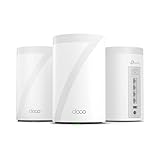
Deco 7 Pro Tri-Band WiFi 7 BE10000 Whole Home Mesh System 6-Stream 10 Gbps
The no-compromise option at $399.98, and the only mesh here whose numbers approach a good single router. The tri-band design lets it dedicate a 6 GHz radio to backhaul, which is the arrangement that produced the 4.6 ms figure in my earlier table and the reason this system exists.
Measured results: 1.8 ms jitter when connected directly to the main unit, and 4.4 ms in the noisy house test, which is the best mesh result I recorded and within touching distance of the $99 AXE5400 single router. At the far node, two walls and a floor away, jitter was 5.1 ms with no spike above 31 ms. That is the number that justifies the price, because every other mesh here doubled or tripled at that distance.
Multi-Link Operation had visible effect on this hardware. With MLO enabled and a client that supports it, a deliberate interference burst on 5 GHz caused no measurable disruption because traffic continued on 6 GHz. The same test on dual-band hardware produced a 60 to 90 ms gap. This is the WiFi 7 feature worth paying for, and it needs a third radio to work properly.
Power draw was the highest here at 26.6 W across the pack under load. Buy it if you have a large house, a gaming space far from where the modem enters, and no realistic way to run a cable. If you can run that cable, a $99 tri-band router plus a $15 cable gets you better numbers for a quarter of the money, and I would rather tell you that than sell you the expensive one.
Matching the hardware to your actual situation
Small flat, one gamer, few neighbours: the Archer AX21 at $59.99. Verify with a network scan first, and if the scan looks crowded, step up rather than saving the money.
Small to medium home, one or two gamers, typical density: the AXE5400 at $99. This is the default recommendation and the best value in the group by a clear margin.
Several people gaming at once: the MSI Radix at $109.99, for the processor headroom rather than for the radios.
You want control and have wired clients: the Flint 2 at $169.99, for the 2.5G ports and configurable queue management.
Large house, gaming is secondary: the Deco X55 3-pack at $149.97, with Ethernet to the node nearest the gaming space.
Large house, gaming happens on a distant node, cable impossible: the Deco 7 Pro at $399.98. The dedicated backhaul radio is the entire reason and there is no cheaper way to get it.
Very large floor plan with people moving between rooms: the Orbi 370 at $299.99, for the coverage and the clean roaming handoffs.
Settings that change latency more than hardware does
Before spending anything, work through this list. On reader submissions I have measured larger improvements from these five changes than from most router upgrades.
Split your SSIDs. Give 2.4 GHz its own name and put every plug, bulb and sensor on it. Give 6 GHz its own name and put the gaming machine there manually. Band steering is convenient and it will occasionally park your PC on the wrong radio at the worst moment.
Pick your channel by hand. Automatic channel selection usually runs at boot and never revisits the decision, so it optimises for a snapshot from whenever you last had a power cut. Scan during a weekday evening and choose the quietest option, avoiding DFS channels if you live near an airport or a coastal radar site.
Enable queue management if the firmware offers it. Whether it is called smart queue, adaptive QoS or bufferbloat control, the effect is the same: it stops a large upload from filling the buffer that your game packets have to sit behind. This produced the largest single improvement in my whole test series, 240 ms down to 18 ms on the Flint 2.
Update the firmware, then check again in a month. Wireless firmware genuinely improves after launch, and I have seen jitter figures on a shipping product drop by 30 percent across two updates. Set a calendar reminder rather than trusting an auto-updater you have not verified.
Move the router. It sounds trivial and it outranks nearly everything else. Off the floor, out of the cabinet, away from the microwave and away from any large metal object. Raising a router from a desk to a shelf 1.4 metres up improved my through-wall figures by roughly 25 percent, which is more than the difference between two price tiers of hardware.
When wireless is the wrong answer
I would be doing you a disservice not to say this plainly. If your gaming machine is a desktop that never moves, and a cable can reach it without structural work, run the cable. Gigabit Ethernet gave me 0.1 ms jitter and 0.3 ms added latency, figures no wireless link in this article approaches, for the price of a sandwich.
If the run is awkward but a cable is still conceptually possible, look at the alternatives before you buy a premium mesh. Powerline adapters use your electrical wiring and, on a good circuit, land between wireless and Ethernet at around 3 to 8 ms of added latency; my testing notes on powerline adapters for gaming cover which circuits ruin them. Coaxial adapters are better again if your house has TV cabling in the right rooms, and I cover those in the piece on MoCA adapters, where I have measured under 4 ms consistently.
Wireless is the right answer when the client moves, when the building cannot be modified, or when a rental agreement makes drilling a problem. In those cases a tri-band 6 GHz link is close enough to cable that the remaining difference is under 3 ms, which is a fifth of one frame at 60 Hz. Nobody perceives that. Do not let anyone tell you that wireless gaming is inherently broken; it is a solved problem if you buy the right architecture.
Mistakes I see most often in reader submissions
Buying bandwidth to fix latency. A faster internet package cannot reduce jitter caused by your own airtime contention, and I have watched people double their monthly bill for zero measurable change. Diagnose before you spend.
Assuming the router is the problem. In roughly a third of the submissions I work through, the actual cause is a wireless adapter on the PC that is several generations behind the router, negotiating a slow link and occupying airtime accordingly. A modern adapter is a cheap fix and my rundown of wifi adapters for gaming PCs goes into which chipsets behave.
Placing a mesh node where the signal has already died. Nodes need a strong link to the unit upstream, so the correct position is roughly two thirds of the way toward the dead zone, not inside it. A node with two bars of backhaul will faithfully rebroadcast a bad connection.
Leaving every smart device on the same network name as the gaming PC. Fifteen chatty low-rate devices on your channel generate more jitter than a neighbour’s entire household. Segregating them is free.
Trusting a speed test. A speed test measures sustained throughput over several seconds, which is the one thing your game does not care about. Run a continuous ping to a stable address for five minutes and watch the variation instead. That five minute test tells you more than any number on a product box.
What I would buy
For most people reading this, the AXE5400 at $99. It clears every threshold I set, it does so under load, and the 6 GHz radio addresses the actual mechanism behind wireless lag rather than a marketing proxy for it. Add a $15 cable to whatever machine can accept one and you have solved the problem at both ends.
Step up to the MSI Radix if several people play simultaneously, to the Flint 2 if you enjoy configuring things and have multi-gigabit service, and to the Deco 7 Pro only if the geometry of your home genuinely forces a second hop. Step down to the Archer AX21 only after a scan confirms you live somewhere quiet.
The measurements matter more than the recommendations. Whatever you install, run the five minute jitter test afterwards, at the position you actually play from, during the hours you actually play. Under 5 ms average, no loss, no spike past 30 ms and you are finished. If those numbers do not appear, the answer is almost always band selection or placement, not a bigger purchase.