The short version, because you probably came here for a recommendation rather than a lecture. If you want the lowest cost per pack and the tightest portion control, the Goldfish Crackers Big Smiles Variety Pack with Cheddar, Colors, and Pretzels, Snack Packs, 30 Ct at $12.86 works out to about $0.43 a pack, which is the cheapest sealed portion in this entire comparison. If you are feeding four or five people through a long session, the Snack Box Care Package Gift Box – Large Variety Snack, Candy & Treats for College Students, Adults, Kids, and Office Treats – 60 Count at $33.99 gives you the most sealed units for the money at roughly $0.57 each. If you eat at the keyboard and want the least mess on your hardware, the Nabisco, Classic Mix Variety Pack, Oreo Mini, Chips Ahoy! Mini, Nutter Butter Bites, Ritz Bits Cheese, 20 Snack Packs at $8.87 is the one I keep on my own bench. And if you simply want chips and you are willing to do the cleaning that chips require, the Frito-Lay Fun Times Mix Variety Pack, 40 Count at $22.43 is the better of the two Frito-Lay boxes here on price per pack.
I am Owen Pritchard, Technical Guides Editor here, and I have spent twelve years working on other people’s computers. My bench is a diagnostics station: POST cards, a drawer of spare parts for swap-testing, several OS images on labelled drives, and — relevant to this article — a steady stream of peripherals that people have sent in because something stopped working. A large share of those faults are not electrical. They are food. Sticky spacebars, scroll wheels that skip, keycaps whose legends have worn through in exactly the pattern of a right hand on WASD, mouse feet that no longer glide because the desk surface has a thin varnish of snack oil on it.
So I am not going to write about flavour. Plenty of people can do that better than me. What I can tell you is which of these boxes leaves residue on your hardware, which ones crumble into particles small enough to fall past a keycap skirt, what each one costs per sealed portion, and who should skip each pick entirely. That last part matters most, and I have made a point of stating it plainly for every product below.
Top 3 picks at a glance

Why a snack choice is really a hardware-maintenance decision
As an Amazon Associate we earn from qualifying purchases at no extra cost to you. Product prices and availability are accurate as of the date shown and are subject to change.


Here is the sequence that brings a keyboard to my bench. You eat something fried. Your fingertips pick up a light film of oil — not enough to notice, certainly not enough to make you get up and wash your hands mid-match. That film transfers to the keycaps. Oil is sticky, so it holds dust. Dust plus oil becomes a soft grey paste that collects in the gap between the keycap skirt and the plate. Over months, that paste works its way down the keycap stem. Eventually a key either feels gritty on the downstroke or stops returning cleanly.
The crumb pathway is different and faster. A typical keycap sits roughly 2 to 3 millimetres above the plate at the bottom of its travel, and the gap around the stem is wide enough to accept anything smaller than a grain of rice. Fine seasoning powder and shattered cracker dust go straight through. Large crumbs sit on top and get blown out easily with a can of air. So crumb size matters far more than crumb quantity, which is the opposite of what most people assume.
Mice are a smaller problem but a more annoying one. The scroll wheel encoder is the part that suffers: sugar dust in a scroll wheel produces an intermittent skip that feels exactly like a failing encoder, and I have swapped perfectly good mice for customers whose real problem was three months of sweet snacks. Mouse feet are easier — a sticky pad slows the glide noticeably, and a wipe with isopropyl restores it in seconds.
None of this is an argument against eating at the desk. It is an argument for choosing a snack format that does not fight your hardware, and for having a cleaning routine that matches what you eat. If you want the full routine and the kit that makes it painless, I wrote it up separately in our guide to the best PC cleaning kit.
The six criteria I use, in order of how much they actually matter
I want the decision framework in front of you before the product list, because otherwise the list just becomes a popularity contest. These are ranked. If a box fails on criterion one, no amount of variety saves it.
1. Oil transfer. Does the food leave a film on your fingertips? This is the single most damaging property because it is cumulative and invisible. My bench test is crude but repeatable: eat a portion, then press a fingertip firmly onto a clean spare keycap, wait thirty seconds, and wipe the keycap with a white microfibre. Fried potato and corn chips leave a visible mark every time. Baked crackers leave a faint one. Dry pretzels and most cookies leave nothing I can see.
2. Crumb size. Does the food break into pieces larger than about 2 millimetres, or does it shatter into powder? Bars and whole cookies are the best behaved. Thin fried chips and small baked crackers are the worst, because they fragment on the first bite and the fragments land in a cone around your hands.
3. Portion sealing. Can you take one unit and stop? A sealed single-serve pack imposes a decision point. An open bag does not. This is the reason variety boxes are worth their packaging premium for desk use even though they are poor value per ounce.
4. Cost per pack. Not cost per box. A 60 count box at $33.99 and a 20 count box at $8.87 look very different on the shelf and are almost identical per portion. I have put the full table below.
5. One-handed operation. Can you open and eat it without letting go of the mouse? Tear-notch pouches pass. Anything requiring two hands and a moment of concentration will either be opened during a loading screen or not at all.
6. Microphone noise. Hard, brittle, high-crunch foods produce sharp transients that headset noise suppression handles poorly, because the algorithms are tuned to remove steady noise floors rather than impulses. If you spend your evenings in voice chat with the same four people, this is a real consideration and they will tell you so.
Cost per sealed pack, compared
This is the table I wish existed on the product pages. Every box below is priced per sealed unit, which is the only number that lets you compare a 20 pack against a 60 pack honestly.
| Product | Brand | Count | Price | Cost per pack | Oil transfer | Crumb size |
|---|---|---|---|---|---|---|
| Goldfish Crackers Big Smiles Variety Pack | Goldfish | 30 | $12.86 | $0.43 | Low-moderate | Very small |
| Nabisco Classic Mix Variety Pack | NABISCO | 20 | $8.87 | $0.44 | Low | Small-medium |
| Dot’s Pretzels Twists 3-Flavor | Dot’s Homestyle Pretzels | 18 | $9.97 | $0.55 | High (seasoning) | Large |
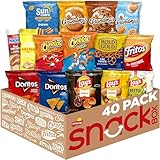
| Frito-Lay Fun Times Mix Variety Pack | Frito Lay | 40 | $22.43 | $0.56 | High | Small |
| Snack Box Care Package Gift Box | Zisbers | 60 | $33.99 | $0.57 | Mixed | Mixed |
| Ultimate Variety Sampler Care Package | LA Signature | 40 | $24.89 | $0.62 | Mixed | Mixed |
| CRAVEBOX Snacks Box Variety Pack Care Package | CRAVEBOX | 45 | $29.95 | $0.67 | Mixed | Mixed |
| Frito-Lay Ultimate Classic Snacks Package | Frito Lay | 40 | $26.91 | $0.67 | High | Small |
Two observations before we go item by item. First, the spread is narrower than the box prices suggest: from $0.43 to $0.67, a difference of 24 cents a portion. Over a hundred sessions at two packs each that is $48, which is real money but not decisive. Second, the assorted “care package” boxes cluster at the expensive end, and they are paying for breadth rather than for food. That breadth is worth something if you are feeding a group and worth nothing if you are feeding yourself.
The picks, and who should not buy each one
Ordered roughly by how often I would recommend them for a desk rather than a kitchen cupboard.
Goldfish Crackers Big Smiles Variety Pack with Cheddar, Colors, and Pretzels, Snack Packs, 30 Ct
At $12.86 for 30 packs this is the cheapest sealed portion here at roughly $0.43, and the portions are genuinely small, which is the point. The mix includes a pretzel variant, which is the driest and best-behaved item in the box from a hardware perspective, and two cracker variants that carry a light cheddar coating.
The trade-off is crumb size. These are small baked crackers and they fracture into small pieces, some of which are fine enough to pass a keycap skirt. In practice I find the residue is dry rather than oily, which means it blows out with compressed air instead of bonding to the plastic — a much better failure mode than the alternative. The cheese powder is present but light; a wipe on a napkin after each pack removes most of it.
Who should skip it: anyone buying for adults who want a substantial snack. These are child-sized portions and a hungry person will open three, which erases the cost advantage and triples the crumb load. Skip it too if your keyboard has no keycap skirt at all — low-profile laptop-style boards have very little clearance and small dry crumbs are harder to dislodge from them, not easier.
Nabisco, Classic Mix Variety Pack, Oreo Mini, Chips Ahoy! Mini, Nutter Butter Bites, Ritz Bits Cheese, 20 Snack Packs
This is what sits in the drawer under my bench, and it costs $8.87 for 20 packs, about $0.44 each. Three of the four items are dry cookies, which means essentially no oil transfer, medium-sized crumbs that stay on top of the keycaps, and a soft chew that barely registers on a boom microphone. The Ritz Bits Cheese is the outlier: it is a filled cracker with a light surface salt and it is the messiest of the four.
The other thing I like about it is the pack count. Twenty is a small commitment. If you are trying to work out whether the variety-box approach suits you at all, this is the cheapest possible test of the idea, and the box is small enough to store in a desk drawer rather than needing a shelf.
Who should skip it: anyone who is trying to reduce sugar. This is four sweet items and one savoury one, and the sweet ones are dense. Skip it if you snack during long late sessions and are sensitive to the energy dip that follows — a bar or a cracker is a much better choice at 11pm than three mini cookies. Also skip it if you are buying for a group; 20 packs disappears in one evening with four people.
Snack Box Care Package Gift Box – Large Variety Snack, Candy & Treats for College Students, Adults, Kids, and Office Treats – 60 Count
Sixty sealed units for $33.99 is roughly $0.57 each, and this is the box I would buy for a LAN or a household where more than one person raids it. The volume is the feature. With sixty units you can afford to have items nobody likes, because the box still delivers on the ones they do.
The candy component changes the maintenance picture in a specific way. Sugar residue on fingers is not oily, so it does not create the dust-binding film that fried food does, but it is hygroscopic — it picks up moisture from the air and becomes tacky. Tacky is worse than greasy on a scroll wheel and better than greasy on a keycap. The practical answer is a damp cloth on the desk mat once a week rather than a dry one.
Who should skip it: a solo player. Sixty units is somewhere between six weeks and three months of one person’s snacking, and assorted boxes are not chosen for shelf life — the items you like will go first and you will be left with a box of the ones you do not. Skip it also if you want any control over the ratio of sweet to savoury, because assorted boxes vary batch to batch.
Frito-Lay Fun Times Mix Variety Pack, 40 Count
Forty packs at $22.43 is $0.56 each, which makes this the better value of the two Frito-Lay boxes here by about 11 cents a pack. If you want chips at the desk, buy this one rather than the more expensive Ultimate Classic box unless the specific flavour assortment matters to you.
I am not going to pretend chips are good for your hardware. Fried snacks are the worst performer on my oil-transfer test by a wide margin, they fragment into small sharp pieces, and the seasoning on the flavoured varieties is fine enough to reach the switch plate. What I will say is that the damage is entirely manageable if you accept a rule: chips mean you wash your hands afterwards, before you touch the keyboard again. That single habit removes most of the problem. The residue that lands on the keycaps from the bag itself is minor compared with what your fingers deposit.
Who should skip it: anyone with a keyboard they care about who knows they will not get up to wash their hands. Be honest with yourself here. Skip it also if you play with a boom mic in a competitive team environment — a bag of chips at the desk is the single loudest thing in this comparison over voice chat, and you will be asked to stop.
CRAVEBOX Snacks Box Variety Pack Care Package (45 Count) Back to School Treats Gift Basket Adults Kids Grandkids Guys Girls Women Men Boyfriend Birthday Cookies Chips College Student Office
Forty-five units at $29.95 comes to about $0.67 a pack, tied for the most expensive portion here. What you get for that is the widest assortment in the comparison — the listing spans cookies and chips and everything between — which makes it a reasonable choice for a shared space where you cannot predict who will be eating.
Assorted boxes like this one are a hedge, and hedges cost money. The value calculation is straightforward: if you would otherwise buy three different smaller boxes to get the same spread, this is cheaper and takes less shelf space. If you already know what you like, it is a 24-cent-per-pack premium over the Goldfish box for the privilege of not choosing.
Who should skip it: anyone on a budget who knows their preferences. At $0.67 a pack you are paying the highest per-portion price in the comparison for variety you may not need. Skip it too if the chip component bothers you, because you cannot control the ratio and you will end up with fried items in a box you bought for the cookies.
Ultimate Variety Sampler Care Package 40 Count – Ready To Gift Assorted Snacks With Cookies Chips Bars Popcorn Crackers For Adults Kids Grandkids Office Break Rooms School Snacks Camp Snack Birthday College Student Offic
Forty units at $24.89 is $0.62 each, sitting between the CRAVEBOX and the Zisbers box on price. The distinguishing feature in the listing is the inclusion of bars and popcorn alongside the usual cookies, chips and crackers, and both of those formats are better desk food than they get credit for.
Bars are the best-behaved snack format there is for someone typing. They are eaten one-handed, they break into large pieces or none at all, they leave nothing on the fingers unless they are chocolate-coated, and they are nearly silent. Popcorn is the opposite on crumb size — it sheds hulls and small fragments constantly — but it is dry, so the fragments brush off rather than bonding.
Who should skip it: anyone who wants a predictable box. Assorted samplers vary, and if the bars are the reason you are buying, a dedicated bar multipack gives you certainty for less money. Skip it also if you are the only one eating from it, for the same reason as the other 40-plus count boxes: assortment plus a single palate equals leftovers.
Dot’s Pretzels Twists, 3-Flavor Snacks Variety Pack, 18 count
Eighteen packs at $9.97 works out to about $0.55 each. Pretzels are structurally the best snack in this comparison for hardware: they are baked rather than fried, they break into large chunks, and plain pretzel dust is coarse enough to sit on top of a keycap rather than falling past it.
The complication is the seasoning, which is the entire point of this particular product. A heavily seasoned pretzel carries a buttery powder coating, and that coating behaves like oil once it is on warm fingertips. In my keycap test this scored closer to the fried chips than to a plain cracker, which surprised me the first time I ran it. The other issue is acoustic. A dense pretzel twist is the hardest, sharpest crunch of anything here, and headset noise suppression consistently lets it through.
Who should skip it: anyone who plays in voice chat with people they do not want to annoy. Skip it also if you were choosing pretzels specifically because you thought they would be the clean option — plain pretzels are, but seasoned ones are not, and this is a seasoned product. And at 18 packs it is the smallest count here, so it is not a group purchase.
Frito-Lay Ultimate Classic Snacks Package, Variety Assortment of Chips, Cookies, Crackers, & Nuts, 0.56 ounces, (Pack of 40) (Packaging May Vary)
Forty packs at $26.91 is $0.67 each, tied for the highest per-portion cost in this comparison, and the listed pack size of 0.56 ounces makes these genuinely small portions. That works out to roughly $1.20 per ounce of food, which is the sort of number that explains why single-serve packaging exists as a business.
What you are buying is breadth within a single brand family: chips, cookies, crackers and nuts in one box. The nut component is the interesting addition, because nuts are dense, satisfying and quiet, and they are the only item in this box I would eat during a session where I actually need to concentrate. The chips carry the same oil-transfer caveat as every fried item here.
Who should skip it: almost anyone choosing on price, because the Fun Times Mix from the same brand delivers the same count for $4.48 less. Buy this one only if the specific assortment appeals to you. Skip it as well if 0.56 ounces sounds too small to be worth opening — for a lot of adults it is, and the answer to a portion that small is usually a second portion.
Grease grades: what actually reaches your keycaps
My rubric has four grades, and it is worth spelling out because it explains most of the recommendations above.
Grade A, negligible transfer: plain dry cookies, bars, unseasoned pretzels, popcorn. Fingertip test leaves nothing visible on a white microfibre. These are the foods you can eat mid-match without a hand wash.
Grade B, light transfer: baked crackers with a dusted coating, chocolate-covered items in a cool room. A faint mark on the cloth. Manageable with a napkin between packs.
Grade C, powder transfer: heavily seasoned baked goods. No liquid oil, but a fine powder that carries fat and behaves like oil once it warms up on skin. A clear mark on the cloth. This is where seasoned pretzels land, and it is why they score worse than their dry structure suggests.
Grade D, oil transfer: anything fried. An obvious, spreadable mark. Wash your hands.
The reason I grade the food rather than the packaging is that packaging does not touch your keyboard and food does. A box can contain items from three different grades, which is exactly why the assorted care packages are hard to score as a unit and why I have marked them “mixed” in the table.
Portion sealing versus the open-bag problem
The strongest argument for buying variety boxes is behavioural rather than nutritional. An open bag next to a mouse has no stopping point. A sealed pack has one built in, and the act of tearing a second pack is a small conscious decision in a way that reaching into a bag is not.
There is a hardware version of the same argument. An open bag sits horizontally on the desk with its contents exposed, usually within the arc your right arm sweeps when you move the mouse. Knocked bags are how snack fragments end up inside a keyboard case rather than on top of it. A sealed pack that you open, empty and discard spends far less time in that danger zone.
The cost of the sealing is real, though, and I would rather be straight about it: you are paying roughly two to three times the per-ounce price of a family bag for the packaging. If the portion control is not something you need, buy the big bag, keep it in the kitchen, and decant what you want into a bowl. A bowl on a coaster to the left of the keyboard is, honestly, the cheapest and cleanest solution of all — it just requires you to get up.
What belongs at the desk and what belongs in the kitchen
I keep two categories. Desk food is dry, one-handed, low-transfer and quiet: bars, plain cookies, whole crackers, nuts. Kitchen food is everything else — chips, anything with a sauce, anything that needs two hands. The rule is not about discipline, it is about proximity. If the fried snack is nine metres away in a cupboard, you eat it during a break, which is when you should be eating it anyway.
Session structure matters more than snack choice for most people. A three-hour block with a five-minute break at the hour mark gives you three natural eating windows, three chances to stand up, and three opportunities to wash your hands. Snacking continuously across the same three hours delivers the same calories with worse concentration and considerably more residue on the hardware.
One more practical note about heat. A machine under load pushes warm air out of the case and across the desk, and a desk that runs a few degrees above room temperature will soften chocolate and make seasoning powders tackier. If your snacks are melting where they sit, that is worth noticing for reasons beyond snacks — our guide on how to fix PC overheating covers what to do about a case that is dumping that much heat into the room.
Snacks and voice chat: the microphone problem nobody plans for
A boom microphone typically sits 2 to 5 centimetres from the corner of your mouth. That is close enough that chewing sounds arrive at a level comparable to speech. Modern noise suppression is good at removing steady noise — a fan, a hum, distant traffic — because those signals are statistically stable. Impulsive sounds are the hard case, because the transient onset of a crunch resembles the onset of a consonant.
The ranking, from loudest to quietest across the products here: seasoned pretzel twists, fried chips, baked crackers, mini cookies, bars. If you are on a team channel, that ranking is your buying guide, and it points squarely at the Nabisco box. Push-to-talk solves the problem completely, and if you use open-mic because your team prefers it, the polite move is to mute manually rather than to trust the software.
The cleaning routine that makes any of this fine
Every fortnight: unplug the keyboard, turn it upside down, tap it firmly over a bin, then run a can of compressed air across the switch plate in short bursts held at an angle rather than straight down. Wipe the keycaps with a microfibre lightly dampened with 70% isopropyl. Wipe the mouse, paying attention to the seam either side of the scroll wheel and the four glide pads underneath. Ten minutes, start to finish.
Every three to four months, or every six weeks if you eat fried food at the desk: pull the keycaps with a wire puller, photograph the layout first so you can reassemble it, and soak the caps in warm water with a drop of dish soap for twenty minutes. Rinse, spread on a towel, leave to dry for at least two hours — longer if you live somewhere humid. Meanwhile clean the exposed plate with a soft brush and isopropyl. Budget about 40 minutes of hands-on work.
Two things to avoid. Do not use alcohol on printed legends unless you already know they are doubleshot or dye-sublimated, because pad-printed legends will lift. And do not use a vacuum cleaner on a keyboard with removable keycaps unless you enjoy hunting for a spacebar stabiliser in a dust bag.
Matching a box to your actual session length
Work backwards from how you play. A person doing four two-hour evenings a week at two packs per evening consumes about 32 packs a month. On that pattern the Goldfish 30 count is a monthly buy at $12.86, the Nabisco 20 count runs out in under three weeks, and the 60 count Zisbers box lasts nearly two months at $33.99 — which is the cheapest of the three on a monthly basis despite the highest sticker price.
A weekend-only player doing one long six-hour session consumes three or four packs a week, or roughly 15 a month, and should buy the smallest box that suits their taste rather than the best per-unit price, because staleness becomes the binding constraint before cost does.
A group of four doing a monthly all-day session will get through 30 to 40 packs in a day. That is one Zisbers or CRAVEBOX box per event, and the assorted format earns its premium here because you are catering for four sets of preferences you do not control.
Common mistakes I see on desks
Putting the snack to the right of the mouse. Your mouse arm sweeps that space constantly and the collision is a matter of time. Left of the keyboard, behind the monitor stand, or on a separate surface entirely.
Buying a large box for one person on the assumption that variety keeps it interesting. It does the opposite: you eat the four items you like, and the remaining forty are the ones you did not choose.
Treating “baked” as a synonym for “clean”. Baked crackers with a seasoning coating transfer more residue than plain fried nuts do. The coating matters more than the cooking method.
Eating with one hand while the other stays on the mouse for four hours straight. This is bad for concentration and worse for your wrists. If you find yourself doing it, the snack is not the problem, the session length is.
What I would actually order
For my own bench, where I care most about keeping oil off the hardware and where I am the only one eating: the Nabisco 20 pack at $8.87. Low transfer, medium crumbs, quiet on a mic, and the small count means the box does not go stale.
For a household where more than one person is playing and the box needs to survive a month: the Zisbers 60 count at $33.99. Best cost per sealed unit at scale, and the breadth stops arguments.
For the cheapest per-portion sealed snack, full stop: the Goldfish 30 count at $12.86. Accept that the crumbs are small and dry, keep a can of air in the drawer, and it is a genuinely good desk snack.
And if none of that is the point and you just want chips: the Frito-Lay Fun Times Mix at $22.43, with the hand-washing rule attached. It is $4.48 cheaper than the other Frito-Lay box for the same forty packs, and the only thing standing between fried snacks and a healthy keyboard is a sink.
Related guides
- Windows Macos Linux Gaming Performance Comparison Strengths Weaknesses
- Desktop Operating Systems Gaming Performance Strengths Weaknesses
- 5G Home Internet Wifi Modem Settings Low Latency Gaming