The complaint I hear most often about long sessions is not about hardware. It is that everything goes soft around hour three. Aim gets loose, decisions get slow, and the fix that people reach for is a fresh energy drink or a bigger snack, which buys about forty minutes and then makes the next dip worse. Meanwhile the keyboard picks up a film that turns the WASD keycaps shiny, and the session gets interrupted four times by trips to the kitchen because nothing edible is within reach.
I spend my working life at a diagnostics bench with POST cards, a shelf of spare parts for swap-testing and several OS images, and the one habit twelve years of that work drills into you is this: change one variable, observe, then change the next. When I finally got tired of my own hour-three slump I ran the same procedure on my desk. Same game, same hours, same chair, one variable changed per week. What follows is the result, ordered the way I would order any fault-finding list, most likely cause first. The eight multipacks at the end are the specific things I keep in the drawer now, with prices, counts, real cost per serving and a plain statement of who should skip each one.
Top 3 picks at a glance

The fix, ordered by how likely it is to be your actual problem
As an Amazon Associate we earn from qualifying purchases at no extra cost to you. Product prices and availability are accurate as of the date shown and are subject to change.


Work down this list and stop when the symptom goes away. Most people fix it at step one or two and never need the rest.
1. Portion size, not food choice. The single most common cause is eating one large quantity in one sitting, usually early, usually while distracted. A family bag beside the mouse has no stopping point, so a portion becomes a continuous grazing session. Replace it with individually sealed single-serve bags and eat one at a time. This alone accounted for most of the improvement in my own logs and it costs nothing to test, since you can portion a big bag into sandwich bags before you sit down and get the same result for a week before you buy anything.
2. Spacing. Two portions two hours apart behave completely differently from two portions eaten back to back at the start. Set the interval at roughly ninety minutes and put the next portion out of arm’s reach so that taking it requires standing up. The standing up is doing half the work here, which brings us to the next point.
3. You are not moving. Four hours in one position produces something people frequently misread as hunger. Before you eat anything at hour three, stand, walk to the other side of the room, drink water, and come back. If the fog clears in five minutes it was not food. That test takes two minutes and saves you a portion.
4. Hydration. Salt-heavy snacks with no water beside them is the most common pairing on a gaming desk and the one that most reliably produces a headache by hour four. A bottle of plain water at the desk, refilled once, changed more for me than any change of snack. It also costs nothing.
5. What you are eating. Only now does the specific product matter, and it matters less than the first four items. Chips versus cookies versus crackers is a preference question with a real but secondary effect. If you got here and still feel the slump, mixing formats within a session, something salty and crunchy at one break, something sweeter and lighter at the next, worked better in my logs than either alone.
6. Contamination and interruption. The last category is not about how you feel but about how the session runs. Greasy fingers on keycaps, crumbs in the switch gaps, and repeated trips to the kitchen are all solved by product format and desk layout rather than by nutrition. A drawer of sealed single-serve bags removes the kitchen trips entirely. Where you place them removes the grease.
Why hour three is when it falls apart
I am an editor of technical guides, not a nutritionist, so take what follows as the pattern I recorded rather than as clinical advice. What I saw in my own notes across several weeks was consistent enough to be worth describing. On sessions where I ate one large quantity of something sweet and salty in the first hour, the noticeable dip landed somewhere between two and a half and three and a half hours in, and it was severe enough that I could see it in my own performance without any special measurement, just the round-by-round outcome in a game I have played for years.
On sessions where the same total amount of food was split into three small portions spaced across the same period, the dip either did not arrive or arrived late and mild. The total calories were similar. The distribution was not. This is not a controversial idea and it is roughly what most people report, but almost nobody applies it at a desk because the desk default is one big open bag.
There is a second factor that has nothing to do with food. Sustained focus at a screen is genuinely tiring on its own, and around the two to three hour mark most people need a real break regardless of what they have eaten. Eating something is an easy way to convince yourself you took a break when you did not. If your snack breaks all happen without leaving the chair, you are not taking breaks, you are eating while working. Splitting the two apart, food away from the desk, breaks that involve standing, was the single change with the largest effect on how I felt at hour five.
The contamination problem nobody budgets for
Grease is the quiet cost of desk snacking. Seasoned chips leave an oily residue on your fingertips that transfers straight to keycaps, mouse buttons and the mat. It does not show up on day one. It shows up three months later when the WASD cluster and the space bar have a distinctly different sheen from the rest of the board, when the mouse’s side grip feels tacky, and when a cloth wipe no longer takes it off.
Crumbs are worse in a different way. Small hard fragments work down between keycaps and sit on the switch plate. On most boards this is a cleaning job rather than a failure, but it makes an audible difference long before it makes a functional one, and on boards without removable keycaps the cleaning job is unpleasant. If you have ever wondered why a keyboard developed a slightly dead-sounding key, look under the cap before you look anywhere else.
Two habits fix nearly all of it, and neither requires buying anything. First, food lives outside the peripheral arc. Draw an imaginary line around where your keyboard, mouse and mat sit, and put the snack outside it, ideally on a different surface at a different height. Second, a small folded towel beside the mat, touched before you touch the mouse again. That is the entire protocol. If you are already past this point and the board is grimy, the sensible order is a full clean before you change anything else, and a proper kit makes that a fifteen minute job rather than an afternoon, which I have covered in detail in the PC cleaning kit guide.
Format matters here too. Crackers and cookies shed dry crumbs that vacuum out easily. Seasoned chips shed both crumbs and oil, and the oil is the part that does not come out. If your setup uses light-coloured keycaps or a fabric mat you will care about this distinction a lot more than someone with a black board and a hard mat.
Portion control is a hardware problem, not a willpower problem
The reason single-serve packaging works is that it introduces a physical stopping point into a process where none exists. An open family bag has no natural end short of the bottom of the bag. A sealed one ounce bag ends after one ounce, and finishing it involves a deliberate second decision, which is exactly the decision point most people need.
The trade is cost per ounce. A 40 count multipack of single-serve bags will always cost more per ounce than the equivalent weight in large bags. In this group the multipacks land roughly between forty-four and sixty-seven cents per serving. You can beat that on a per-ounce basis with a big bag and no packaging. What you cannot beat is the stopping point, and if the stopping point is the actual problem, the extra cost is buying the thing you needed.
There is a cheaper version of this and I recommend testing it before spending anything. Take a large bag, portion it into small resealable bags on a Sunday, put them in a drawer, and run a week. If the hour-three slump improves, the mechanism is confirmed and you can decide whether the convenience of factory-sealed packs is worth roughly twenty cents a serving to you. For me it was, because the Sunday portioning job is exactly the kind of chore that quietly stops happening by week three.
How I tested this, and what the method cannot tell you
The method was deliberately simple. Same game, same three-hour to five-hour evening window, same chair and desk layout, one variable changed per week. Week one was the baseline, one large bag, no water. Week two split the same food into portions. Week three added spaced timing and moved the food off the desk. Week four introduced a standing break at ninety minutes. I logged how I felt at hour three on a crude one to five scale and noted anything obvious about performance in a game where I have enough hours to recognise my own bad nights.
What the method can tell you: whether a change makes a noticeable difference to one person under fairly controlled conditions. What it cannot tell you: anything generalisable, anything about the underlying physiology, and anything that survives a bad night’s sleep, which overwhelms every other variable on this list and did so twice during the test. If you sleep badly, no snack arrangement will save the session, and I would stop reading here and fix that instead.
Two things surprised me. The first was how much of the effect came from the standing break rather than the food, which was not what I expected going in. The second was how strongly format preference shifted across a session. Salty and crunchy worked for me at the first break and felt wrong at the third, where something lighter and sweeter was clearly better. That is a preference, not a finding, but it does argue for keeping two formats in the drawer rather than committing to one.
How to read the eight packs below
These are all multipacks of individually sealed single-serve items, which is the format that solves the portion problem. Judge them on four things and ignore the rest.
Count and cost per serving. Divide the price by the number of items. That number, not the sticker price, is what you are actually comparing. The spread here runs from about $0.44 to about $0.67 per serving, which is more than a fifty per cent difference between the ends.
Format mix. Chips only, cookies and crackers only, or a genuine mix. A mixed box is worth more than its cost per serving suggests if you get bored quickly, and worth less if you know you will only eat two of the five things in it.
Grease profile. Seasoned chips leave residue. Cookies and crackers largely do not. If your peripherals matter to you, this belongs in the decision.
Who it is genuinely for. Several of these are sold as gift boxes and care packages, and the pricing reflects the presentation as much as the contents. If you are buying for your own drawer, presentation is worth nothing to you.
The eight packs, with the case against each
Lay’s Potato Chips, 4 Flavor Variety Pack, 1 oz Single Serve Bags, (40 Pack)
At $18.98 for 40 bags this is about $0.47 per serving, the second cheapest per unit in the group and the cheapest of the chip-focused options. Four flavours across forty one-ounce bags is the plainest possible version of the format, and plain is an advantage here. One ounce is a sensible desk portion, small enough that finishing it does not feel like a meal and large enough that you do not immediately open a second.
This is the pack I would hand to someone testing the single-serve idea for the first time, because the cost of being wrong is under twenty dollars and there is nothing exotic in the box to leave uneaten. Four flavours also means the rejection risk is low, since most people who like potato chips at all will eat at least three of four.
Who should not buy it: anyone who cares about keeping peripherals clean and is not willing to change desk habits, because potato chips are exactly the seasoned, oily category that transfers to keycaps. Also anyone who wants variety across formats rather than flavours, since this is forty bags of the same thing in different seasonings and boredom is a genuine risk by week three.
Frito-Lay Fun Times Mix Variety Pack, 40 Count
$22.43 for 40 works out to roughly $0.56 per serving. The step up from the Lay’s pack is format variety rather than quantity, and that is worth about nine cents a serving if you are the sort of person who tires of one texture. Forty single-serve items is roughly a month of two-portion evenings for one person, or about two weeks if the room is shared.
Practical note on all the 40 count boxes: they take more drawer space than people expect. Mine lives in the second desk drawer with the box lid cut down, which keeps everything visible. A box shoved in a cupboard is a box you will walk past to the kitchen instead of opening, which defeats the point of buying it.
Who should not buy it: anyone who already knows exactly what they reach for. Mixed boxes always leave a residue of the least popular item, and paying a variety premium to then let four items go stale is worse value than buying the single-brand pack. Also a poor fit if you want anything other than savoury snacks, because this is a savoury box.
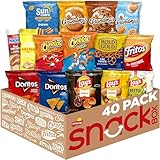
Frito Lay Flamin’ Hot Mix, 6 Flavor Single Serve Cheetos, Doritos, Chester’s & Funyuns Variety Pack, (40 Count)
Same price and count as the Fun Times box, $22.43 for 40, so the same $0.56 per serving, with six flavours built around the hot seasoning family. If that is your preference this is straightforwardly the widest selection in the group at that price, and six flavours across forty items is the highest variety-to-cost ratio here.
The thing worth flagging honestly is that heavily seasoned snacks are the worst offenders for finger residue. The coloured seasoning is visible on your fingertips, which at least has the virtue of being obvious, unlike plain oil. If you buy this box, the towel beside the mat stops being optional. I would also keep it away from any light-coloured keycaps or a pale desk mat entirely.
Who should not buy it: anyone sharing the box with people who do not want hot seasoning, since six flavours of the same profile means there is no fallback item. Also anyone who plays with a controller, where seasoning on the thumbsticks and grips is harder to clean than a keyboard and much harder to ignore.
Frito-Lay Snacks Variety Pack 35, Classic Mix, 1 Count
$21.24 for 35 items is about $0.61 per serving, which makes it more expensive per unit than the 40 count boxes above despite the lower sticker price. That is the exact trap that catches people comparing headline prices. Five fewer items for a dollar and change less money is a worse deal, and the only reason to choose it over the 40 count Fun Times box is if the specific classic selection matches your preferences better.
Do the division on every one of these before you decide anything. It takes ten seconds and it reorders the list. Sticker price ranks this box third cheapest of the eight; cost per serving ranks it sixth.
Who should not buy it: anyone optimising for cost, since two other savoury boxes here beat it per serving. It makes sense mainly if the classic mix is specifically what you want and the alternatives contain items you know you will not eat, in which case a higher cost per serving on things you actually eat beats a lower cost on things you do not.
Frito-Lay Ultimate Classic Snacks Package, Variety Assortment of Chips, Cookies, Crackers, & Nuts, 0.56 ounces, (Pack of 40) (Packaging May Vary)
At $26.91 for 40 this is roughly $0.67 per serving, the highest unit cost in the group. What you get for it is the broadest format range of any single-brand option here, chips alongside cookies, crackers and nuts, which is the mix my own logs favoured across a long session rather than a short one. The listed 0.56 ounce size also means individual items are smaller than the one ounce Lay’s bags, so read the count and the size together rather than assuming a serving is a serving.
Format range is the argument for this box and it is a real one. Having something crunchy and savoury for the first break and something sweeter for the third, from one box, is genuinely more useful across a five hour evening than forty bags of chips. Whether that is worth twenty cents a serving over the Lay’s pack is a judgement call, and for a five hour session I think it is; for a two hour session it clearly is not.
Who should not buy it: anyone on a tight budget, since it is the most expensive per serving here and the gap is large. Also anyone who only plays short sessions, where format variety within one evening is irrelevant because you are only eating once.
Nabisco, Classic Mix Variety Pack, Oreo Mini, Chips Ahoy! Mini, Nutter Butter Bites, Ritz Bits Cheese, 20 Snack Packs
$8.87 for 20 snack packs is roughly $0.44 per serving, the lowest cost per serving of the eight, and the lowest total outlay by a wide margin. It is also the only pack here built around cookies and crackers rather than chips, which makes it the cleanest option for anyone worried about peripherals. Dry crumbs vacuum out. Chip oil does not come off keycaps.
The low total price makes this the sensible first purchase for testing whether the whole single-serve approach works for you. Under ten dollars to find out is a reasonable price for an experiment, and if the answer is no you have lost the cost of a coffee rather than the cost of a 40 count box.
Four sub-brands in one box also gives real variety at the cheapest unit price here, which is unusual. Cheapest per serving is normally the least varied option and it is not in this case.
Who should not buy it: anyone who wants savoury chips, since this is almost entirely the sweet and cracker end. Also worth noting the count is half that of the 40 count boxes, so at two portions an evening it is roughly ten evenings for one person. If you are buying for a shared room you will be reordering constantly, and the reordering is a bigger annoyance than the price difference.
Ultimate Variety Sampler Care Package 40 Count – Ready To Gift Assorted Snacks With Cookies Chips Bars Popcorn Crackers For Adults Kids Grandkids Office Break Rooms School Snacks Camp Snack Birthday College Student Offic
$24.89 for 40 items is about $0.62 per serving. The pitch is breadth, cookies alongside chips, bars, popcorn and crackers, which is wider than any single-brand box here. Bars and popcorn are the two formats absent from every other option on this list, and both are genuinely useful at a desk. A bar is the least messy thing you can eat at a keyboard by a large margin, and popcorn is bulky enough per calorie to feel like a real portion.
Be clear about what the pricing includes. This is sold as a ready-to-gift care package, and part of the cost is presentation rather than contents. For your own desk drawer that presentation is worth nothing. It is worth something if you are actually sending it to a student or a friend, which is a legitimate use and probably the main one.
Who should not buy it: anyone buying purely for their own drawer on a budget, since two boxes here give you forty items for less. Mixed samplers also carry the highest rejection risk of any format, because with five categories in one box the odds that you dislike at least one whole category are high, and a rejected category in a mixed box is several wasted items rather than one.
Snack Box Care Package Gift Box – Large Variety Snack, Candy & Treats for College Students, Adults, Kids, and Office Treats – 60 Count
$33.99 for 60 items is roughly $0.57 per serving, and it is the largest box here by fifty per cent. For a shared room, a household with more than one player, or an office corner, the count is the real argument. Sixty single-serve items at two portions an evening is around a month for two people, and the per-serving cost sits mid-pack rather than at the expensive end, which is unusual for a gift-presentation box.
The candy and treats component is worth thinking about against everything said earlier. If your problem is the hour-three slump and you have not yet fixed portion size and spacing, a box weighted toward sweets is the one most likely to make that worse. If you have already fixed those things, it is fine and the variety is welcome. Order of operations matters here more than the product does.
Who should not buy it: a solo player, because sixty items of mixed candy and snacks will outlast your interest in most of them and staleness is a real cost on an opened box. Also anyone specifically trying to avoid a sweet-heavy selection, since that is a substantial share of what is in it.
Everything compared
| Pack | Items | Price | Cost per serving | Profile | Best for |
|---|---|---|---|---|---|
| Nabisco Classic Mix Variety Pack | 20 | $8.87 | $0.44 | Cookies, crackers | Cheapest test, cleanest for peripherals |
| Lay’s 4 Flavor Variety Pack | 40 | $18.98 | $0.47 | Potato chips only | Best value at volume |
| Frito-Lay Fun Times Mix | 40 | $22.43 | $0.56 | Mixed savoury | Savoury variety without the heat |
| Frito Lay Flamin’ Hot Mix | 40 | $22.43 | $0.56 | 6 hot-seasoned flavours | Widest single-profile selection |
| Zisbers Snack Box Care Package | 60 | $33.99 | $0.57 | Snacks, candy, treats | Shared rooms and multi-player households |
| Frito-Lay Snacks Variety Pack 35 | 35 | $21.24 | $0.61 | Classic savoury mix | Only if the specific selection fits |
| LA Signature Ultimate Variety Sampler | 40 | $24.89 | $0.62 | Cookies, chips, bars, popcorn, crackers | Widest format range, gifting |
| Frito-Lay Ultimate Classic Snacks Package | 40 | $26.91 | $0.67 | Chips, cookies, crackers, nuts | Long sessions needing format variety |
Two observations from that table. First, sticker price and cost per serving rank these differently, and the Frito-Lay Snacks Variety Pack 35 is the clearest example of a low sticker price hiding a mid-table unit cost. Second, the spread between cheapest and most expensive per serving is twenty-three cents, which across two portions an evening for a month is around fourteen dollars. That is real but it is not enormous, so if a more expensive box is the one you will actually eat, buy that one.
What a session actually costs
Two portions an evening, five evenings a week, is ten servings a week. At $0.47 per serving that is $4.70 a week, or roughly $245 a year. At $0.67 it is $6.70 a week, or about $348. The gap over a year is about a hundred dollars, which is the price of a decent mouse.
Put that against the alternative most people are actually running, which is a delivery order or a trip to a shop somewhere in the middle of a long session. One of those exceeds a week of single-serve packs, and it also costs you twenty minutes and the momentum of the session. If the drawer full of sealed packs prevents even two of those a month, the entire snack budget pays for itself and returns change.
The other cost worth naming is peripheral wear. A mat that has absorbed enough oil to feel tacky gets replaced. Keycaps that have gone shiny do not go back. Neither is expensive on its own, and neither is caused by any specific product on this list, but both are caused by eating at the keyboard rather than beside it, which is a free change.
Setting up a two-tier snack station
The layout that worked best for me has two tiers, and the distinction between them is the whole point.
Tier one, within reach: water only. A bottle or a lidded cup, positioned behind and to the side of the mouse rather than in front of anything, on a coaster or a hard surface rather than on the mat. That is the entire contents of tier one. Nothing you eat lives here.
Tier two, out of reach: the box of sealed single-serve packs, in a drawer or on a shelf that requires standing up. Getting a snack should cost you a stand and three steps. That small friction is doing the timing work for you without any conscious effort, and it converts a snack into a break, which is the behaviour you actually wanted.
A third element that helped more than it should: a small towel folded beside the mat. It sounds fussy. It is the difference between clean peripherals after a year and a board you are embarrassed to photograph. Anyone who has taken a keyboard apart to clean it properly, and I have taken apart a lot of them on the bench, ends up doing this.
One more layout note. If you have a cluttered desk with cables running across the surface, food and open drinks are a genuinely bad combination with them. Sorting the cable routing first makes everything else on this list easier to keep tidy, and I have written up the approach in the cable management guide.
Drinks: the variable that undoes all of this
You can get every part of the food side right and still lose the session to what is in the cup. The pattern I see most often is a large caffeinated drink in hour one, a second in hour three when the first wears off, and then a wrecked night’s sleep that makes the next day’s session worse than the one you were trying to rescue. That is a loop and it compounds across a week.
The arrangement that worked for me was plain water as the default at the desk, with anything caffeinated deliberately placed early rather than late, and nothing after the mid-point of the evening. That is not a rule anyone needs to follow, but the general shape of it, water as the baseline and stimulants placed early rather than used as a rescue at hour three, was more useful than any change I made to the food.
Sugary drinks deserve one specific warning that has nothing to do with energy. A knocked-over sugary drink into a keyboard is a substantially worse outcome than water, because the residue makes switches sticky after it dries even if the board survives the initial spill. Lids exist. Use one, and keep the cup behind the plane of the keyboard so that a knock sends it away from the board rather than into it.
What to keep off the desk entirely
A short list, learned the annoying way.
Anything requiring two hands or cutlery. If eating it means letting go of both mouse and keyboard and looking away, it is a kitchen table item, not a desk item. That is fine. Take the break properly and go eat it there.
Anything that drips. Fruit, sauces, anything with a wet component. The failure mode is not dramatic, it is a slow accumulation of sticky spots on the desk surface that eventually transfer to the mat.
Open family bags. Covered at length above. No stopping point, maximum residue exposure, and they go stale between sessions anyway.
Anything that needs to stay hot. A hot meal at the desk becomes a cold meal at the desk, and cold food eaten distractedly is how you end up eating a second one an hour later.
Who should buy nothing here
If you play in ninety minute sessions, you do not need a snack system and buying a 40 count box will mostly produce stale snacks. Drink water and eat before or after.
If your problem is specifically that you feel wrecked at hour three and you have not yet tried spacing, standing breaks and water, fix those first. They are free and in my own testing they accounted for more of the improvement than anything I bought. Buying a box of snacks to solve a problem caused by not moving for four hours is treating a symptom.
And if you want to test the mechanism before spending anything, portion a large bag you already own into small bags, put them in a drawer across the room, and run a week. If it helps, then buy the sealed packs for the convenience. If it does not, you have learned something useful for the cost of ten minutes and a box of sandwich bags.
This guide covers one angle on the topic. For the full comparison, see our main guide: Best Snack Brands for a Gaming Setup, Judged by What They Leave Behind.
Final verdict
Start with the Nabisco Classic Mix at $8.87 for 20 packs. It is the cheapest way to find out whether single-serve portioning fixes your hour-three problem, it is the lowest cost per serving in the group at roughly $0.44, and it is the format least likely to leave residue on your peripherals.
If it works and you want volume, the Lay’s 4 Flavor Variety Pack at $18.98 for 40 bags is the best value at scale here, about $0.47 per serving, provided you accept that potato chips demand the towel-and-layout discipline described above.
For long evenings where one format gets tiring, the Frito-Lay Ultimate Classic Snacks Package at $26.91 gives the widest range within a single brand, and the extra twenty cents a serving over the Lay’s pack buys the ability to switch textures across a session. For a shared room, the 60 count Zisbers box at $33.99 is the only one here with the count to keep up.
But the ranking that actually matters is the one at the top of this article, and none of the first four items on it cost anything. Portion size, spacing, standing up, water. Fix those, then buy the box that keeps you out of the kitchen.
Related guides
- Windows Macos Linux Gaming Performance Comparison Strengths Weaknesses
- Desktop Operating Systems Gaming Performance Strengths Weaknesses
- 5G Home Internet Wifi Modem Settings Low Latency Gaming