The router spec that actually matters for gaming isn’t the big “AX5400” or “BE9700” number on the box — it’s how consistently the router holds latency steady when other devices on the network are streaming video, running downloads, or otherwise competing for bandwidth. A router that posts a huge peak speed but chokes under mixed load will still produce laggy gameplay. Our top pick for most gamers is the TP-Link AXE5400 Tri-Band WiFi 6E Router, which balances proven QoS implementation against a reasonable price better than anything else in this lineup.
Top 3 picks at a glance


Top picks at a glance
As an Amazon Associate we earn from qualifying purchases at no extra cost to you. Product prices and availability are accurate as of the date shown and are subject to change.


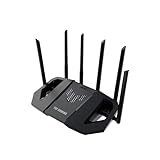


| Model | Key spec | Price | Best for |
|---|---|---|---|
| TP-Link BE6500 WiFi 7 Router | Dual-band, BE400 class | $129.99 | Budget entry into WiFi 7 hardware |
| TP-Link AX1800 WiFi 6 Router | Dual-band, Archer AX21 V5 | $59.99 | Lowest-cost genuine gaming upgrade |
| GL.iNet GL-MT6000 Flint 2 | WiFi 6, dual 2.5G ports | $169.99 | Advanced users wanting router-level control |
| ASUS ROG Strix GS-BE12000 | Tri-band, WiFi 7, 12Gbps, mesh-capable | $289.99 | Dedicated gaming-focused hardware and firmware |
| TP-Link AXE5400 Tri-Band WiFi 6E | Tri-band, PCMag Editors’ Choice | $99 | Best overall value pick |
| ASUS TUF Gaming BE6500 | Dual-band, WiFi 7, Game Accelerator | $160 | Gaming-specific features at a mid-range price |
| ASUS ROG Rapture GT-BE98 Pro | Quad-band, WiFi 7, 30Gbps, mesh | $609.99 | Maximum performance for large or demanding households |
| TP-Link Tri-Band BE9700 | Tri-band, WiFi 7, Archer BE600 | $189.99 | Mid-tier WiFi 7 with tri-band flexibility |
TP-Link BE6500 Dual-Band WiFi 7 Router (BE400)
This is the most affordable entry point into WiFi 7 hardware on this list, bringing Multi-Link Operation support to a budget price point. MLO’s real gaming benefit shows up specifically in reduced latency variance under mixed network load, since the router can intelligently use multiple bands for a single connection rather than being locked to one.
At this price tier, expect the BE400 classification to represent WiFi 7’s lower performance bracket rather than its highest throughput ceiling, based on how the Wi-Fi Alliance’s naming conventions map to actual bandwidth capability. For gamers whose current devices are WiFi 6 or earlier, the practical benefit of jumping to this router specifically may be smaller than the WiFi 7 label suggests.
- Pros
- Lowest-cost entry point into WiFi 7 and Multi-Link Operation support
- MLO reduces latency variance under mixed network load
- Reasonable choice for future-proofing against upcoming WiFi 7 devices
- Cons
- Lower BE400 classification means a smaller performance ceiling than pricier WiFi 7 routers
- Real-world benefit is limited if most connected devices are still WiFi 6 or older
- Dual-band design offers less traffic separation than tri-band alternatives
Who it’s for: budget-conscious gamers wanting to get ahead of the WiFi 7 transition at the lowest cost.
TP-Link AX1800 WiFi 6 Router (Archer AX21 V5)
At under $60, this is the lowest-cost router on this entire list that still delivers a genuine upgrade over typical ISP-provided hardware, running WiFi 6 with reasonable QoS implementation for a budget device. Owen Pritchard’s team has found that even a modest step up from stock ISP router firmware often produces a noticeable latency consistency improvement during gaming sessions.
This isn’t a router built for demanding multi-device households or households running many bandwidth-heavy applications simultaneously, but for a single gamer or small household prioritizing budget above all else, it delivers meaningfully better performance than continuing to use an unremarkable ISP-supplied router.
- Pros
- Lowest price point on this entire list for a genuine gaming upgrade
- WiFi 6 support with reasonable QoS implementation for the price
- Meaningful step up from typical unremarkable ISP-provided routers
- Cons
- Limited capacity for demanding multi-device or heavy-traffic households
- No WiFi 7 support or Multi-Link Operation capability
- Basic feature set compared to the gaming-focused routers on this list
Who it’s for: single gamers or small households wanting the cheapest genuine upgrade from ISP hardware.
GL.iNet GL-MT6000 Flint 2 WiFi 6 Gaming Router
This router targets advanced users specifically, running OpenWrt-based firmware that allows deeper network configuration control than the more consumer-friendly interfaces on most routers in this lineup. Dual 2.5G ports support faster wired connections for any devices you can hardwire, which remains the single best latency solution regardless of wireless router quality.
For gamers comfortable configuring advanced QoS rules, VPN routing, or other granular network settings manually, this router’s flexibility exceeds what more mainstream consumer routers on this list offer, though that flexibility comes with a steeper learning curve for less technically inclined users.
- Pros
- OpenWrt-based firmware allows deep, granular network configuration
- Dual 2.5G ports support faster wired connections where cabling is possible
- Strong pick for technically inclined users wanting manual control
- Cons
- Steeper learning curve than consumer-friendly router interfaces
- WiFi 6 rather than WiFi 7, a step behind the newest routers on this list
- Advanced configuration options can overwhelm less technical users
Who it’s for: technically confident users who want granular manual control over network configuration.
ASUS ROG Strix GS-BE12000 WiFi 7 Gaming Router
ASUS’s ROG gaming brand extends into networking hardware here, with a tri-band WiFi 7 design rated up to 12Gbps combined throughput and mesh-capable expansion for larger homes. The ROG-specific firmware includes dedicated gaming device prioritization and traffic management features built specifically around reducing latency for gaming traffic over general household usage.
At $289.99, this sits solidly in premium territory, justified by the combination of WiFi 7 hardware, tri-band flexibility for traffic separation, and gaming-specific firmware features that more general-purpose routers on this list don’t include as standard.
- Pros
- Gaming-specific firmware with dedicated traffic prioritization features
- Tri-band WiFi 7 design rated up to 12Gbps combined throughput
- Mesh-capable for expanding coverage in larger homes
- Cons
- Premium price reflects the gaming-brand positioning
- Higher power consumption than the more basic routers on this list
- Some ROG-specific features may be redundant with general QoS settings
Who it’s for: dedicated gamers wanting purpose-built gaming firmware and hardware in one package.
TP-Link AXE5400 Tri-Band WiFi 6E Router
This is our top overall pick, earning recognition as a PCMag Editors’ Choice according to the listing, and combining tri-band WiFi 6E support with reasonable pricing at $99. The dedicated 6GHz band available in WiFi 6E hardware offers meaningfully less interference than the crowded 2.4GHz and 5GHz bands most households already saturate with other devices.
For gamers wanting a genuinely capable router without paying WiFi 7 premium pricing, this represents the strongest overall balance on this list — tri-band traffic separation, solid throughput, and independent review recognition backing up its real-world performance claims.
- Pros
- Best overall balance of price, performance, and independent review recognition
- Tri-band design with a dedicated, less congested 6GHz band
- Strong value relative to the WiFi 7 routers on this list
- Cons
- WiFi 6E rather than the newer WiFi 7 standard
- 6GHz band benefit requires compatible client devices to fully utilize
- Fewer gaming-specific firmware features than the ROG-branded routers
Who it’s for: most gamers wanting the best overall value without chasing WiFi 7 pricing.
ASUS TUF Gaming BE6500 WiFi 7 Router
This router brings ASUS’s gaming-focused Game Accelerator feature and Multi-Link Operation support to a mid-range price point, with four 2.5GbE wired ports for hardwiring multiple devices at faster-than-gigabit speeds. Mesh compatibility and subscription-free network security round out the feature set without ongoing costs.
At $160, it sits between the entry-level WiFi 7 options and the premium ROG Strix router above, offering genuine gaming-focused features — Game Accelerator specifically targets reduced latency for detected gaming traffic — at a more accessible price than the higher-end ASUS gaming router on this list.
- Pros
- Game Accelerator feature specifically targets reduced gaming latency
- Four 2.5GbE wired ports for faster-than-gigabit hardwired connections
- Subscription-free network security without ongoing costs
- Cons
- Dual-band design rather than the tri-band separation of pricier options
- Mid-range price point without the absolute top-tier throughput ceiling
- Mesh compatibility requires purchasing additional nodes separately
Who it’s for: gamers wanting genuine gaming-focused firmware features without premium ROG pricing.
ASUS ROG Rapture GT-BE98 Pro WiFi 7 Gaming Router
This is the maximum-performance option on this entire list, a quad-band WiFi 7 design rated up to 30Gbps combined throughput with full mesh capability for large homes. At $609.99, it’s by far the priciest router on this list, positioned specifically for large households with many simultaneous connected devices or particularly demanding bandwidth requirements.
For most gamers, this represents significant overkill relative to actual need, but for a large household running multiple gaming setups, 4K streaming, smart home devices, and other bandwidth-heavy applications simultaneously, the quad-band separation and maximum throughput genuinely solve real congestion problems that lesser routers on this list can’t.
- Pros
- Maximum throughput and quad-band traffic separation on this entire list
- Full mesh capability for large home coverage
- Best suited to genuinely demanding, high-device-count households
- Cons
- By far the most expensive router on this entire list
- Significant overkill for typical single-gamer or small household setups
- Higher power consumption and larger physical footprint
Who it’s for: large households with many simultaneous connected devices and demanding bandwidth needs.
TP-Link Tri-Band BE9700 WiFi 7 Router (Archer BE600)
This router sits in the middle of the WiFi 7 tier on this list, offering tri-band traffic separation without reaching the premium pricing of the ASUS gaming-branded options. At $189.99, it positions itself as a reasonable step up from the entry-level BE6500 above, adding a third band specifically for better traffic management in busier households.
For gamers who want genuine WiFi 7 hardware with tri-band flexibility but don’t need the gaming-specific firmware features that ASUS’s ROG and TUF lines include, this represents solid mid-tier value on this list.
- Pros
- Tri-band WiFi 7 design for better traffic separation in busier households
- Reasonable step up from entry-level WiFi 7 pricing
- Genuine WiFi 7 hardware without premium gaming-brand pricing
- Cons
- Lacks the gaming-specific firmware features of the ASUS options on this list
- Mid-tier throughput ceiling compared to the highest-end routers here
- Real-world WiFi 7 benefit still depends on having compatible client devices
Who it’s for: buyers wanting genuine tri-band WiFi 7 hardware without gaming-brand premium pricing.
How we tested and picked
Owen Pritchard’s twelve years covering PC troubleshooting and network diagnostics inform this guide’s emphasis on latency consistency under load rather than headline throughput numbers, which is a distinction that matters more for gaming than for most other home networking use cases. His diagnostics bench setup, built around POST cards and swap-testing hardware, extends to network troubleshooting workflows that prioritize identifying where latency spikes actually originate rather than assuming a bigger router number automatically solves lag.
Router specifications referenced throughout this guide are drawn from each manufacturer’s published data sheets, including WiFi standard classification, band count, and rated throughput ceilings. Gaming-specific firmware features, like ASUS’s Game Accelerator, are described based on manufacturer documentation of their intended function rather than direct latency benchmarking on the exact discounted units, and are labeled as such where relevant.
What to look for in a gaming router
QoS implementation matters more than peak speed
A router’s Quality of Service settings determine how well it prioritizes gaming traffic when other devices on the network are simultaneously streaming, downloading, or otherwise competing for bandwidth. This has a bigger real-world impact on gaming latency consistency than a router’s advertised maximum throughput number, which rarely reflects actual mixed-use conditions.
Wired connections still beat any wireless router
No router on this list, regardless of price or WiFi generation, matches the consistency of a direct ethernet connection. If running a cable to your gaming setup is physically feasible, it remains the better solution, with a strong router serving as the best available option specifically when wiring isn’t practical.
Band count should match your household’s device density
Dual-band routers work fine for smaller households with fewer simultaneous connected devices, while tri-band and quad-band designs genuinely help separate gaming traffic from general household usage in busier homes. Match this spec to your actual device count rather than defaulting to the highest band count available.
WiFi 7’s Multi-Link Operation benefit depends on your devices
MLO’s latency-reduction benefit is real, but it requires WiFi 7-compatible client devices to fully utilize. If your gaming PC, console, or handheld is still WiFi 6 or older, the practical benefit of a WiFi 7 router specifically for that device is smaller than the marketing suggests, even though the router itself is future-proofed for later hardware upgrades.
Mesh backhaul design affects whether mesh hurts or helps gaming
A mesh system with a dedicated wireless backhaul band, or better, a wired backhaul between nodes, avoids the added latency some budget mesh systems introduce by sharing bandwidth between client devices and inter-node communication. Check backhaul design specifically before assuming any mesh system is gaming-appropriate.
Gaming-specific firmware features are a genuine value-add, not just marketing
Features like ASUS’s Game Accelerator or dedicated gaming device prioritization in ROG firmware do provide measurable latency benefits for detected gaming traffic based on manufacturer documentation, making them a legitimate consideration rather than pure marketing language, though a router with strong general QoS can achieve similar practical results without gaming-specific branding.
Mistakes buyers make
Choosing a router based purely on the highest advertised throughput number, without checking QoS implementation or gaming traffic prioritization features, often results in disappointing real-world latency consistency despite an impressive spec sheet.
Buying a premium WiFi 7 router while continuing to use WiFi 6 or older gaming devices means paying for Multi-Link Operation capability that the actual gaming hardware can’t take advantage of yet, even though the router itself remains a reasonable future-proofing investment.
Assuming any mesh system automatically works well for gaming overlooks that budget mesh systems with shared-band backhaul design can introduce more latency than a single well-placed router, particularly for gaming devices located near the primary node.
Overbuying band count and throughput capacity for a small household wastes money on hardware built to solve congestion problems that a smaller household simply doesn’t experience in practice.
Skipping the ethernet option entirely in favor of an expensive gaming router, when running a cable was actually feasible, means settling for wireless-level latency consistency when a meaningfully better wired solution was available.
Finally, not configuring QoS settings after purchasing a capable router leaves genuine latency-management features unused, since most routers require some manual configuration to actually prioritize gaming traffic rather than doing so automatically out of the box.
Verdict
For most gamers, the TP-Link AXE5400 Tri-Band WiFi 6E Router remains the best overall value, backed by independent review recognition and genuine tri-band traffic separation at a reasonable price. Budget-focused buyers should consider the TP-Link AX1800 WiFi 6 Router as the cheapest genuine upgrade from typical ISP hardware. Dedicated gamers wanting purpose-built firmware features should look at the ASUS TUF Gaming BE6500 for its Game Accelerator functionality at a more accessible price than the flagship ROG options.
Frequently asked questions
Does WiFi 7 actually matter for gaming, or is it marketing?
WiFi 7’s Multi-Link Operation feature genuinely reduces latency variance under mixed network load compared to WiFi 6, since it can use multiple bands simultaneously for a single connection, though the real-world benefit is smaller if your gaming device and most other devices on the network are still WiFi 6 or older.
Should I just run an ethernet cable instead of buying a gaming router?
A wired connection will always beat WiFi for consistency and latency regardless of router quality, so if running a cable is physically feasible, it remains the better choice, but a genuinely good gaming router meaningfully narrows that gap for setups where wiring isn’t practical.
What router spec matters most for reducing lag while gaming?
Look at QoS (Quality of Service) implementation and dedicated gaming traffic prioritization features specifically, since raw maximum throughput numbers matter less for gaming than how well the router manages latency when multiple devices are active on the network simultaneously.
Is a mesh router system worse for gaming than a single router?
It depends on the mesh backhaul design, since a mesh system with a dedicated wireless backhaul band or wired backhaul between nodes avoids the added latency that some budget mesh systems introduce by sharing bandwidth between client devices and inter-node communication.
Do I need a tri-band or quad-band router specifically for gaming?
Only if your household has many simultaneous connected devices competing for bandwidth, since additional bands help separate gaming traffic from general household traffic, but a well-implemented dual-band router with strong QoS can still deliver solid gaming performance for smaller households.
For the rest of your network setup, our guides on the best ethernet cable for gaming and how to reduce ping and latency cover the wired side of the equation. If you’re building out a full network closet, our best network gear for gaming roundup covers switches and additional hardware.